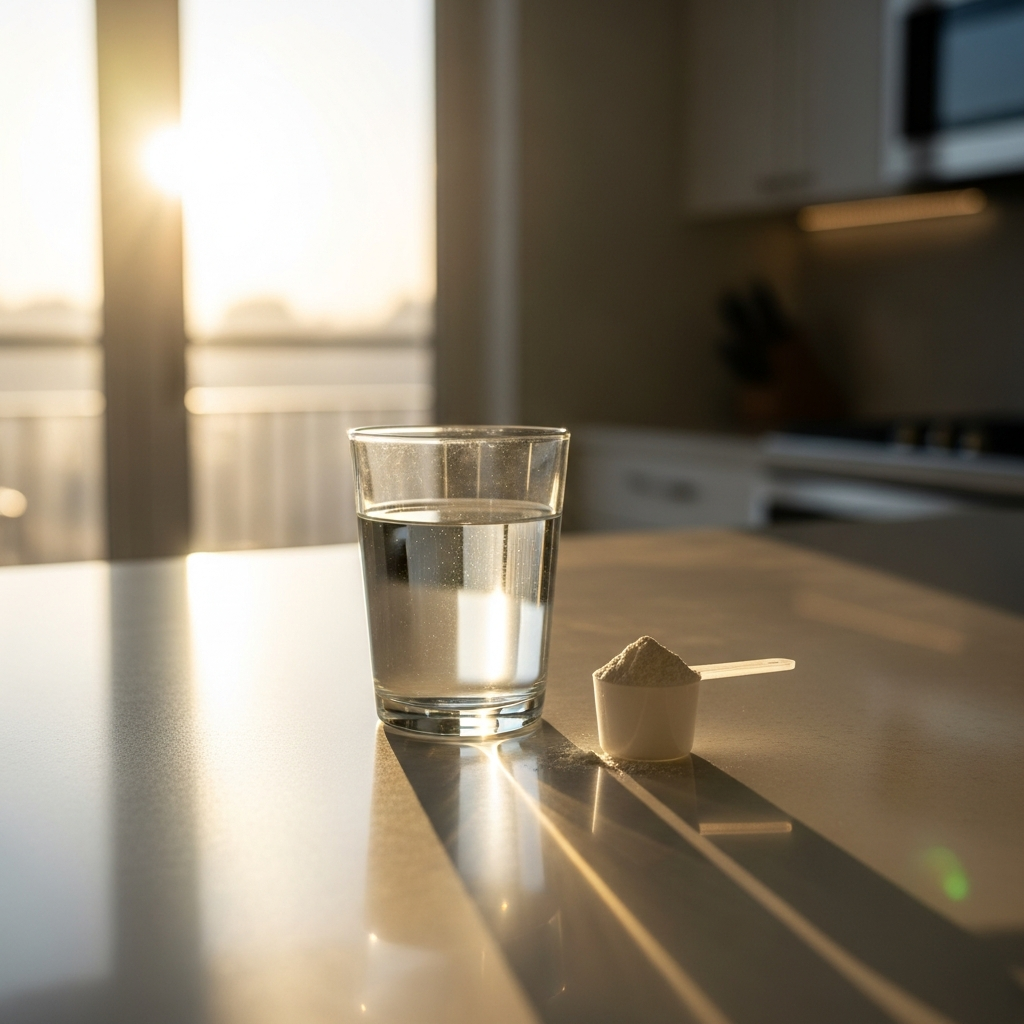
Taking Creatine on an Empty Stomach in the Morning: Does It Work?
Morning creatine on an empty stomach is one of the most common habits among supplement users. But is it effective, does it cause stomach issues, and is it actually the best time to dose?
Key Takeaways
- Creatine is absorbed without food — fasted morning dosing is effective.
- Some people experience mild nausea when taking creatine on a completely empty stomach.
- Dissolving creatine in warm water or juice reduces stomach sensitivity.
- Insulin slightly enhances creatine uptake — a small carbohydrate or protein with your dose can help.
- Consistency of timing matters more than the specific time of day.
- Morning dosing is ideal for building a daily habit that is easy to stick to.
Does Creatine Absorb on an Empty Stomach?
Yes — and this is a common misconception worth clearing up. Creatine monohydrate is a small, water-soluble molecule. It does not require food to be absorbed. It passes through the stomach and is taken up by the small intestine into the bloodstream, then transported into muscle cells via a transporter (CreaT1) that does not depend on digestion.
Studies on creatine pharmacokinetics show that plasma creatine peaks within 1–2 hours of ingestion regardless of fed state. Your muscles will receive their creatine whether you ate breakfast first or not.
Will It Upset Your Stomach?
This varies person to person. For most people, 3–5g of creatine dissolved in water on an empty stomach causes no issues. For a minority, an empty stomach combined with creatine can cause:
- Mild nausea — most common on an entirely empty stomach, especially in the first week of supplementation
- Bloating or cramping — usually related to undissolved creatine or insufficient water, not the empty stomach itself
If you experience GI discomfort, the fixes are simple:
- Dissolve creatine thoroughly in warm water — it dissolves much better than in cold water
- Chase it with a full glass (250–350ml) of water
- Have a small snack first — even a banana or a glass of juice is enough
- Try a micronized creatine formula, which has a finer particle size and dissolves more completely
See our full guide on how to fix creatine stomach upset for more strategies.
Does Food Improve Creatine Uptake?
Slightly — yes. Insulin enhances creatine transport into muscle cells by upregulating the CreaT1 transporter. Carbohydrates and protein both stimulate insulin release. A 1996 study in the American Journal of Physiology found that combining creatine with simple carbohydrates significantly increased muscle creatine retention compared to creatine alone.
In practice, this means taking creatine with a meal — especially one containing carbohydrates — slightly optimizes uptake. A few practical options for morning dosers:
- Mix creatine into orange juice (natural sugars provide a small insulin boost)
- Take creatine alongside a banana or a bowl of oatmeal
- Mix it into a protein shake with added fruit
That said, the difference is marginal. Daily supplementation saturates your muscle phosphocreatine stores within 3–4 weeks regardless of whether you pair creatine with food or not. If fasted dosing is easier to remember, do that.
Is Morning the Best Time to Take Creatine?
The honest answer: the best time is whenever you will actually do it every day. Creatine works through accumulation in muscle cells — it is not an acute pre-workout stimulant. A consistent daily dose keeps your stores topped up, and missing days matters more than timing.
That said, here are the common timing strategies and their practical merits:
- Morning (fasted): Easy habit anchor — morning routines are consistent. Fully effective.
- Pre-workout: Some evidence suggests slightly better uptake around training due to increased blood flow to muscles. The effect is small.
- Post-workout: A 2013 study in the Journal of the ISSN found post-workout creatine slightly outperformed pre-workout for body composition changes. The difference was modest.
- With a meal: Marginally improves uptake due to insulin; easier on the stomach.
The conclusion from the research: timing matters a little, but consistency matters a lot. Pick a time that fits your life and stick with it. Use our Creatine Dose Calculator to confirm your ideal daily amount.
The Morning Creatine Protocol
If you want to make morning dosing work optimally:
- Mix 3–5g in warm water (300–400ml) — warm water dissolves creatine better than cold
- Add a splash of juice if you want the insulin co-benefit (optional)
- Drink the full glass — do not sip it slowly
- Eat within 30 minutes if you are prone to nausea on an empty stomach
- Repeat every day — even on rest days. Creatine stores need daily maintenance, not just workout-day dosing
If you are just starting out, see our guide on creatine loading to understand whether you need a loading phase or can just start with 5g daily.
Morning Creatine: By the Numbers
- 1–2h Time to peak plasma creatine after fasted morning dose
- 3–4 weeks To fully saturate muscle stores with 5g/day
- ~10% Estimated uptake improvement when paired with carbohydrates
- 5g Standard daily maintenance dose — morning, noon, or night
Frequently Asked Questions
Can you take creatine first thing in the morning before eating?
Yes. Creatine absorbs effectively without food. Most people tolerate it on an empty stomach without issues. If you feel nauseous, try dissolving it in warm water or juice, or have a small snack first.
Is it better to take creatine in the morning or before a workout?
The research suggests post-workout may have a slight edge, but the difference is small. Morning dosing is popular because it is easy to remember and builds a consistent habit. Consistency over months trumps perfect timing.
Does taking creatine on an empty stomach cause diarrhea?
In some people, especially during a loading phase (20g/day), creatine can cause loose stools. At a standard 5g dose, GI side effects on an empty stomach are uncommon. Dissolving creatine fully in warm water and drinking plenty of fluid reduces this risk.
Should I take creatine with breakfast?
Taking creatine with a meal that contains carbohydrates and protein slightly improves absorption due to insulin stimulation. If you have breakfast, mixing creatine into your meal or drink is a simple optimization.
Does creatine break a fast?
Creatine monohydrate contains no calories and does not trigger an insulin response on its own. It will not break a fast from a metabolic standpoint, though technically any supplement can be considered breaking a strict fast depending on the definition you follow.
How long does it take for morning creatine to start working?
You will not feel an acute effect from a single dose — creatine is not a stimulant. It works by gradually saturating your muscle phosphocreatine stores over 3–4 weeks of daily 5g dosing. Performance benefits become noticeable after full saturation.