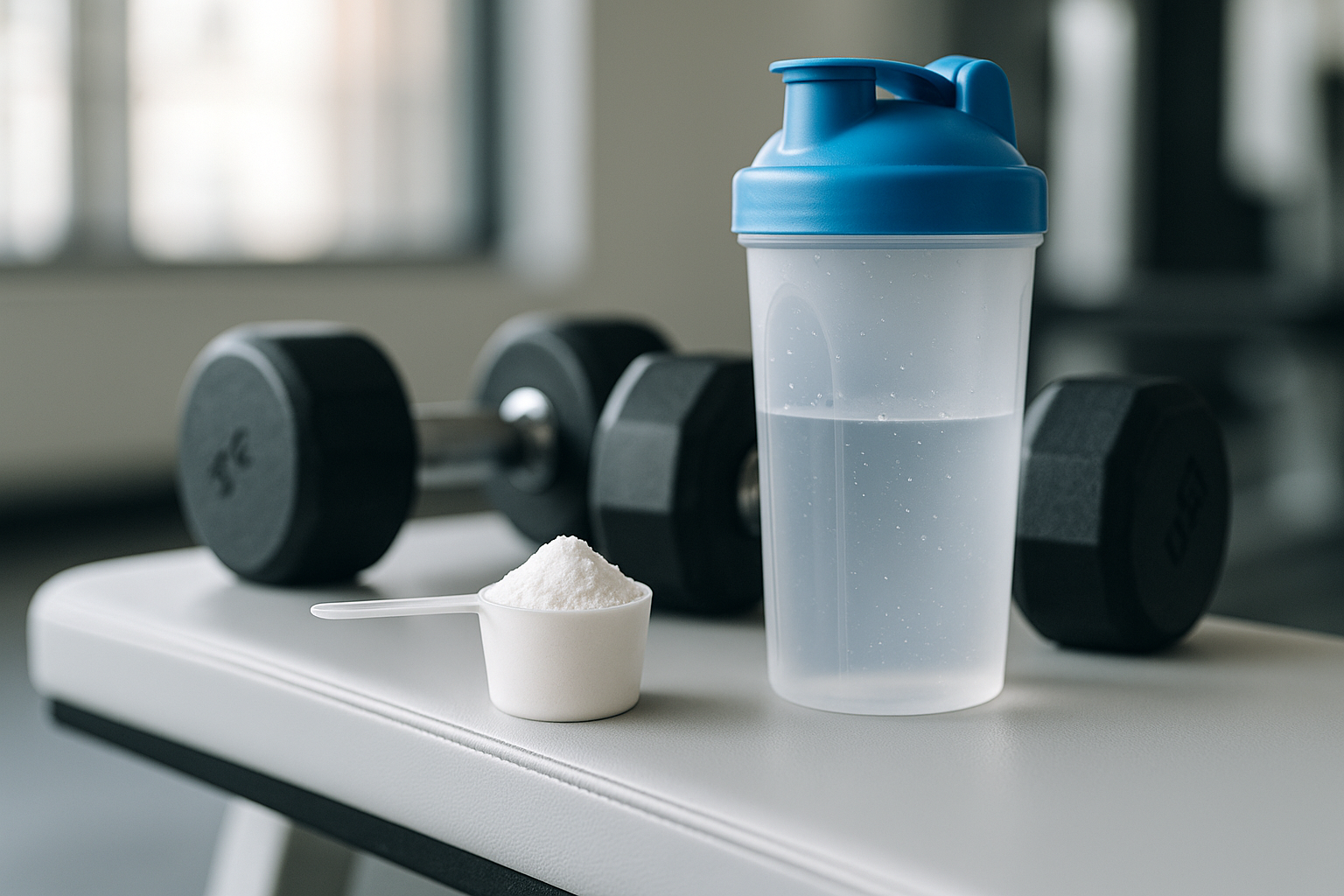
Pre-workout creatine may boost lifting performance most
A new pilot trial reports that acute creatine ingestion before resistance training improved strength performance more than taking creatine during or after the workout. That is a notable timing result, but it comes from a small randomized crossover study and should be viewed as an early signal, not a final rule for everyone who uses creatine.
Source: Nutrients
Key Takeaways
- The new study suggests taking creatine before resistance training may improve same-session strength performance more than taking it during or after.
- This was a randomized crossover pilot trial, which is useful for early testing but not strong enough to settle the timing question on its own.
- The finding is about timing, not about proving that one special creatine form or high dose is needed.
- For most lifters, total daily intake still matters more than fine-tuning the exact minute of use.
- Creatine monohydrate remains the best-studied option, typically taken as 3 to 5 g/day after stores are built.
- If pre-workout timing is convenient and well tolerated, this study gives reasonable support for trying it.
What the new study found
The headline result is straightforward: this Nutrients pilot trial found that taking creatine before resistance training enhanced strength performance more than taking it during or after training. If the paper holds up under broader testing, that would suggest pre-workout timing may matter more than many lifters assumed.
That is interesting because most creatine advice has focused on daily consistency rather than exact workout timing. In the broader evidence base, creatine works primarily by increasing intramuscular phosphocreatine stores over time, helping regenerate ATP during repeated high-intensity efforts. That is why the standard practical guidance has usually been to take it whenever you will reliably remember it, using a well-studied form such as monohydrate. Readers can review the basics in our creatine guides.
What makes this paper newsworthy is that it specifically tested whether timing around a workout changes acute resistance-training performance. According to the study title and framing, the answer was yes: pre-workout ingestion came out ahead. What we cannot say from the material provided is how large the advantage was, whether it applied across all exercises equally, or whether the benefit would persist over weeks or months of training.
So the correct takeaway is not that every lifter must immediately change their routine. It is that a controlled pilot study has produced a plausible, practical signal: if you are already using creatine, taking it before lifting may be worth trying.
Why the study design matters
This paper was a randomized crossover pilot trial. That design matters. In a crossover study, participants typically complete multiple conditions at different times, allowing each person to serve as their own comparison. For sports nutrition questions, that can be helpful because it reduces the noise created by individual differences in training status, body size, diet, and baseline performance.
The word pilot is equally important. Pilot trials are usually small and exploratory. They are designed to test feasibility, generate hypotheses, and identify whether a signal exists that deserves larger confirmation. They are not usually the last word.
Because the supplied source material does not include the full methods, sample size, dose details, participant characteristics, or outcome statistics, any interpretation has to stay tightly limited to what the paper appears to show: timing before training outperformed timing during or after training in this trial. We should not infer more than that.
- Strengths: randomized design, crossover structure, direct comparison of specific timing strategies.
- Likely limitations: small sample, short-term testing, and limited generalizability beyond the people actually studied.
- Unknowns from the provided material: exact dose, washout details, training background, sex distribution, and whether diet or prior creatine use were tightly controlled.
In short, the design is strong enough to make the result worth paying attention to, but not strong enough to overturn the bigger principle that habitual daily intake is still central.
What it means in practice for people taking creatine

For most people, the practical message is simple: if you already take creatine, moving your dose to before training is a reasonable experiment. This study supports that choice more than taking it during or after the session, at least for acute resistance-training performance.
That said, timing should be treated as a second-order variable. The foundation remains using enough creatine consistently to maintain muscle stores. In mainstream creatine practice, that usually means 3 to 5 g/day of creatine monohydrate once stores are saturated. Some people use a loading phase of roughly 20 g/day split into 4 doses for 5 to 7 days, then drop to maintenance. If you want help estimating an approach, our creatine dosage calculator can help.
Who may care most about this timing result?
- Lifters chasing every small performance edge in heavy or repeated sets.
- Competitive strength and physique athletes with structured training sessions.
- People who already tolerate pre-workout supplements well and want a simple timing tweak.
Who may care less?
- People who miss doses unless creatine is attached to a regular meal.
- Beginners who have not yet built a consistent supplementation habit.
- Anyone with gastrointestinal discomfort when taking supplements too close to training.
If pre-workout use fits your routine, this paper gives you a sensible reason to try it. If it does not, consistency still beats perfect timing.
How this fits the broader creatine evidence
The broader creatine literature has long been stronger on whether creatine works than on exactly when to take it. The best-supported conclusion remains that creatine monohydrate improves high-intensity exercise capacity and lean-mass gains over training in many contexts, especially when used consistently. The International Society of Sports Nutrition position stand is still one of the best overviews of that evidence: Kreider et al. (2017), ISSN Position Stand: Safety and Efficacy of Creatine.
Timing, by contrast, has been less settled. There have been mechanistic reasons to think pre-workout intake could help, especially if acute availability affects training quality, but much of creatine's benefit comes from cumulative saturation rather than an immediate stimulant-like effect. That is one reason many evidence reviews have not treated timing as a make-or-break variable. A useful context piece is Antonio et al. (2021), Common questions and misconceptions about creatine supplementation.
So this new pilot trial does not rewrite creatine science. It adds a targeted new data point to a narrower question: once someone is taking creatine, is there a best workout-adjacent time to use it? Based on this study, before training may be the best of the three tested options.
For readers comparing products, this is also a reminder not to confuse timing with formulation hype. The research foundation is still strongest for monohydrate, not for flashy proprietary blends marketed as more "advanced". See our best creatine rankings and creatine brand reviews for evidence-based product context.
Important caveats, including safety and overinterpretation
The biggest risk with a study like this is overreading it. A pilot crossover trial can reveal a promising effect, but it does not automatically prove that pre-workout timing will outperform all other strategies for everyone. We still need to know whether the result replicates in larger samples, across different ages and training levels, and over longer training blocks rather than a short acute window.
Another important distinction: this study appears to address performance timing, not safety. On safety, the mainstream evidence remains reassuring for healthy people using standard doses of creatine monohydrate. As summarized in major reviews, creatine at common supplemental intakes has not been shown to harm kidney function in healthy individuals without underlying renal disease. People with kidney disease, those under medical care for renal issues, or anyone with a complex medical history should speak with a qualified clinician before supplementing.
Two more caveats matter in the real world:
- Convenience matters. If pre-workout timing makes you skip doses, it is probably the wrong strategy for you.
- Tolerance matters. Some people prefer creatine with a meal or post-workout shake because it sits better.
If you are shopping for a simple, evidence-based option to test, browse our creatine product catalog for straightforward monohydrate choices. The key is not chasing novelty. It is using a reliable product, an appropriate dose, and a routine you can sustain.
Bottom line
This new Nutrients paper suggests that taking creatine before resistance training may improve strength performance more than taking it during or after the session. That is a useful and practical finding, especially for lifters who like to optimise details around training.
But the wording that matters most is pilot trial. This is an early, controlled signal, not the final answer. It is strong enough to justify trying pre-workout timing if that suits your routine, but not strong enough to say timing now matters more than total daily intake, product quality, or training consistency.
For most readers, the practical hierarchy still looks like this:
- Use creatine monohydrate.
- Take it consistently.
- Aim for an evidence-based daily intake, usually 3 to 5 g/day once saturated.
- If convenient, consider taking it before lifting based on this new pilot evidence.
That is the measured interpretation. The news is real, the finding is interesting, and it may matter at the margins. It just needs confirmation before it becomes a hard rule.
What this creatine timing study means
- Before Best timing in this pilot trial — Pre-workout creatine outperformed during and after training for strength performance.
- 3-5 g/day Typical maintenance dose — Mainstream evidence-based daily intake for creatine monohydrate after saturation.
- ~20 g/day Common loading approach — Usually split into 4 doses for 5-7 days.
- Pilot trial Evidence level of the new finding — Promising early evidence, but larger confirmation studies are still needed.
Frequently Asked Questions
Does this study mean I should always take creatine before workouts?
Not necessarily. The study suggests pre-workout creatine may be the best of the tested timing options for acute strength performance, but it was a pilot trial. If taking creatine before training is easy and comfortable for you, it is reasonable to try, but daily consistency still matters more than perfect timing.
Is post-workout creatine now a bad idea?
No, post-workout creatine is not a bad idea. This study only suggests that pre-workout timing performed better than during or after in this specific trial. It does not show that post-workout creatine stops working, especially since creatine's core benefits mainly depend on maintaining elevated muscle stores over time.
What dose should I use if I want to test pre-workout timing?
For most adults, the standard evidence-based approach is still creatine monohydrate at 3 to 5 g/day once stores are built. Some people use a loading phase of about 20 g/day split into 4 doses for 5 to 7 days, then switch to maintenance. There is no need to assume a special high dose just because timing changed.
Will pre-workout creatine feel like a stimulant?
Usually no. Creatine is not a stimulant like caffeine, and most of its benefits come from increasing muscle phosphocreatine stores rather than creating a sharp immediate sensation. Even if pre-workout timing proves helpful, many users will not feel a dramatic acute effect from a single dose.
Which form of creatine makes the most sense here?
Creatine monohydrate still makes the most sense. It is the best-studied form by a wide margin, and the broader evidence base supporting creatine's performance and training benefits is built largely on monohydrate. Timing findings do not change that basic hierarchy.
Is creatine safe for healthy people?
For healthy people using standard doses, creatine is generally considered safe in the scientific literature. Major reviews have not found evidence of kidney harm in healthy individuals without underlying renal disease. Anyone with kidney disease or a complex medical condition should still speak with a clinician before using it.