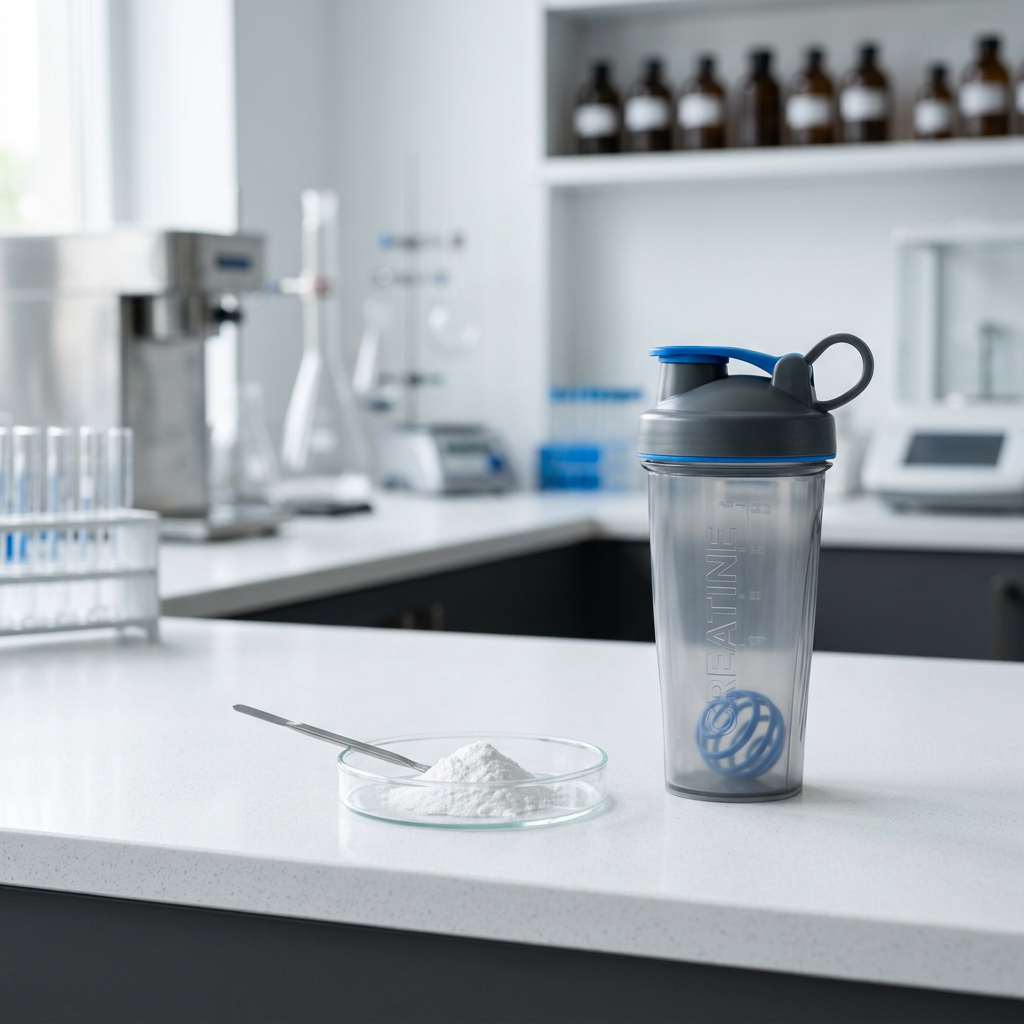
Pancreatic cancer tissue shows lower creatine levels
A new tissue-imaging study found that pancreatic ductal adenocarcinoma had lower creatine levels than normal pancreatic tissue, alongside broad shifts in lipids and other metabolites. That is a finding about tumour biology, not evidence that taking creatine causes pancreatic cancer or that creatine supplements should be avoided by healthy users.
Source: Clinical cancer research : an official journal of the American Association for Cancer Research
Key Takeaways
- Researchers mapped metabolites directly inside human pancreatic tissue using MALDI imaging at 200 μm resolution.
- Pancreatic ductal adenocarcinoma tissue showed lower creatine, malate, and LPC 16:0 than normal/nonneoplastic pancreas tissue.
- The study was observational and tissue-based, so it cannot show that creatine intake raises or lowers cancer risk.
- Several changes were already visible in IPMN, a precursor lesion, but the PDAC pattern was more distinct.
- For healthy users, this paper does not change standard creatine guidance: monohydrate remains the most-studied form.
What the study found about creatine in pancreatic cancer tissue
The headline result for creatine users is straightforward: in this study, pancreatic ductal adenocarcinoma (PDAC) tissue contained less creatine than normal/nonneoplastic pancreatic tissue. The researchers also reported lower malate and lysophosphatidylcholine (LPC 16:0), while several other metabolites and lipid species were higher in PDAC, including taurine, ascorbic acid, many phosphatidylcholines, sphingomyelins, acetylcarnitine, and butyrylcarnitine.
Just as important, the paper did not study people taking creatine supplements. It analysed the metabolic composition of human tissue samples to see how cancer tissue differs from precursor lesions and normal pancreas. That makes this a study of tumour metabolism, not a trial of creatine use.
The authors also compared PDAC with intraductal papillary mucinous neoplasm (IPMN), a precursor lesion. Relative to IPMN, PDAC showed higher acetylcarnitine, butyrylcarnitine, and one phosphatidylcholine species, while creatine was again among the compounds reduced in PDAC. IPMN itself also differed from normal tissue, with lower xanthine, arginine, and tryptophan.
For readers who use or are considering creatine, the practical interpretation is narrow but important: this paper does not suggest that supplemental creatine feeds pancreatic cancer. It shows that established pancreatic tumour tissue has a different internal metabolic fingerprint, and lower tissue creatine is one part of that pattern.
How researchers measured the tumour metabolic fingerprint

The study used matrix-assisted laser desorption/ionization mass spectrometry imaging, usually shortened to MALDI-MSI. In simple terms, this technique measures many small molecules directly in thin tissue sections while preserving their location, so researchers can see where metabolites and lipids are concentrated inside a sample rather than just averaging everything together.
Here, MALDI-MSI generated spatial metabolic images at 200 μm resolution. That allowed the team to compare human PDAC tissue, IPMN tissue, and normal/nonneoplastic pancreatic tissue and to map how their chemical profiles differed across the sample. The authors emphasised that these metabolic signatures were spatially heterogeneous, meaning the tumour landscape was not uniform.
That spatial aspect matters. A bulk tissue assay might miss the fact that one region of a tumour can behave differently from another region. Because pancreatic cancer is biologically complex, a technique that preserves that geography can help researchers connect metabolism with processes such as proliferation, immune evasion, and possible treatment resistance.
Still, this is not the kind of study that tells you whether a supplement helps or harms a person. It is best understood as a high-resolution map of cancer tissue chemistry. For consumer guidance on standard supplementation practices, evidence reviews remain more relevant than this paper, including broader summaries in our creatine guides and the established evidence base around creatine monohydrate safety and efficacy.
What this does and does not mean for people taking creatine
The most useful way to read this study is to separate tissue biochemistry from supplement advice. The paper shows that creatine levels were lower inside PDAC tissue than in comparison tissue. It does not show that taking creatine lowers or raises pancreatic cancer risk, changes tumour growth, or affects treatment outcomes.
Why not? Because the study was observational, cross-sectional, and tissue-based. There was no supplementation intervention, no randomization, no follow-up of creatine users, and no test of dose response. A difference found inside tumour tissue can reflect many things: altered transport, altered synthesis, altered breakdown, different cell composition, or the metabolic demands of the cancer itself.
That distinction matters because people often assume that if a nutrient is lower in diseased tissue, supplementing it must be protective, or if a compound is involved in metabolism, taking more must be risky. Neither conclusion follows from this paper.
- Healthy adults using creatine for training: this study does not provide a reason to stop.
- People worried about cancer risk: this study does not show creatine causes pancreatic cancer.
- People with cancer or in treatment: do not use this paper alone to start or stop supplementation; decisions should be made with the oncology team.
If your question is everyday use for performance or training, the standard evidence base is still the right reference point. Our creatine dosage calculator and best creatine rankings are built around that broader literature, not on single disease-biology papers like this one.
The study’s main limitations
This is a strong mechanistic imaging study, but it has clear limits for real-world supplementation questions.
- No supplementation data: the paper did not test creatine monohydrate, compare users with non-users, or report intake, timing, or dose.
- No causal inference: because samples were analysed at one point in time, we cannot say whether lower creatine contributed to tumour behaviour or simply reflected it.
- Tissue findings are not whole-body findings: metabolite levels inside a tumour do not automatically represent blood levels, dietary intake, muscle stores, or supplement effects.
- Abstract-only detail here: from the source material provided, we know the direction of change and the imaging resolution, but not every sample-count detail that would help judge precision and generalisability.
- Clinical implications are still indirect: the authors link these metabolic changes to proliferation, immune evasion, and treatment resistance, but this study mainly identifies associations and patterns.
In other words, the paper is hypothesis-generating and biologically informative. It may help cancer researchers identify pathways worth testing, but it should not be used as a shortcut to consumer claims about creatine safety or effectiveness. That is especially important online, where nuanced metabolism papers are often stretched into headlines they do not support.
For broader context on common myths and evidence-based answers, readers can compare this paper’s limited scope with the larger human literature summarised in Antonio et al. on common questions and misconceptions about creatine.
How this fits the broader evidence on creatine
For most readers, the key context is that creatine monohydrate remains the most-studied creatine form for exercise performance and lean mass support. The wider evidence base has focused mainly on muscle creatine stores, strength, high-intensity performance, training adaptations, and safety in generally healthy people, not on pancreatic tumour lipidomics.
That matters because a single oncology tissue study should not outweigh decades of sports-nutrition research when the consumer question is, “Should I take creatine for training?” Standard practice has not changed: a common maintenance intake is 3 to 5 g per day, and a typical loading approach is about 20 g per day split into 4 doses for 5 to 7 days, followed by maintenance. Those are mainstream evidence-based ranges, not findings from this paper.
If you are shopping rather than reading cancer metabolism papers, what matters more is product quality, dose, and form. Monohydrate is still the benchmark. Our creatine product catalog and creatine brand reviews can help readers compare options without chasing underpowered trends or disease-related scare headlines.
The broader lesson from this study is not “creatine is dangerous” or “creatine is protective.” It is that creatine metabolism inside cancer tissue is altered. That is an interesting scientific signal. It may eventually contribute to biomarker work or therapeutic research, but it does not override the existing supplement literature for healthy users.
Bottom line for supplement users
This study found that pancreatic cancer tissue had lower creatine levels than normal pancreatic tissue, as part of a broader, spatially heterogeneous metabolic and lipid pattern. That is a meaningful observation for cancer biology research.
For creatine users, the practical bottom line is simpler: nothing in this paper shows that taking creatine causes pancreatic cancer, worsens it, or should change standard use in healthy adults. It also does not prove that creatine supplementation would help people with pancreatic disease. Those are separate clinical questions that would require targeted human studies.
If you are a generally healthy person using creatine for gym performance, sprint work, or muscle gain, current best practice is unchanged: choose a reputable creatine monohydrate product, use an evidence-based dose, and ignore claims that stretch this paper beyond what it actually tested.
If you have pancreatic disease, active cancer, unexplained digestive symptoms, or are receiving chemotherapy, your situation is different. Supplement decisions belong with your physician or oncology team, because individual treatment context matters more than a single tissue-mapping paper.
The most accurate takeaway is also the least dramatic: this was an important tumour-metabolism study, not a consumer safety warning about creatine.
Creatine context from this study and mainstream use
- 200 μm MALDI imaging resolution — The study mapped metabolites in tissue at 200 micrometre spatial resolution.
- 3-5 g/day Typical maintenance dose — Mainstream creatine monohydrate guidance from the wider evidence base.
- ~20 g/day Typical loading protocol — Usually split into 4 doses daily for 5-7 days.
- 5-7 days Common loading duration — Standard sports-nutrition practice, not tested in this cancer paper.
Frequently Asked Questions
Did this study find that creatine causes pancreatic cancer?
No, this study did not find that creatine causes pancreatic cancer. It compared the chemical makeup of human pancreatic tissues and found lower creatine levels inside PDAC tissue, but it did not test creatine supplementation, track users over time, or establish cause and effect.
Should healthy people stop taking creatine because of this paper?
No, healthy people should not treat this paper as a reason to stop taking creatine. The study examined tumour tissue metabolism, not supplement safety in healthy adults, and it does not overturn the broader evidence supporting creatine monohydrate’s standard use.
Why would cancer tissue have lower creatine?
Cancer tissue may have lower creatine because tumours often rewire energy metabolism. This paper cannot tell us the exact reason, but possibilities include altered creatine transport, synthesis, turnover, or the different energy demands and cell composition of pancreatic tumour tissue.
Does lower creatine in tumour tissue mean creatine supplements are protective?
No, lower creatine in tumour tissue does not mean supplements are protective. A tissue difference can generate research questions, but it does not prove that raising creatine intake would reduce cancer risk or improve outcomes.
What dose of creatine is still considered standard for training?
The standard evidence-based approach is still creatine monohydrate at 3 to 5 g per day for maintenance. A common loading option is about 20 g per day split into 4 doses for 5 to 7 days, then maintenance.
If someone has pancreatic cancer, should they take creatine?
Anyone with pancreatic cancer should discuss creatine with their oncology team before using it. This study does not provide a treatment recommendation, and supplement decisions during cancer care depend on the individual’s diagnosis, medications, nutrition status, and treatment plan.