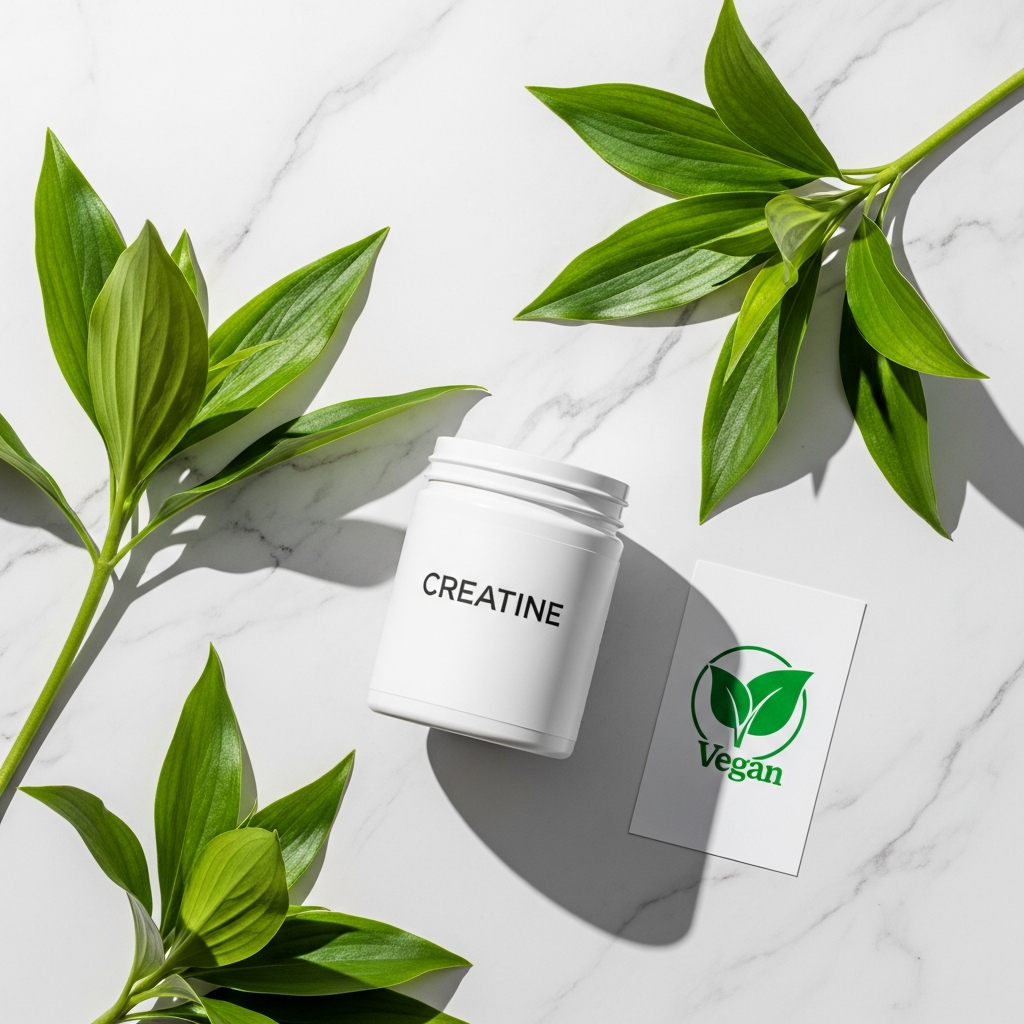
Vegan Creatine: Does It Exist, and Which Products Are Actually Vegan?
Creatine monohydrate is synthetically produced and contains no animal-derived ingredients — making it inherently vegan. But not all creatine products are vegan. Here is what to look for, what to avoid, and why vegans have the most to gain from supplementing.
Key Takeaways
- Creatine monohydrate powder is vegan — it is synthesized from sarcosine and cyanamide, with no animal inputs in the manufacturing process.
- Creatine capsules may NOT be vegan — many use gelatin capsules derived from animal collagen. Always check the capsule material.
- Vegans have lower baseline muscle creatine stores than omnivores, meaning supplementation produces a proportionally larger improvement in both athletic and cognitive performance.
- The cognitive benefits of creatine are strongest in vegetarians and vegans — multiple studies confirm this population sees the largest gains in working memory and processing speed.
- Creapure-certified creatine is explicitly vegan — AlzChem confirms no animal products are used in their manufacturing process.
- There is no such thing as 'plant-based creatine' derived from vegetables — all creatine supplements are synthetically produced, which makes them vegan by default.
Is Creatine Vegan? The Straightforward Answer
Creatine monohydrate powder is vegan. All creatine supplements are synthetically produced through a chemical process that combines sarcosine (a derivative of glycine, an amino acid) with cyanamide. No animals, animal byproducts, or animal-derived ingredients are involved in the manufacturing process.
The creatine that naturally occurs in animal muscle tissue is not harvested for supplements — that would be economically and technically impractical. Instead, every gram of creatine you buy in a supplement has been synthesized in a chemical facility. This synthesis process is entirely vegan.
So: creatine monohydrate in powder form is vegan by default. The question is not about the creatine itself — it is about the other components of the product (capsule shells, processing aids, flavours) that may introduce animal-derived ingredients.
The Capsule Problem: Where Vegan Breaks Down
The biggest pitfall for vegan creatine users is capsule products. The majority of supplement capsules are made from gelatin — a protein derived from the collagen of animal hides and bones. If your creatine comes in standard gelatin capsules, it is not vegan.
How to identify vegan capsules:
- Look for 'vegetarian capsules', 'vegan capsules', or 'HPMC capsules' on the label. HPMC (hydroxypropyl methylcellulose) is a plant-derived capsule material.
- If the label just says 'capsules' without specifying material, assume gelatin and check the brand's website or contact them directly.
- Some brands explicitly certify their products as vegan — this is the clearest indicator.
Creatine powder has no capsule issue at all — just creatine monohydrate and sometimes a flavouring agent. If you want 100% certainty, unflavoured creatine monohydrate powder from a reputable brand is the cleanest vegan option.
Why Vegans Need Creatine More Than Omnivores
This is the most important point that gets overlooked in vegan nutrition discussions: vegans are the population with the most to gain from creatine supplementation.
Dietary creatine comes almost exclusively from meat and fish. A typical omnivore diet provides 1–2g of creatine per day through food — partially satisfying muscle and brain creatine requirements. Vegans get essentially zero dietary creatine. Their bodies synthesize all their creatine internally, but this endogenous production cannot fully compensate — resulting in measurably lower resting muscle and brain creatine stores.
The consequences of this deficit, documented across multiple studies:
- Lower muscle phosphocreatine stores: Meaning less ATP available for explosive efforts and longer recovery between high-intensity bouts.
- Lower brain creatine levels: Contributing to the cognitive performance differences seen in some plant-based diet research.
- Larger supplementation response: Because vegans start lower, they have more room to improve — and they do. Studies consistently show vegans experience significantly larger performance and cognitive gains from creatine supplementation than omnivores.
Cognitive Benefits: Especially Strong for Vegans
The cognitive research on creatine is particularly compelling for vegans. The landmark 2003 Rae et al. randomized trial — the most cited creatine cognition study — was conducted specifically in vegetarians. It found that 6 weeks of creatine supplementation (5g/day) significantly improved working memory and fluid intelligence compared to placebo. The effect sizes in this study were considerably larger than what is typically seen in omnivore populations.
The mechanism is straightforward: vegans start with lower brain phosphocreatine levels. Supplementation raises these levels substantially, improving the energy availability for cognitively demanding tasks — working memory, processing speed, and executive function.
For vegan athletes juggling demanding training schedules with cognitive workloads, this dual physical-and-cognitive benefit makes creatine one of the most justified supplements in a plant-based stack. Read more in our guide on creatine for mental clarity and mood.
The Best Vegan Creatine Products in Canada
The good news: most quality creatine monohydrate powders are vegan by nature. Here is what to look for:
- Unflavoured creatine monohydrate powder: The simplest and most certainly vegan option. No capsules, minimal additives, just creatine. Mix into water, juice, or a smoothie.
- Creapure-certified products: AlzChem confirms Creapure production involves no animal products. Products labeled 'Creatine Monohydrate (Creapure®)' are vegan.
- Vegan-certified products: Some brands carry certified vegan logos — these have been verified by third parties for the absence of all animal-derived ingredients in the product, manufacturing process, and supply chain.
- Avoid unless confirmed: Creatine capsules (unless labeled vegetarian/HPMC), flavoured creatines with unclear flavour sourcing, and any product that lists 'gelatin' in the ingredient or 'other ingredients' section.
See our Best Creatine Monohydrate guide for top-rated options available in Canada, most of which are suitable for vegans in powder form.
Creatine and Vegans: Key Facts
- Vegan Creatine monohydrate powder — synthetically produced, no animal inputs
- Check Capsule material — gelatin capsules are not vegan; look for HPMC or vegetarian capsules
- Lower Baseline creatine stores in vegans vs omnivores — meaning the biggest performance gains
- 2003 Landmark Rae et al. study showing creatine dramatically improved cognition in vegetarians
Frequently Asked Questions
Is creatine powder vegan?
Yes. Creatine monohydrate powder is synthetically produced from sarcosine and cyanamide — no animals or animal byproducts are involved. All major creatine monohydrate powders, including Creapure-certified products, are vegan. The only creatine products that may not be vegan are capsule forms using gelatin shells.
Are creatine capsules vegan?
Many are not. Standard supplement capsules are made from gelatin (animal collagen). To find vegan creatine capsules, look for products labeled 'vegetarian capsules,' 'vegan capsules,' or 'HPMC capsules.' If the label just says 'capsules' without specifying material, contact the brand to confirm.
Is there plant-based creatine derived from vegetables?
No. Creatine is not found in meaningful amounts in any plant food. All creatine supplements are synthetically produced — which is actually good news for vegans, since it means the manufacturing process involves no animal inputs. There is no 'plant-sourced' creatine; the synthetic version is the vegan version.
Should vegans take creatine?
Yes — more so than omnivores. Vegans get zero dietary creatine (found only in meat and fish), resulting in lower muscle and brain creatine stores. Research consistently shows vegans experience larger performance and cognitive improvements from creatine supplementation than omnivores, since they have more room to improve from a lower baseline.
What is the best creatine for vegans?
Unflavoured creatine monohydrate powder from a reputable brand — ideally Creapure-certified, which AlzChem confirms is produced without animal products. Avoid capsule products unless they specifically state 'vegetarian' or 'vegan' capsules. Our Best Creatine Monohydrate guide lists top-rated vegan-suitable options available in Canada.
How much creatine should vegans take?
The same daily dose as anyone else: 3–5g of creatine monohydrate per day. Because vegans start with lower baseline stores, a loading phase (20g/day for 5–7 days) may be worth considering to saturate stores quickly — but standard maintenance dosing achieves full saturation within 3–4 weeks regardless.