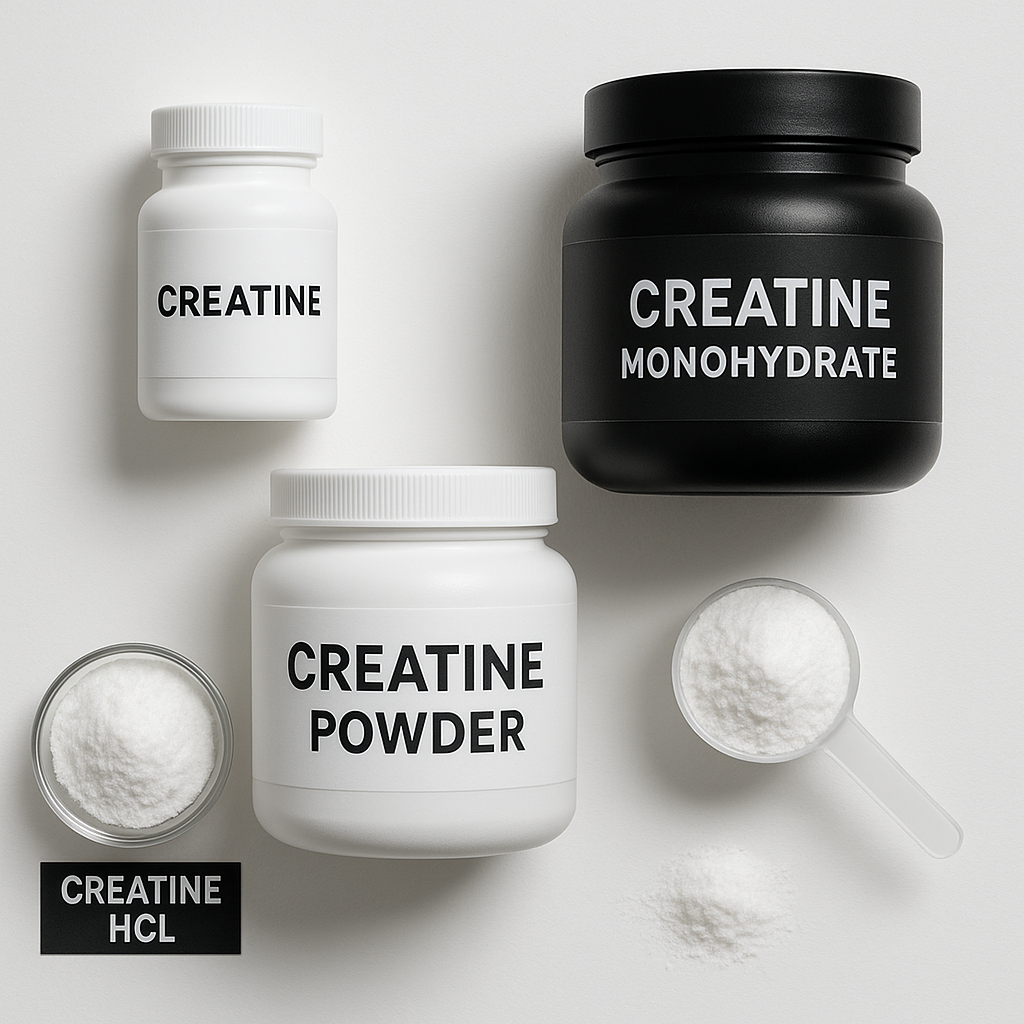
Types of Creatine: Every Form Explained, Ranked by Evidence
Walk into any supplement store and you will find monohydrate, HCL, buffered, ethyl ester, malate, nitrate, and more — each brand claiming theirs is better absorbed, easier on the stomach, or more effective. Here is a plain-English breakdown of every major creatine form, what the research actually shows, and which one most people should buy.
Key Takeaways
- Creatine monohydrate is the most researched form in sports nutrition — it has been studied for over 30 years and forms the basis of nearly every expert recommendation.
- No alternative creatine form has been shown to outperform monohydrate in a well-designed head-to-head trial on muscle gain, strength, or power output.
- Micronized creatine monohydrate is identical in effect to standard monohydrate — just ground finer for better mixing and marginally improved GI comfort.
- Creatine HCL, Kre-Alkalyn, ethyl ester, and other branded forms are typically 3–8x more expensive per gram of creatine with no proven advantage over monohydrate.
- Liquid creatine and creatine serum are likely ineffective — creatine degrades to creatinine in solution over time, especially in acidic or warm conditions.
Why Are There So Many Types of Creatine?
Creatine monohydrate has been studied since the early 1990s and is one of the most evidence-backed sports supplements ever tested. So why are there a dozen other forms on the market?
The short answer is: patents, marketing margins, and genuine (if usually overstated) attempts to solve real problems with the original molecule.
Creatine monohydrate's main practical limitations are: it dissolves slowly in cold water, a small percentage of users experience stomach discomfort at high doses, and the creatine molecule itself is not particularly exciting to put on a product label. Supplement companies have been creating and patenting modified forms of creatine since the late 1990s, often with compelling mechanisms and limited clinical validation.
Here is a guide to every major creatine form you will encounter — starting with the gold standard and working through the alternatives in order of evidence.
1. Creatine Monohydrate — The Gold Standard
Creatine monohydrate is creatine bonded to a single water molecule. It is the form used in approximately 95% of all creatine research, including every major meta-analysis and the International Society of Sports Nutrition's (ISSN) position stand.
What it does: Saturates muscle phosphocreatine stores, enabling faster ATP regeneration during high-intensity efforts. The result is more reps, more power output, faster recovery between sets, and — over weeks of training — more lean muscle mass.
Evidence level: Extremely strong. Hundreds of randomized controlled trials, multiple systematic reviews and meta-analyses. The ISSN has rated creatine monohydrate as the most effective ergogenic nutritional supplement currently available to athletes for increasing high-intensity exercise capacity and lean body mass.
Standard dose: 3–5 g per day. Optional loading phase of 20 g/day (split into 4 doses) for 5–7 days.
Typical price: $0.05–0.15 CAD per gram of creatine.
Who should use it: Almost everyone supplementing creatine. This is the default recommendation unless you have a specific, documented reason to use an alternative form.
Limitation: Dissolves slowly in cold water (fine when stirred, but can be gritty). Causes mild GI discomfort in roughly 5–7% of users at doses above 10 g in a single serving.
2. Micronized Creatine Monohydrate — Same Molecule, Better Mixing
Micronized creatine monohydrate is standard monohydrate ground to a much finer particle size — typically 20 times smaller than standard monohydrate. The active molecule is identical. The difference is purely physical.
What it does: Exactly the same as standard monohydrate — the biochemical effect is unchanged. The finer particle size means it dissolves faster and more completely in water, leaving less gritty residue and potentially reducing GI discomfort from undissolved powder.
Evidence level: The performance evidence for micronized monohydrate is the same as for standard monohydrate (they are the same molecule). There are no large head-to-head trials comparing GI tolerability, but the improved dissolution is well-documented physically.
Standard dose: 3–5 g/day, identical to standard monohydrate.
Typical price: $0.07–0.20 CAD per gram — slightly more than standard monohydrate, but close.
Who should use it: Anyone who finds standard monohydrate gritty or hard to mix, or who experiences mild GI discomfort that does not resolve with larger amounts of water. A sensible upgrade over standard monohydrate for most people, at minimal extra cost.
Note on Creapure: Creapure is the trade name for pharmaceutical-grade creatine monohydrate manufactured in Germany by AlzChem. It is the gold standard for purity (tested to 99.99% creatine monohydrate). Many premium micronized products use Creapure as their base.
3. Creatine HCL (Hydrochloride) — Better Solubility, Unproven Edge
Creatine hydrochloride is creatine bonded to a hydrochloride group, which dramatically increases its solubility in water. It dissolves completely in a small volume of liquid at concentrations that would leave standard monohydrate as a slurry.
What it does: Same mechanism as monohydrate — raises muscle phosphocreatine stores. The higher solubility theoretically means better absorption from the gut and less osmotic water draw in the stomach (a key cause of GI discomfort).
Evidence level: Weak to moderate. The theoretical solubility advantage is real and measurable in a test tube. In human trials, creatine HCL has been shown to increase muscle creatine stores — but no well-powered, independently funded head-to-head trial has demonstrated that HCL outperforms monohydrate at equivalent creatine doses for muscle gain, strength, or power. The lower dose used in HCL products (typically 1–2 g vs. 3–5 g for monohydrate) makes comparisons complicated.
Standard dose: 1–2 g/day (manufacturers claim equivalent effect to 5 g monohydrate due to better absorption — this claim is not independently validated).
Typical price: $0.40–0.80 CAD per gram — 3–8x more expensive than monohydrate per gram of creatine.
Who should use it: People who have genuinely exhausted monohydrate options (tried micronized, tried capsules, tried taking with food) and still experience GI issues. For most users, the extra cost is not justified by the evidence.
4. Buffered Creatine (Kre-Alkalyn) — The pH Marketing Claim
Buffered creatine — sold primarily under the brand name Kre-Alkalyn — is creatine processed with an alkaline compound (typically bicarbonate) to raise its pH. The marketing claim: creatine converts to the waste product creatinine in acidic environments, and a higher pH prevents this degradation, allowing more creatine to reach muscle tissue.
What the research actually shows: The pH argument has a theoretical basis — creatine does convert to creatinine faster in highly acidic conditions. However, stomach acid is only one part of the absorption picture, and the body's buffering systems regulate pH throughout the GI tract. The most important test of any creatine form is whether it actually raises muscle creatine stores — and the most rigorous comparison found that Kre-Alkalyn did not outperform standard creatine monohydrate in a double-blind trial.
A 2012 study in the Journal of the International Society of Sports Nutrition found no significant difference in muscle creatine retention, body composition, strength, or power between Kre-Alkalyn and monohydrate groups over 8 weeks of resistance training.
Standard dose: 1.5–3 g/day (per manufacturer recommendations).
Typical price: $0.50–1.00 CAD per gram — significantly more expensive than monohydrate.
Who should use it: No strong reason to choose it over standard monohydrate. The mechanism is interesting but the clinical evidence does not support the premium.
5. Creatine Ethyl Ester — Largely Discredited
Creatine ethyl ester (CEE) is creatine bonded to an ester group, which was theorized to improve cellular membrane permeability and therefore increase creatine uptake into muscle cells. It was popular in the mid-2000s.
What the research shows: The evidence for CEE is negative, not just weak. A 2009 study published in the International Journal of Sport Nutrition and Exercise Metabolism directly compared CEE to creatine monohydrate and placebo in a double-blind trial. The CEE group showed no advantage over monohydrate on muscle creatine stores, body composition, strength, or power. More concerning, CEE was found to convert to creatinine (the waste product) at a faster rate than monohydrate — meaning less actual creatine reaching muscle tissue.
Multiple subsequent reviews have concurred: CEE does not outperform monohydrate and may be less effective.
Standard dose: Varies; typically 2–3 g/day.
Typical price: $0.30–0.60 CAD per gram.
Who should use it: Nobody. Creatine ethyl ester is outperformed by monohydrate in head-to-head testing and has no advantages that justify its use or price. This is a case where the research has settled the question clearly.
6. Creatine Nitrate — Pump Blend, Not a Creatine Upgrade
Creatine nitrate is creatine bonded to nitrate ions. The rationale combines the performance effects of creatine with those of dietary nitrate — nitric oxide precursors that improve vasodilation (blood flow to working muscles) and are found naturally in beet root and dark leafy greens.
What it does: Theoretically delivers both creatine's phosphagen system benefits and nitrate's vascular effects in one compound. Some companies report higher water solubility than monohydrate.
Evidence level: Weak. The combination is interesting mechanistically, but there are few independent head-to-head trials comparing creatine nitrate to monohydrate for muscle gain or strength. What evidence exists does not show a meaningful advantage for the combination over monohydrate alone. The nitrate dose in most creatine nitrate products is also far below the doses used in nitrate performance research (where whole beet root juice or concentrated beet root extract is typically used).
Typical price: $0.30–0.60 CAD per gram.
Who should use it: Not recommended as a primary creatine supplement. If you want vasodilation benefits, beet root extract or L-citrulline supplementation has stronger direct evidence and is cheaper. Combine these with plain monohydrate instead.
7. Creatine Malate (Tri-Creatine Malate) — Limited Evidence
Creatine malate bonds creatine with malic acid — the organic acid that plays a role in the Krebs cycle (cellular energy production). The marketing angle is that malic acid enhances ATP production through aerobic metabolism, synergizing with creatine's phosphagen system benefits.
What it does: The malic acid component does have a role in aerobic energy production, but whether supplemental malic acid meaningfully increases Krebs cycle activity in exercising humans is not established. The creatine component works through the same mechanism as monohydrate.
Evidence level: Very limited. There are a small number of human trials showing that creatine malate improves anaerobic performance and reduces fatigue — but these trials are small, often not independently funded, and have not been replicated at scale. No meta-analysis has examined creatine malate specifically.
Typical price: $0.25–0.50 CAD per gram of creatine.
Who should use it: The evidence does not justify choosing creatine malate over monohydrate. Interesting mechanism, insufficient clinical validation.
8. Creatine Magnesium Chelate — Niche Application
Creatine magnesium chelate combines creatine with magnesium. The theoretical advantage: magnesium is a cofactor in the phosphocreatine energy system — specifically, ATP exists in the cell primarily as magnesium-ATP (Mg-ATP). Providing creatine alongside magnesium was theorized to improve phosphocreatine recycling efficiency.
What it does: The magnesium co-factor relationship is biochemically real. However, most people consuming adequate dietary magnesium (from nuts, seeds, legumes, dark greens) are not magnesium-limited in their phosphocreatine system. Supplemental magnesium would only help if you are deficient — and creatine magnesium chelate products typically provide doses far below the therapeutic magnesium doses used in magnesium deficiency research.
Evidence level: A 2004 study found creatine magnesium chelate to be as effective as monohydrate for bench press strength but did not show superiority. No subsequent large trials have confirmed an advantage.
Who should use it: If you are magnesium deficient (common in people with poor vegetable intake or high sweat losses), taking a separate magnesium supplement alongside plain monohydrate is more cost-effective than paying the premium for chelate forms.
9. Liquid Creatine and Creatine Serum — Avoid
Liquid creatine products — sold as ready-to-drink creatine or creatine serum — pre-dissolve creatine in water, sometimes acidified to improve stability. The convenience pitch is obvious: no mixing required.
The problem: Creatine in aqueous solution is not stable. It degrades to creatinine (the waste product of creatine metabolism) over time, especially in the presence of heat and acid. The rate of degradation depends on pH, temperature, and storage time. By the time a liquid creatine product reaches the consumer, a meaningful portion of the creatine may have already converted to creatinine — which has no ergogenic benefit.
A 2001 study directly measured creatine and creatinine levels in commercially available liquid creatine products and found that creatine concentrations were often dramatically lower than labelled — with up to 100% conversion to creatinine in some samples stored at room temperature.
No peer-reviewed study has demonstrated that a commercial liquid creatine product effectively raises muscle creatine stores to the same degree as monohydrate powder dissolved fresh in water.
Who should use it: Nobody. Liquid creatine is a convenience product with a fundamental chemistry problem. Dissolve monohydrate powder in water immediately before use instead.
How to Choose the Right Creatine Form
The decision tree for most people is simple:
- Start with creatine monohydrate. It is the most evidence-backed, most cost-effective form. Choose a product using Creapure (made in Germany) or one with published third-party testing for purity. A 500 g tub of quality monohydrate will cost $25–40 CAD and last 3–4 months at a standard 5 g/day dose.
- If mixing or stomach issues arise, switch to micronized monohydrate. It dissolves more completely, tastes the same, and costs only marginally more. Take it with food and plenty of water.
- If stomach issues persist with micronized monohydrate, try capsules. Creatine capsules (still monohydrate) sidestep the dissolution issue entirely.
- Only consider HCL if all monohydrate options have failed. HCL's solubility advantage may genuinely help a small subset of GI-sensitive users. Expect to pay 3–5x more per gram.
- Do not buy ethyl ester or liquid creatine. These have negative evidence (CEE) or a fundamental stability problem (liquid).
The supplement industry's creatine innovation has produced some genuinely interesting chemistry — but three decades of research keeps returning to the same conclusion: creatine monohydrate, taken consistently at 3–5 g per day, is the most effective and cost-efficient option for the vast majority of people.
Creatine Forms: Quick Comparison
- Monohydrate Gold standard — hundreds of trials, lowest cost, strongest evidence
- Micronized Same molecule, finer grind — better mixing, slight GI advantage
- HCL More soluble — limited head-to-head evidence, 3–8x more expensive
- Kre-Alkalyn pH marketing — 2012 RCT found no advantage over monohydrate
- Avoid Ethyl ester (converts to creatinine faster) and liquid creatine (degrades in solution)
Frequently Asked Questions
What is the best type of creatine?
Creatine monohydrate is the best-supported form by a wide margin. It has been studied in hundreds of randomized controlled trials and is the basis of every major expert recommendation in sports nutrition. No alternative form has outperformed it in well-designed head-to-head trials. For most people, standard or micronized creatine monohydrate (ideally using Creapure) is the right choice.
What is the difference between creatine monohydrate and creatine HCL?
Creatine HCL (hydrochloride) is more water-soluble than monohydrate and may cause less GI discomfort in sensitive individuals. However, no large, independent head-to-head trial has shown HCL produces greater muscle gain, strength, or power than monohydrate at equivalent creatine doses. HCL costs 3–8x more per gram. The solubility advantage is real; the performance advantage over monohydrate is not established.
Is creatine HCL better than monohydrate?
No — not by the available clinical evidence. HCL is more soluble and potentially easier on the stomach for sensitive users, but it has not been shown to produce superior muscle or performance outcomes compared to monohydrate in head-to-head trials. It also costs significantly more. For most people, micronized monohydrate with food and adequate water achieves the same GI improvement at a fraction of the cost.
What is Kre-Alkalyn and is it better than creatine monohydrate?
Kre-Alkalyn is a patented buffered creatine with a higher pH, marketed as degrading less in stomach acid. A 2012 double-blind RCT found no significant difference between Kre-Alkalyn and monohydrate in muscle creatine retention, body composition, strength, or power. The mechanism is interesting but the clinical evidence does not support paying the premium.
Is creatine ethyl ester effective?
No. A 2009 double-blind trial found creatine ethyl ester did not outperform standard monohydrate and actually converted to creatinine (the waste product) faster — meaning less creatine reached muscle tissue. Most sports nutrition researchers consider CEE an inferior form. Avoid it.
Can I take liquid creatine?
It is not recommended. Creatine in aqueous solution degrades to creatinine over time, especially with heat and acidity. Studies have found that commercial liquid creatine products can contain a fraction of their labelled creatine content by the time they reach consumers. Dissolve creatine monohydrate powder fresh in water immediately before use instead.
What does micronized creatine mean?
Micronized creatine is standard creatine monohydrate ground to a much finer particle size (typically 20x smaller). The performance effect is identical — it is the same molecule. The practical difference is better solubility in water, a smoother texture, and potentially fewer GI issues from undissolved particles. It costs slightly more than standard monohydrate.
How much creatine monohydrate should I take per day?
The evidence-based maintenance dose is 3–5 g per day, taken consistently. An optional loading phase of 20 g/day (split into four 5 g doses) for 5–7 days saturates muscle stores faster but is not required — the 3–5 g maintenance dose reaches the same saturation in approximately 3–4 weeks.