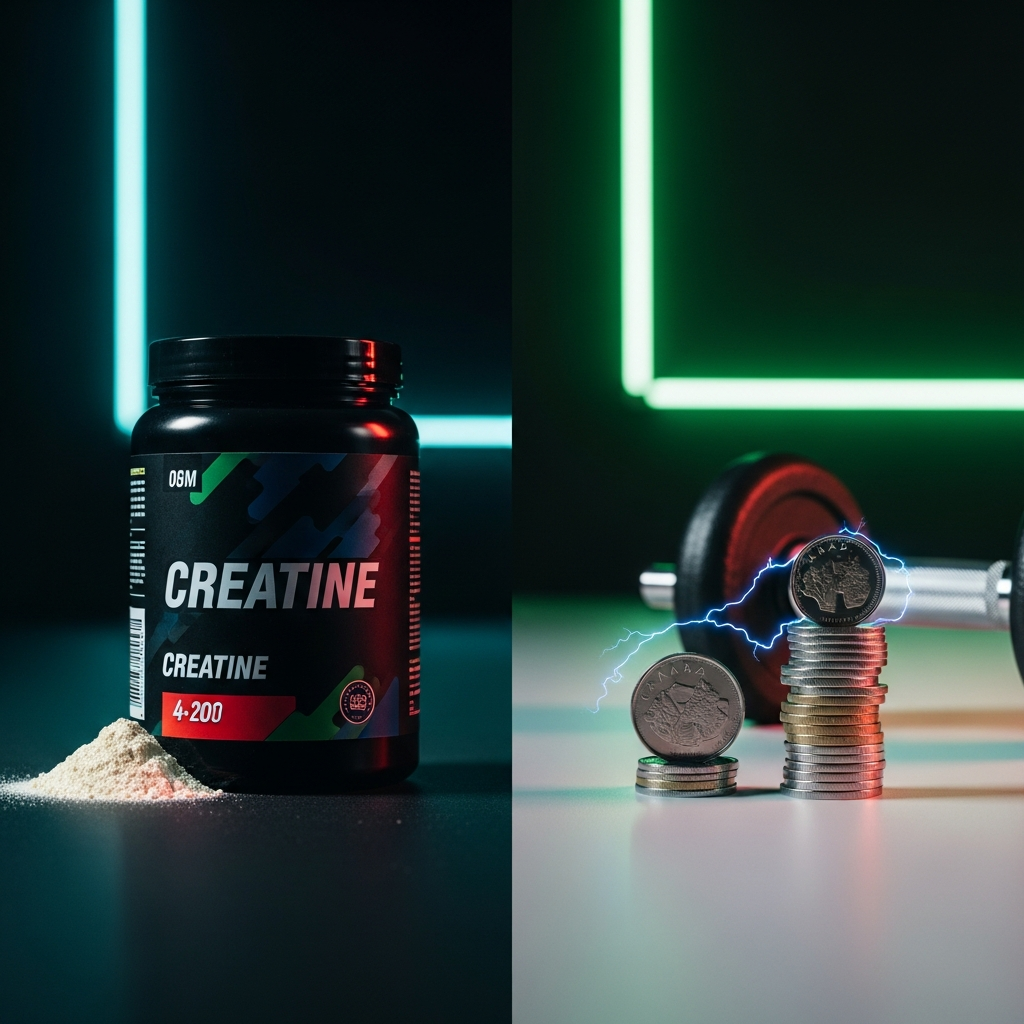
Is Creatine Worth It? An Honest Cost-Benefit Breakdown
Every supplement promises the world. Creatine is one of the very few that mostly delivers — and it happens to be one of the cheapest. Here's an honest look at whether it's worth your money, who benefits most, and who could reasonably skip it.
Key Takeaways
- Creatine costs roughly $3-8 per month at an effective dose, making it one of the best-value supplements available.
- It has strong, repeatable evidence for strength, power, training volume, and muscle gain.
- Benefits extend beyond the gym, with growing research on cognition and healthy aging.
- It's not a magic pill — it amplifies training and nutrition rather than replacing them.
- For most people who lift or train hard, the value proposition is clearly positive.
What creatine actually costs
Let's start with the money, because this is where creatine quietly wins. A typical tub of monohydrate delivers around 60-80 servings at 5 g each. At normal Canadian pricing, that works out to roughly:
| Purchase | Cost | Cost per day |
|---|---|---|
| Value tub (~300 g) | ~$20-25 | ~$0.30-0.40 |
| Larger tub (~500 g) | ~$30-40 | ~$0.25-0.35 |
| Monthly cost at 5 g/day | ~$3-8 | — |
For the price of a couple of coffees a month, you get a supplement backed by hundreds of studies. That's the context every 'is it worth it' conversation should start from.
What you get for that money
Creatine is one of the most researched supplements in existence, and the benefits are consistent rather than hyped:
- Strength and power: Reliable improvements in maximal strength and short, explosive output.
- Training volume: More reps and better between-set recovery, which compounds into more progress over time.
- Muscle gain: Greater lean mass when combined with resistance training.
- Recovery: Some evidence for reduced muscle damage and faster recovery.
These aren't dramatic overnight changes — they're steady, meaningful edges that add up over months of training.
Benefits beyond the gym
The value case has widened in recent years. Creatine plays a role in energy metabolism throughout the body, not just in muscle, and research is exploring benefits that matter even if you never touch a barbell:
- Cognition: Emerging evidence suggests creatine may support mental performance, particularly under sleep deprivation or high demand.
- Healthy aging: Combined with resistance training, it may help older adults preserve muscle and strength.
This research is still developing, but it strengthens an already-solid value proposition, especially for people outside a hardcore training context.
Who benefits most
Creatine isn't equally valuable for everyone. The people who tend to get the clearest return are:
- Anyone doing resistance or high-intensity training — the core use case.
- Vegetarians and vegans — lower dietary creatine usually means a stronger response.
- Athletes in power/sprint sports — the phosphocreatine system is exactly what they lean on.
- Older adults pairing it with strength work to protect muscle.
Who might reasonably skip it
Honesty cuts both ways. Creatine may be low priority if:
- You don't train and have no interest in strength, power, or (per emerging research) cognitive support.
- You're a pure endurance athlete whose events don't rely on short bursts — the performance case is weaker, and the small water-weight gain may not appeal.
- You have a relevant medical condition — in which case check with your doctor first, as you should before starting any supplement.
Even here, 'skip' often means 'not a top priority' rather than 'harmful' — creatine has an excellent long-term safety record in healthy people.
How it stacks up against other supplements
Put creatine next to the rest of the supplement aisle and its value stands out. Most products are expensive, thinly evidenced, or both. Creatine is cheap and heavily evidenced — a rare combination.
| Supplement | Evidence | Rough monthly cost |
|---|---|---|
| Creatine monohydrate | Strong | $3-8 |
| Whey protein | Strong (as food) | $30-60 |
| Most 'fat burners' | Weak | $40+ |
| Most 'test boosters' | Weak | $40+ |
If you were going to buy exactly one supplement for training, creatine would be the evidence-based pick.
The verdict
For the vast majority of people who train, creatine is worth it — arguably the best value in the supplement world. It's cheap, safe for healthy adults, and backed by more evidence than almost anything else you can buy. The key caveat is expectations: it's a multiplier on consistent training and good nutrition, not a shortcut around them. Set realistic expectations, use plain monohydrate at 3-5 g a day, and you're getting a lot of proven benefit for a few dollars a month.
The value case in four numbers
- $3-8 Monthly cost — At an effective dose
- 100s Studies behind it — One of the most researched
- 5 g Daily dose — A level teaspoon
- #1 Value among supplements — Evidence per dollar
Frequently Asked Questions
Is creatine worth the money?
For most people who train, yes. At roughly $3-8 per month for an effective dose, creatine offers strong, well-documented benefits for strength, power, training volume, and muscle gain, making it one of the best value-for-money supplements available.
How much does creatine cost per month?
At the standard 5 g per day, a typical tub costs about $0.25-0.40 per day, or roughly $3-8 per month depending on the size and brand you buy.
Who benefits most from creatine?
People doing resistance or high-intensity training benefit most, along with vegetarians and vegans (who tend to have lower baseline stores), power and sprint athletes, and older adults pairing it with strength training.
Is creatine worth it if I don't lift weights?
The strongest case is for training. However, emerging research on cognition and healthy aging is widening its appeal. If you neither train nor have those goals, it's lower priority — though still safe for healthy adults.
Is creatine better value than protein powder?
They do different jobs. Protein supports overall intake and recovery, while creatine specifically boosts strength and power. Per dollar, creatine is cheaper and has a very strong evidence base for its specific effects.
Are expensive creatine products worth it?
Usually not. Plain or micronized creatine monohydrate is the most researched and effective form and the cheapest. Premium 'advanced' forms rarely justify their price.
Is creatine safe to take long term?
In healthy adults, creatine has an excellent long-term safety record across decades of research. As with any supplement, people with medical conditions should check with a doctor first.