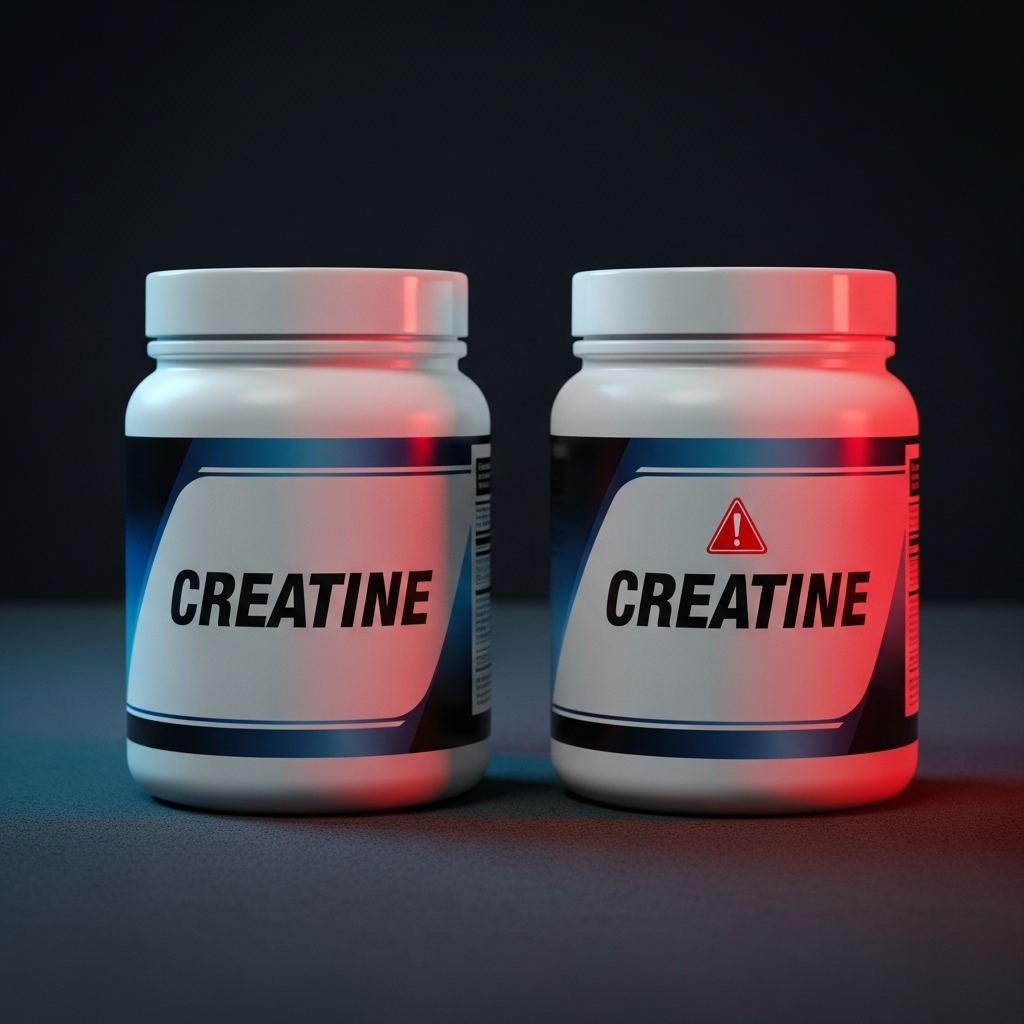
How to Spot Fake or Low-Quality Creatine Before You Buy
Creatine is cheap to make well and cheaper to fake badly. Counterfeit and diluted products do show up online and in grey-market stores. Here's how to tell real, quality creatine from the stuff that will waste your money.
Key Takeaways
- If a deal looks too cheap to be true, the powder may be underdosed or cut with fillers.
- Buy from reputable retailers and brands with verifiable batch and lot numbers.
- Look for purity markers (Creapure) and third-party testing seals (NSF, Informed Sport).
- Physical clues — clumping, off smell, refusing to settle in water — can hint at low quality.
- A vague, ingredient-light or misspelled label is a classic counterfeit red flag.
Is fake creatine really a thing?
Outright counterfeits — fake tubs mimicking a well-known brand — are relatively rare but do appear on unregulated marketplaces. Far more common is low-quality or diluted creatine: powder that's underdosed, cut with cheap fillers, or made to a poor purity standard with excess by-products. Both waste your money and can undermine your results. Knowing the warning signs protects you from both.
Warning sign 1: A price that's too good to be true
Quality creatine is affordable, but there's a floor. If one seller is dramatically cheaper than every reputable option for the same claimed amount, ask why. Common explanations are dilution (less creatine than stated), inferior raw material, or grey-market stock with no quality guarantee. Compare on cost per gram, not sticker price, and be suspicious of outliers at the bottom.
Warning sign 2: An unfamiliar seller or third-party marketplace listing
Where you buy matters as much as what you buy. Counterfeits thrive in marketplace listings sold and shipped by unknown third parties. Reduce your risk by buying:
- Directly from the brand, or from the brand's official store on a marketplace.
- From established Canadian supplement retailers with return policies.
- From listings with a long history of genuine, detailed reviews.
Be wary of brand-new listings, sellers with no track record, or prices that only appear through obscure resellers.
Warning sign 3: Label red flags
Counterfeit and low-quality products often reveal themselves on the packaging:
| Red flag | Why it matters |
|---|---|
| Spelling or grammar errors | Legit brands proofread their packaging |
| No lot/batch number or expiry date | Traceability is standard for real products |
| Creatine hidden in a proprietary blend | You can't verify the actual dose |
| Blurry, off-centre, or peeling labels | Signs of cheap or counterfeit production |
| No manufacturer contact details | Reputable companies list who to contact |
Warning sign 4: No purity markers or third-party testing
Quality creatine is often made with — or tested to — a verifiable standard. The absence of any purity marker (like Creapure) or independent testing seal (NSF Certified for Sport, Informed Sport) doesn't automatically mean a product is fake, but their presence is strong reassurance. For a product category where testing is common, an unwillingness to verify quality is a reason to look elsewhere.
Warning sign 5: Physical clues in the powder
Once you've opened a tub, your senses can catch problems the label hid:
- Colour: Pure creatine monohydrate is white. A grey, yellow, or off-white tint can indicate impurities or contamination.
- Smell: It should be virtually odourless. A strong chemical or sour smell is a bad sign.
- Texture: Excessive rock-hard clumping (beyond a little settling) can point to moisture exposure or poor manufacturing.
- Mixing: Monohydrate isn't fully water-soluble, so a little grit is normal. But powder that never settles or leaves a strange residue is worth questioning.
Warning sign 6: A strong unexpected taste
Unflavoured creatine monohydrate is close to tasteless, sometimes very slightly bitter. If an 'unflavoured' product tastes strongly sweet, chalky, or chemical, it may be cut with fillers or not be pure monohydrate at all.
How to buy with confidence
You don't need to be paranoid — just deliberate. Stick to reputable brands and retailers, prefer monohydrate with a purity marker and third-party testing, compare on cost per gram, and trust your senses when the tub arrives. If something feels off, return it. The whole point of creatine is that quality is cheap and easy to get — there's no reason to gamble on a suspicious deal.
Fake creatine, spotted
- White Colour of pure monohydrate — Off-colour = suspect
- 0 Odour it should have — Strong smell is a flag
- Lot # Should be on every tub — Traceability matters
- $/g Compare, don't chase deals — Too cheap = risk
Frequently Asked Questions
Is fake creatine common?
Outright counterfeits are relatively rare but appear on unregulated marketplaces. More common is low-quality or diluted creatine that's underdosed or cut with fillers. Both are avoidable by buying reputable, tested products.
What colour should real creatine be?
Pure creatine monohydrate is white and virtually odourless. A grey, yellow, or off-white tint, or a strong chemical smell, can indicate impurities or a low-quality product.
Does creatine dissolve completely in water?
No — monohydrate is only partially water-soluble, so a little grit at the bottom of your glass is completely normal. That said, powder that leaves an unusual residue or never settles at all is worth questioning.
How can I verify a creatine brand is legitimate?
Buy directly from the brand or an established retailer, check for a lot/batch number and expiry date, look for third-party testing seals (NSF, Informed Sport), and read detailed genuine reviews. Avoid unknown third-party marketplace sellers.
Is very cheap creatine always fake?
Not always, but suspiciously low prices are a warning sign. Compare cost per gram across reputable options; an extreme outlier at the bottom may be diluted, poorly made, or grey-market stock.
Should unflavoured creatine have a taste?
Unflavoured monohydrate is nearly tasteless, sometimes slightly bitter. A strong sweet, chalky, or chemical taste in an 'unflavoured' product suggests fillers or that it isn't pure monohydrate.
What does Creapure tell me about quality?
Creapure is a branded, high-purity creatine monohydrate tested for contaminants. Its presence on a label is a strong quality signal, though other reputable suppliers can also produce clean creatine.