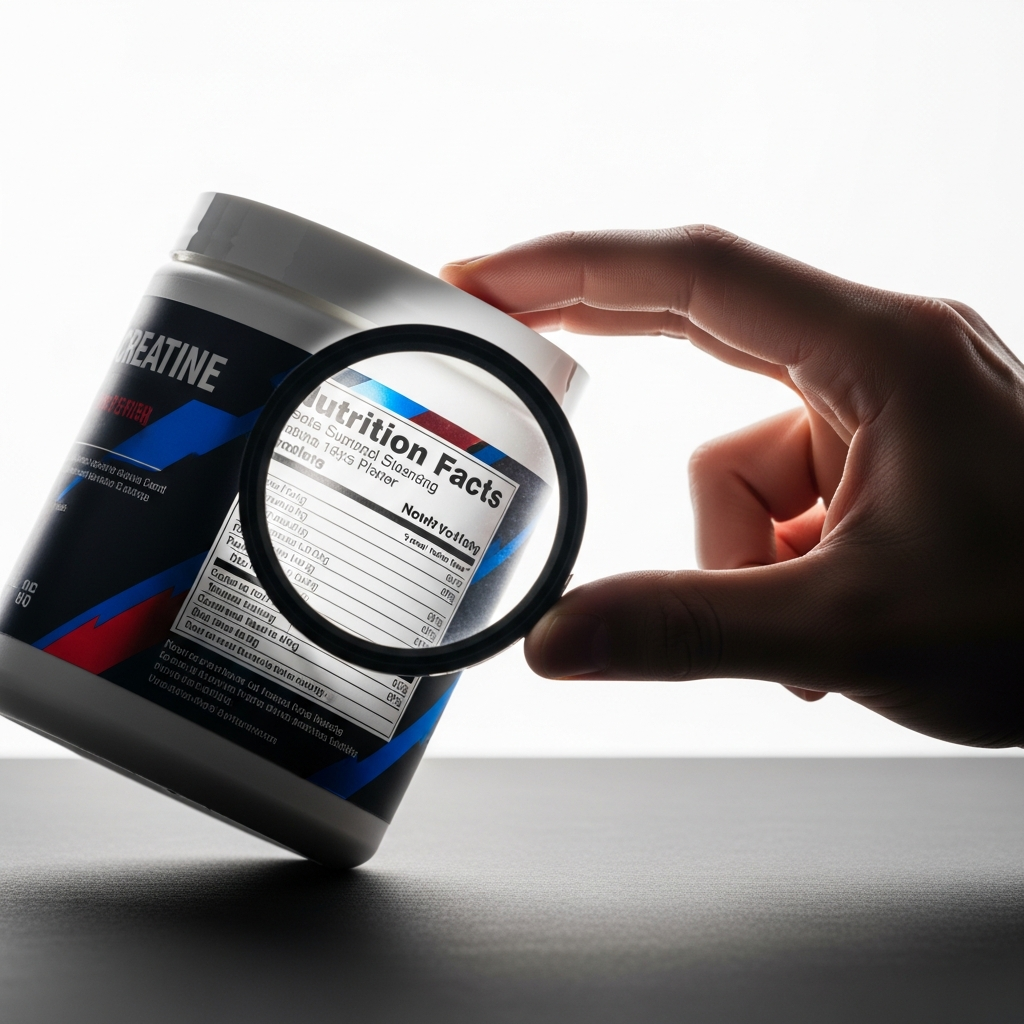
How to Read a Creatine Label: A Buyer's Field Guide
Two tubs can look identical on the shelf and cost wildly different amounts. The label tells you which one is actually worth buying — if you know where to look. Here's how to decode a creatine label line by line.
Key Takeaways
- Check the actual grams of creatine per serving, not just the scoop size — fillers can pad the scoop.
- 'Creatine monohydrate' should be the first (ideally only) active ingredient.
- Purity markers like Creapure and third-party seals (NSF Certified for Sport, Informed Sport) signal verified quality.
- Servings per container × grams per serving tells you the true cost per gram.
- Long proprietary blends and unnecessary additives are a red flag on a single-ingredient supplement.
Why the label matters more than the front of the tub
The front of a creatine tub is marketing: big claims, athletic imagery, and words like 'advanced' or 'ultra-pure'. The supplement facts panel on the back is the regulated part — it's where the real story lives. Learning to read it turns you from a shopper who buys on vibes into one who buys on value.
Step 1: Confirm the active ingredient
You want to see creatine monohydrate listed as the active ingredient — ideally the only one. If a product buries creatine inside a long 'proprietary blend' with a dozen other names, you can't tell how much creatine you're actually getting. For a single-purpose supplement, simpler is better.
Watch for creative naming. 'Creatine matrix' or 'tri-creatine complex' can mean you're paying for a mix of unproven forms rather than straightforward monohydrate.
Step 2: Find the real grams of creatine per serving
This is the number that matters. A scoop might be 6 grams total but only contain 3 grams of actual creatine once you subtract flavouring, sweeteners, and anti-caking agents. Look for the line that specifies creatine content, and compare it to the evidence-based target:
| What to look for | Good sign | Red flag |
|---|---|---|
| Creatine per serving | 3-5 g of creatine monohydrate | Under 3 g, or unlisted |
| Scoop vs creatine | Scoop ≈ creatine content | Large scoop, small creatine number |
| Ingredient order | Creatine listed first | Creatine near the bottom |
Step 3: Do the cost-per-gram math
Price per tub is meaningless without context. To compare products fairly, calculate cost per gram of creatine:
Cost per gram = price ÷ (servings per container × grams of creatine per serving)
A $25 tub with 60 servings of 5 g (300 g total) costs about $0.08/g. A $20 'deal' with 40 servings of 3 g (120 g total) costs about $0.17/g — more than double. The cheaper sticker price is the more expensive product.
Step 4: Look for purity markers
Creatine can be manufactured to different purity standards. Creapure is a widely recognized branded form of creatine monohydrate made in Germany and tested for contaminants and by-products. It's not the only way to get quality creatine, but seeing it on a label is a reassuring signal that the raw material meets a strict spec.
Step 5: Check for third-party testing seals
Because supplements aren't regulated as tightly as medicines, independent testing is your best assurance that what's on the label is what's in the tub. Look for these seals:
- NSF Certified for Sport — screens for banned substances and verifies contents; trusted by athletes.
- Informed Sport / Informed Choice — batch-level banned-substance testing.
- USP or other GMP certifications — signals quality manufacturing.
If you compete in a tested sport, these seals aren't optional — they're the difference between a safe buy and a risky one.
Step 6: Scan the 'other ingredients' line
A little anti-caking agent is normal. But a long list of sweeteners, dyes, and fillers on a product that's supposed to be one simple compound is worth questioning. Unflavoured monohydrate should have an extremely short ingredient list. Flavoured versions add more, which is fine if you want the taste — just know you're paying for flavouring, not more creatine.
Your 30-second label checklist
Before you buy, run through this quick mental checklist:
- Is creatine monohydrate the main (or only) active ingredient?
- Does one serving deliver 3-5 g of actual creatine?
- What's the cost per gram versus alternatives?
- Is there a purity marker (e.g. Creapure)?
- Is it third-party tested (NSF / Informed Sport)?
- Is the other-ingredients list short and sensible?
Six checks, half a minute, and you'll never overpay for underpowered creatine again.
The label numbers that matter
- 3-5 g Real creatine per serving — Not just scoop size
- 1st Where monohydrate should sit — In the ingredient list
- $/g The comparison that counts — Price ÷ total grams
- NSF Seal to look for — Third-party tested
Frequently Asked Questions
How much actual creatine should be in one serving?
Look for 3-5 grams of creatine monohydrate per serving. Be careful to read the creatine content specifically, since a large scoop may include flavouring and fillers that reduce the real creatine amount.
What does Creapure mean on a creatine label?
Creapure is a branded, high-purity form of creatine monohydrate manufactured in Germany and tested for impurities. It's a trusted signal of raw-material quality, though quality creatine can also come from other reputable suppliers.
How do I compare the price of two creatine products?
Calculate cost per gram: divide the price by (servings per container × grams of creatine per serving). This reveals which product is actually cheaper, since a low sticker price can hide a smaller total amount of creatine.
Should creatine be third-party tested?
Ideally yes. Seals like NSF Certified for Sport and Informed Sport verify that the product contains what it claims and is screened for banned substances — essential if you compete in a drug-tested sport and reassuring for everyone else.
Are fillers in creatine bad?
A small amount of anti-caking agent is normal and harmless. The concern is a long list of unnecessary additives or a proprietary blend that hides how much creatine you're really getting.
Is flavoured creatine worse than unflavoured?
Not worse, just different. Flavoured versions add sweeteners and flavouring, so you're paying partly for taste. Unflavoured monohydrate gives you the most creatine per dollar with the shortest ingredient list.
What's a red flag on a creatine label?
Creatine listed near the bottom of the ingredients, an undisclosed amount hidden in a proprietary blend, under 3 g per serving, exotic unproven forms marketed as superior, and no third-party testing.