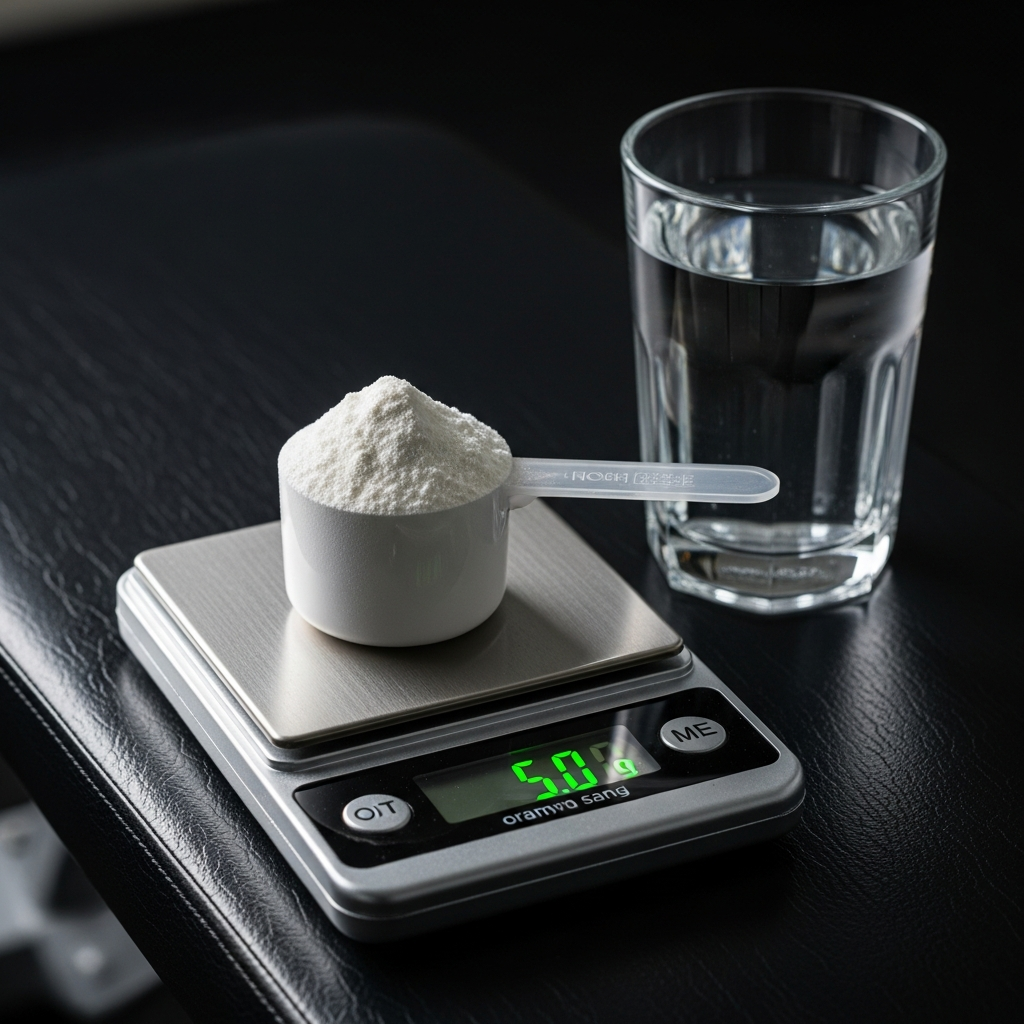
How Much Creatine Per Day? Exact Dosing by Bodyweight and Goal
The standard '5g per day' advice is a good starting point, but your optimal dose depends on your bodyweight, goals, and whether you want to load. Here is the full evidence-based dosing breakdown — no guesswork.
Key Takeaways
- The research-supported maintenance dose is 3–5g of creatine monohydrate per day for most adults.
- Larger individuals (over 90kg) may benefit from 5g; smaller individuals (under 60kg) can see full saturation at 3g.
- A loading phase (20g/day split into 4 doses for 5–7 days) saturates stores in one week instead of 3–4 weeks — but the end result is identical.
- Timing is less important than daily consistency — take creatine whenever it fits your routine and you will remember it.
- Creatine does not need to be cycled — stopping supplementation simply causes your stores to gradually deplete over 4–6 weeks.
- The most common mistake is taking creatine inconsistently — missing days repeatedly prevents you from ever fully saturating muscle stores.
The Standard Daily Dose: 3–5 Grams
The evidence-based maintenance dose for creatine monohydrate is 3–5 grams per day. This is the dose range used across the vast majority of research on creatine performance, body composition, and health outcomes — and it is the recommendation of the International Society of Sports Nutrition.
At this dose, daily creatine intake replaces the approximately 1–2g your body naturally breaks down per day, while building up the excess that saturates your muscle phosphocreatine stores over 3–4 weeks. Once saturated, a daily 3–5g maintains that saturation indefinitely.
Most supplement brands recommend 5g as a round, easy-to-measure dose — and for most adults, this is appropriate. Smaller individuals may reach full saturation at 3g; larger individuals may benefit from the full 5g.
Dose by Bodyweight: Getting More Precise
If you want to dial in your dose more precisely, the research supports approximately 0.03–0.05g of creatine per kilogram of bodyweight per day for maintenance. Here is what that looks like in practice:
- Under 60kg (132 lbs): 3g/day
- 60–80kg (132–176 lbs): 3–4g/day
- 80–100kg (176–220 lbs): 4–5g/day
- Over 100kg (220+ lbs): 5g/day
For most people, the practical difference between 3g and 5g per day is minimal — both will fully saturate your muscle creatine stores given enough time. Use our Creatine Dose Calculator to get a personalized recommendation based on your bodyweight and goals.
Athletes in heavy strength sports (powerlifting, rugby, American football) at high bodyweights sometimes use up to 10g/day — this is safe but not shown to provide additional benefit over 5g in most research.
Should You Do a Loading Phase?
A creatine loading phase involves taking 20g per day, split into 4 doses of 5g, for 5–7 days. This saturates your muscle stores in about one week instead of the 3–4 weeks it takes with maintenance dosing alone.
After loading, you drop back to the standard 3–5g/day maintenance dose. The end result — fully saturated muscle creatine stores — is the same whether you loaded or not. The only difference is how quickly you get there.
When loading makes sense:
- You are starting creatine 1–2 weeks before a competition or an important training block and want maximal benefit quickly.
- You previously stopped taking creatine and your stores have depleted.
When to skip loading:
- You are in no rush — 3–4 weeks is fine for long-term supplementation.
- You have a sensitive stomach — 20g/day can cause GI discomfort (bloating, cramps) in some people. Spreading doses helps, but avoiding loading altogether eliminates the risk.
See our detailed guide on the creatine loading protocol for a step-by-step breakdown.
When Should You Take Creatine?
Timing is less important than daily consistency, but the research does offer some guidance:
- Post-workout with protein and carbohydrates has a slight edge in several studies — insulin sensitivity is elevated after training, which may slightly improve creatine uptake into muscle cells.
- Pre-workout is also fine, though creatine is not acutely active (a single dose does not create an immediate effect the way caffeine does). Any benefit comes from chronic saturation, not the single dose you take today.
- Morning with breakfast works well for many people — creatine with a meal reduces any GI sensitivity and is easy to remember.
- Any consistent time is better than a 'perfect' time you forget. Pick whatever time works for your routine and stick to it.
For a deeper look at timing research, see our article on creatine timing before or after workout.
Do You Need to Cycle Creatine?
No. There is no scientific basis for cycling creatine on and off. This recommendation was common in early supplement culture when the mechanisms were less understood, but modern research does not support it.
Your body does not 'adapt' to creatine in a way that reduces its effectiveness over time. Your creatine transporter expression may slightly downregulate with chronic supplementation, but this is a minor effect that does not meaningfully blunt creatine's benefits in long-term users.
What happens when you stop taking creatine: your muscle stores gradually deplete over 4–6 weeks, returning to your pre-supplementation baseline. Any strength or power gains derived from creatine's energetic support will diminish accordingly. There is no benefit — and real cost — to voluntary cycling.
The simple approach: take 3–5g every day, indefinitely. No loading, no cycling, no complicated protocols required.
The Most Common Dosing Mistakes
After reviewing the research and common user questions, these are the dosing mistakes that actually matter:
- Inconsistency: Skipping days regularly means your stores never fully saturate. Creatine works through accumulation — consistency over weeks and months is the whole game.
- Under-dosing: Taking 1–2g because you are 'being cautious.' Below 3g per day, you are unlikely to reach full muscle saturation, especially if you are a larger individual. 3–5g is both safe and effective.
- Over-complicating timing: Spending energy on 'optimal' timing while being inconsistent about actually taking it. Get the daily dose right first; optimize timing second.
- Expecting immediate results: Creatine requires 3–4 weeks of daily use to fully saturate muscle stores. Some people take it for a week, notice nothing, and stop. Give it a full month before evaluating results.
- Mixing with hot liquids: Creatine can degrade in very hot water. Dissolve in room-temperature or cool water; mix into coffee or tea separately if preferred.
Creatine Daily Dosing: The Numbers
- 3–5g Evidence-backed daily maintenance dose for most adults
- 3–4 weeks Time to full muscle saturation at maintenance dosing — no loading required
- 20g/day Loading protocol dose (split into 4×5g) to saturate stores in 5–7 days
- 4–6 weeks Time for creatine stores to deplete after stopping supplementation
Frequently Asked Questions
Is 5g of creatine per day enough?
Yes, for most adults. 5g per day is the most commonly used and researched maintenance dose. It will fully saturate muscle creatine stores within 3–4 weeks. Larger individuals (over 100kg) may benefit from staying at the top of the 3–5g range; smaller individuals (under 60kg) may reach full saturation at 3g.
Can I take 10g of creatine per day?
10g per day is safe but not shown to provide additional performance benefits over 5g in most research. The kidney health concerns around high-dose creatine have been studied extensively — no adverse effects have been found at doses up to 10g/day in healthy individuals. However, the extra cost and potential for mild GI discomfort at higher doses make it unnecessary for most people.
What happens if I miss a day of creatine?
Nothing significant. Missing a single day does not meaningfully deplete your muscle creatine stores — depletion takes 4–6 weeks of complete abstinence. Just resume your normal dose the next day. Do not double-dose to 'make up' for a missed day.
Should I take creatine every day or just on workout days?
Every day. Creatine works through steady accumulation in muscle tissue — you need to maintain elevated stores continuously, not just on training days. Taking it only on workout days will leave you perpetually below full saturation.
Is creatine loading necessary?
No — loading is optional. A loading phase (20g/day for 5–7 days) saturates stores faster, but the same saturation is achieved with 3–5g/day over 3–4 weeks. Loading makes sense if you want rapid results before a competition; otherwise, maintenance dosing is simpler, cheaper, and easier on your stomach.
How do I calculate my exact creatine dose?
Use our free Creatine Dose Calculator — enter your bodyweight and it applies the research-supported 0.03–0.05g/kg formula to give you a personalized daily dose recommendation. For most adults, this comes out to 3–5g per day.