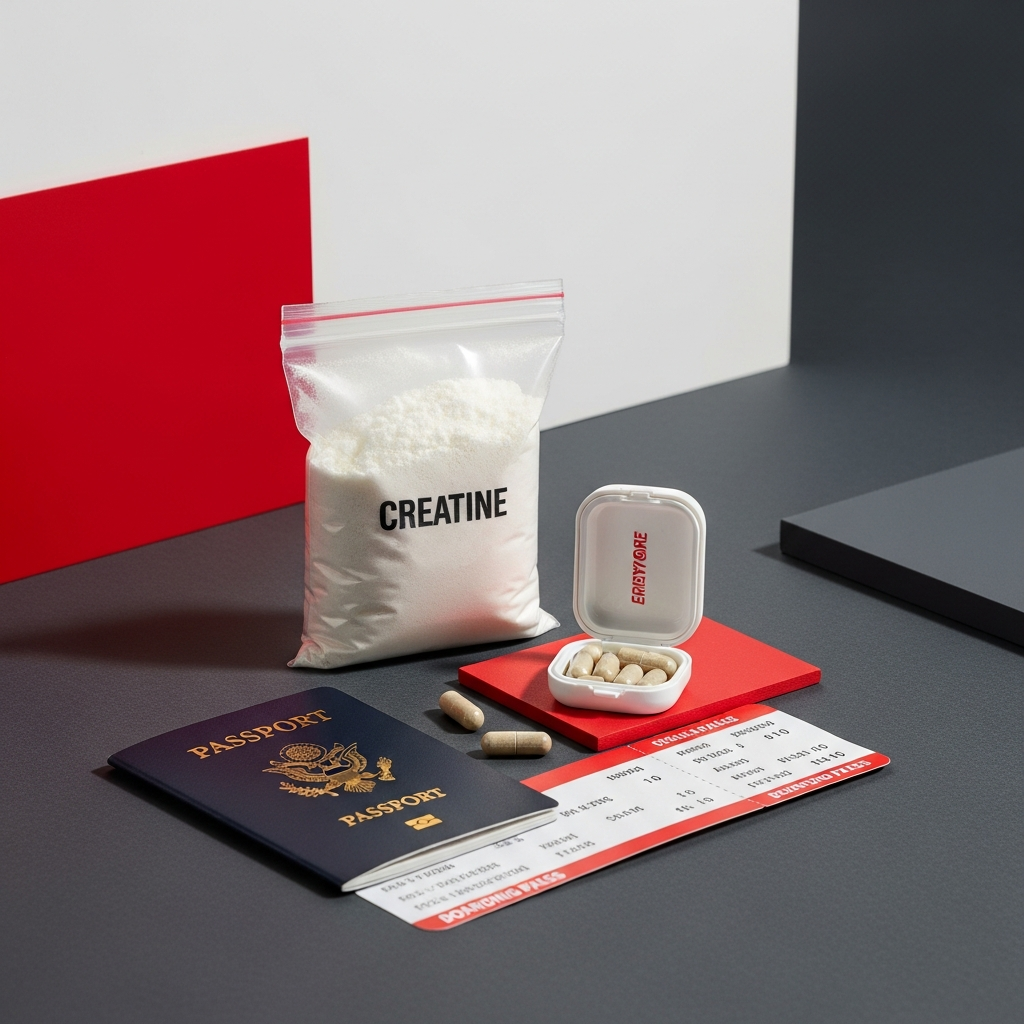
Flying With Creatine: How to Travel Without Breaking Your Routine
White powder in a zip-top bag has a reputation problem at airports — but creatine is completely legal to fly with in Canada and almost everywhere else. Here's how to pack it so security waves you through, plus practical ways to keep your routine intact on the road.
Key Takeaways
- Creatine is legal to carry on flights within and out of Canada — powders have no carry-on quantity limit in Canada, though the U.S. flags powders over 350 ml for extra screening.
- Keep creatine in its original labelled tub or clearly labelled single-serve packets to speed up any inspection.
- Capsules and gummies are the lowest-friction travel formats — no scoops, no powder questions, no mess.
- Missing a few days won't erase your progress; muscle creatine stores fall slowly over weeks, not days.
- For trips longer than two weeks, pack enough for 3-5 g per day or buy a small tub at your destination.
Yes, you can fly with creatine
Let's clear the big worry first: creatine is a legal dietary supplement in Canada, the United States, the UK, the EU, Australia, and virtually every common travel destination. It is not a controlled substance anywhere, and airport security is not looking for it.
In Canada, CATSA allows powders and granular materials in carry-on baggage with no quantity limit for non-flagged powders like supplements. Flying to or within the United States is slightly different: the TSA asks that powders over 350 ml (about 12 oz) be placed in a separate bin for X-ray screening, and unidentifiable powders may get a closer look. A standard month of creatine — about 90-150 g — is well under that threshold.
The only realistic 'problem' is a short secondary inspection if a large bag of loose white powder looks ambiguous on the scanner. That costs you five minutes, not your supplement.
How to pack it so nobody blinks
Security friction is almost always a labelling problem, not a legality problem. A few habits make inspections fast or nonexistent:
- Keep the original container when you can. A sealed, labelled tub with an NPN (Natural Product Number) on it answers every question before it's asked.
- Use labelled single-serve packets or a pill organizer. Several Canadian brands sell stick packs; otherwise, small zip bags marked with a permanent marker ('creatine monohydrate') are far better than anonymous baggies.
- Carry-on beats checked. Checked bags get lost; your routine doesn't have to.
- Don't pre-mix powder into drinks before security. Liquids over 100 ml get confiscated — dry powder doesn't.
Crossing land borders? Same story: personal-use quantities of legal supplements are fine entering the U.S. or returning to Canada. Just don't bury a bag of powder loose at the bottom of a duffel and make an officer guess.
The easiest formats for travel
If you travel often, the format you buy matters more than any packing trick:
| Format | Travel friction | Notes |
|---|---|---|
| Capsules | Lowest | No scoop, no questions, fits a pill case. You'll swallow 5-7 caps for a 5 g dose. |
| Gummies | Low | Zero prep, but check the dose per gummy — many require 4-6 for a full serving. |
| Stick packs | Low | Pre-measured, labelled, tear-and-pour. Ideal for trips under two weeks. |
| Loose powder | Medium | Cheapest per serving. Portion into labelled bags or a small screw-top container. |
Plenty of people keep a big tub of powder at home and a bottle of capsules that lives permanently in their travel bag — the best of both worlds.
What if you miss a few days anyway?
Relax. Once your muscles are saturated, creatine stores decline slowly — research shows it takes roughly 4-6 weeks of complete abstinence for muscle creatine to return to baseline. A one-week beach holiday without a single dose barely dents your stores, and a few days of normal dosing when you're back tops you up.
So the honest advice is two-sided: it's easy to keep your routine going while travelling, and it's also not a crisis if you don't. What matters is the months-long pattern, not any single week.
Long trips: pack it or buy it there?
For trips beyond two or three weeks, do the quick math: 5 g per day × trip length. A month abroad needs about 150 g — roughly half a small tub, which packs down to the size of a paperback in a zip bag.
Alternatively, creatine monohydrate is one of the most widely available supplements on earth. Any city with a pharmacy, supermarket supplement aisle, or sports nutrition store will sell it, usually at prices comparable to Canada. If luggage space is tight, buying a small tub at your destination and leaving it behind is a perfectly good strategy.
One caution for exotic destinations: stick to recognizable brands and sealed containers, for the same reasons we cover in our guide to spotting fake or low-quality creatine.
Creatine travel cheat sheet
- 350 ml U.S. TSA powder threshold for extra screening — A month of creatine (~150 g) is well under it
- 0 Countries on common travel routes where creatine is banned
- 4-6 weeks Time for muscle stores to fall to baseline after stopping
Frequently Asked Questions
Can I bring creatine in my carry-on in Canada?
Yes. CATSA permits supplement powders in carry-on baggage with no quantity limit. Keeping it in the original labelled container or clearly marked packets makes screening faster.
Will creatine powder get flagged at U.S. airports?
Powders over 350 ml (about 12 oz) must be screened separately on U.S. flights, and unlabelled powders can prompt a quick manual check. A typical travel quantity of creatine is well under the threshold — label it and you're fine.
Do I lose my gains if I stop creatine for a week on vacation?
No. Muscle creatine stores take roughly 4-6 weeks of complete abstinence to return to baseline. A missed week has a negligible effect, and normal daily dosing restores full saturation quickly.
Are capsules or powder better for travel?
Capsules are the lowest-friction option — no scoops, no powder questions at security, no mess. Powder is cheaper per serving but needs to be portioned and labelled. Many travellers keep both.