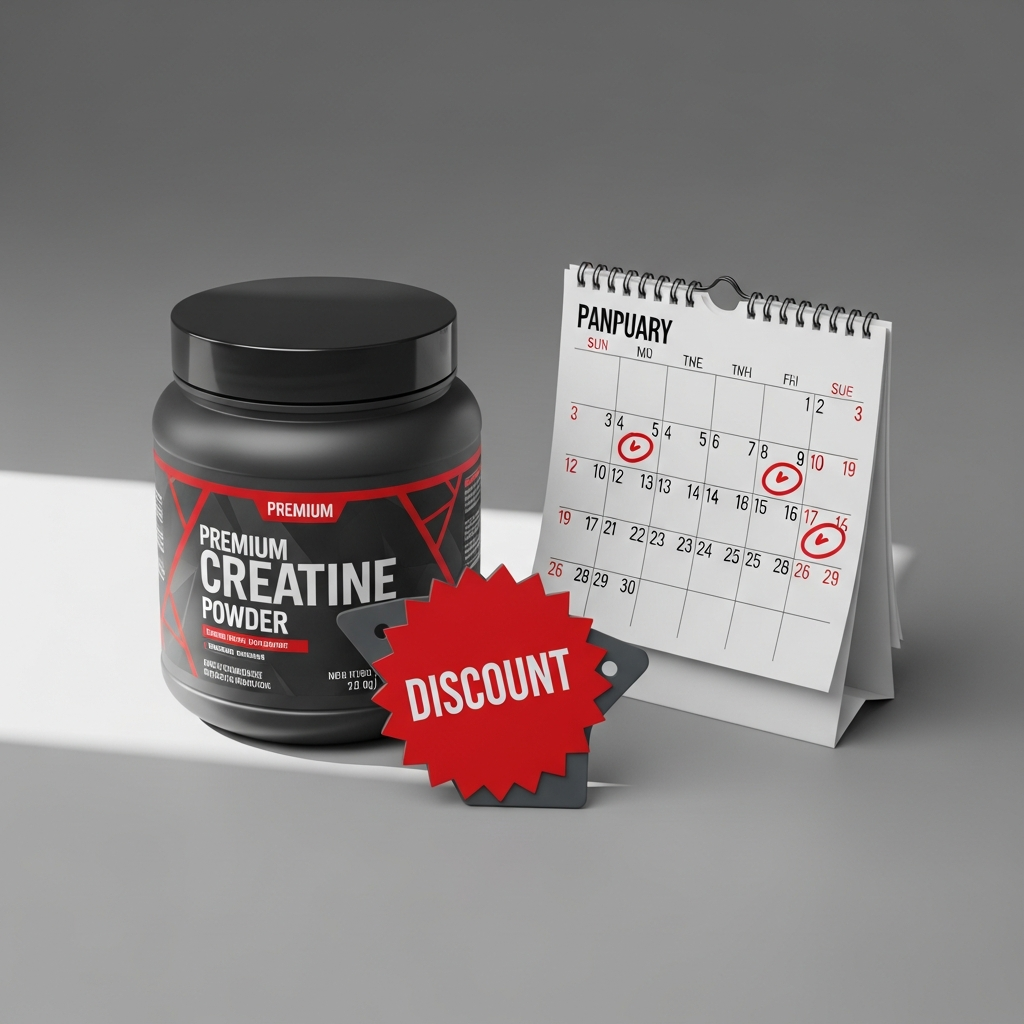
The Canadian Creatine Sale Calendar: When to Buy and When to Wait
Creatine is already cheap, but Canadians routinely overpay by buying at the wrong moment. Prices on the same tub can swing 20-40% across the year. Here's when the real sales happen, how deep the discounts actually go, and how to spot a fake deal.
Key Takeaways
- The four big discount windows in Canada are Amazon Prime Day (July), Black Friday/Cyber Monday (late November), Boxing Week (late December), and New Year fitness sales (January).
- Real creatine discounts typically run 15-30% off; anything advertised at '60% off' usually means the list price was inflated first.
- Judge every deal by cost per serving, not tub price — a bigger tub at 10% off often beats a small tub at 25% off.
- Creatine has a long shelf life, so buying 2-3 tubs during a genuine sale is a safe way to lock in the low price.
- Set a price-per-serving benchmark (roughly $0.30-0.50 for quality monohydrate) and buy whenever a trusted brand drops below it.
Why creatine prices swing so much
Creatine monohydrate is a commodity — the raw material is produced by a handful of large manufacturers and the ingredient itself is nearly identical between brands. That means retail prices are driven less by the product and more by retail events, inventory cycles, and marketing budgets.
In practice, the same 500 g tub that sells for $45 in a quiet week can drop to $30-34 during a major sale event, then drift back up in the weeks after. Supplement retailers also use creatine as a 'door crasher' — a familiar product discounted aggressively to pull you into a store or site where you'll buy higher-margin items too.
None of this changes what's in the tub. It just means patient buyers pay meaningfully less for the identical product.
The Canadian sale calendar
These are the windows when creatine discounts reliably show up in Canada:
| Window | When | What to expect |
|---|---|---|
| Amazon Prime Day | Mid-July | 15-30% off major brands on Amazon.ca; competitors often price-match the same week. |
| Back-to-school / fall promos | Late August - September | Smaller (10-20%) but frequent promos from Canadian supplement retailers. |
| Black Friday / Cyber Monday | Late November | The deepest and widest discounts of the year — 20-30%+ off, site-wide codes, bundle deals. |
| Boxing Week | Dec 26 - early Jan | Clearance-driven; great prices but popular sizes sell out fast. |
| New Year fitness sales | January | Resolution-season promos, often 15-25% off plus free-shipping thresholds. |
Between those windows, prices mostly sit at list. If you run out in April, don't wait three months — but if it's early November and you have two weeks of powder left, waiting is usually rewarded.
Real discounts vs. inflated 'deals'
Sale events also bring out pricing games. The most common one: quietly raising the 'regular' price in October so the November 'discount' looks dramatic. A few defences:
- Track cost per serving, not percentages. Quality monohydrate in Canada generally lands around $0.30-0.50 per 5 g serving at fair prices. A '50% off' tub that still costs $0.60 per serving isn't a deal.
- Use a price tracker for Amazon listings. Free tools that chart a listing's price history instantly expose inflated list prices.
- Beware of bundle padding. 'Buy creatine, get a shaker + samples' bundles often cost more than buying the tub alone elsewhere.
- Check the size. Some sale listings quietly swap in a smaller tub (250 g vs 500 g) at a similar price.
Our guide on reading a creatine label covers the serving math in more detail.
The stock-up math: how much to buy during a sale
Because creatine is a dry, stable powder with a typical shelf life of two to three years, buying ahead during a genuine sale is low-risk. At 5 g per day, one 500 g tub lasts about 100 days — so three tubs during a Black Friday sale covers you for roughly ten months, usually at the year's best price.
Two caveats: store unopened tubs somewhere cool and dry, and don't stock up on formats with shorter effective lifespans or dose-per-unit downsides (gummies in particular can degrade faster and are more expensive per gram). Plain monohydrate powder is the format that rewards buying in bulk.
The simplest strategy: set a benchmark and pounce
You don't need to monitor prices all year. Decide on a trigger price per serving — say $0.35 for a trusted, third-party-tested monohydrate — and buy whenever a brand you like drops below it, whatever the month. Sales calendars tell you when that's likely; the benchmark stops you from overthinking it.
And keep perspective: even at full price, creatine costs $3-8 a month. The calendar saves you real money over years of use, but the worst-case outcome of buying at the 'wrong' time is a few dollars — never a reason to skip a month of consistent dosing.
Creatine deal-hunting numbers
- 20-40% Typical annual price swing on the same tub in Canada
- $0.30-0.50 Fair cost per 5 g serving for quality monohydrate
- ~100 days How long a 500 g tub lasts at 5 g per day
Frequently Asked Questions
When is creatine cheapest in Canada?
Black Friday/Cyber Monday (late November) usually brings the deepest and widest discounts, followed by Amazon Prime Day in July, Boxing Week, and January fitness sales. Expect genuine discounts of 15-30% during these windows.
Is it safe to stock up on creatine during a sale?
Yes. Creatine monohydrate powder is very stable, with a typical shelf life of two to three years when stored cool and dry. Buying two or three tubs during a real sale is a low-risk way to lock in the best price.
How do I know a creatine deal is real?
Ignore the percentage and compute cost per serving: divide the sale price by the number of 5 g servings. Quality monohydrate at $0.30-0.50 per serving is a fair-to-good price. Price-history trackers for Amazon listings also expose inflated 'regular' prices.
Should I wait for a sale if I'm out of creatine?
No — consistency matters more than a few dollars. Creatine costs $3-8 per month even at full price. Use the calendar for planned stock-ups, not as a reason to interrupt daily dosing.