Creatine Powder vs. Capsules vs. Gummies: Which Form Actually Wins?
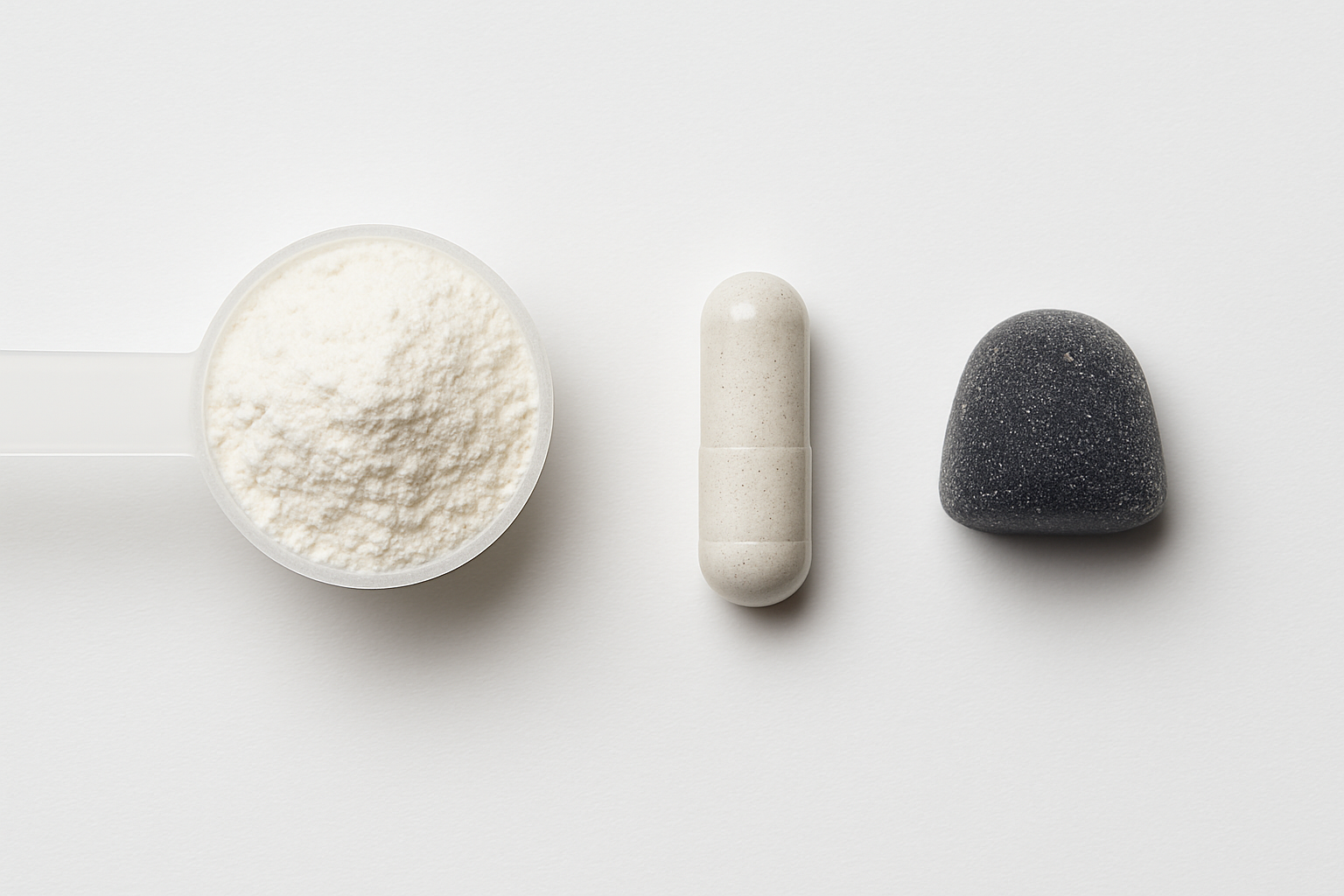
Walk into any supplement store and you will find creatine in three main physical forms: loose powder, capsules, and gummies. The marketing claims vary wildly. Here is a straight comparison across effectiveness, convenience, cost, and who should use each.
Key Takeaways
- All three forms deliver the same active molecule — creatine monohydrate — to your muscles. The delivery method does not change the biochemistry.
- Powder wins on cost and flexibility (you can dose precisely and mix it into anything). Capsules win on portability and stomach comfort. Gummies win on taste but lose badly on cost and dose control.
- Creatine gummies are typically 3–8x more expensive per gram of creatine than powder — a meaningful difference when you are taking 3–5 g every day indefinitely.
- If GI discomfort is your main concern with powder, try micronized powder with food before switching to capsules or gummies.
- The "best" form is the one you will take consistently every day — adherence trumps delivery method.
Creatine Powder — The Baseline
Creatine monohydrate powder is the original and most-studied delivery format. The research base for creatine is built almost entirely on powder-based dosing. It dissolves in water (better when micronized), is unflavoured in its pure form, and can be mixed into protein shakes, juice, or plain water.
Pros:
- Lowest cost per gram of creatine — by a wide margin
- Precise dosing with a scale or scoop
- Mixes into any liquid or food
- Huge brand and size selection
- The form all major research uses
Cons:
- Requires mixing — gritty if undissolved (less so with micronized)
- Can cause GI discomfort in some people when taken in large doses without food
- Not as portable as capsules for travel or gym bags
Typical cost (Canada): $0.05–0.15/g. A 500 g tub at 5 g/day lasts 100 days and costs approximately $25–40 CAD.
Creatine Capsules — Convenience Over Cost
Creatine capsules are simply creatine monohydrate powder inside a gelatin or vegetarian capsule shell. The active ingredient is identical — the only difference is the delivery vessel.
Pros:
- No mixing required — swallow with water
- Highly portable: bottle fits in any gym bag or travel kit
- No taste whatsoever
- Easier on the stomach for users who find powder GI-irritating (no large bolus of powder hitting the stomach at once)
- Accurate per-capsule dosing
Cons:
- More expensive per gram than powder — typically 2–3x the cost
- You may need to swallow 4–6 capsules to reach a 5 g dose (depending on capsule size)
- Capsule material may matter for vegans (gelatin capsules are animal-derived; look for HPMC/vegetarian capsules)
Typical cost (Canada): $0.15–0.30/g. Noticeably more than powder, but still reasonable for the convenience benefit.
Creatine Gummies — Tasty but Expensive
Creatine gummies are the newest format — designed to make creatine more appealing to people who dislike mixing powders or swallowing pills. They work on the same principle: deliver creatine monohydrate into the body. The experience is different.
Pros:
- Genuinely enjoyable to take — flavoured and chewy
- Zero preparation required
- Strong adherence for people who dislike other forms
- Good for convincing reluctant family members or beginners to try creatine
Cons:
- Very expensive — typically $0.40–0.80/g or more. At 5 g/day, you could be spending $70–120+ CAD per month vs. $8–12 for powder
- Dose control: gummies often come in 1–1.5 g doses, requiring 3–5 pieces per serving — easy to lose track
- Added sugars: most gummies contain sugar, citric acid, and flavourings — fine in small amounts but adds up
- Heat/travel stability: gummies can melt or stick together in warm conditions
- Limited research: creatine gummies are newer; while the ingredient is the same, bioavailability studies specifically on gummy form are limited
Typical cost (Canada): $0.40–0.80/g — 4–8x more expensive than powder for an identical dose.
The Verdict: Which Form Should You Use?
Here is the honest recommendation matrix:
- Use powder if you want maximum value, do not mind mixing, and are comfortable at home or in the gym.
- Use capsules if you travel frequently, dislike mixing, have GI sensitivity to powder, or want the simplest possible routine.
- Use gummies if the only way you will take creatine consistently is in gummy form — adherence wins. But be aware you are paying a significant premium. Consider mixing gummies into a cheaper powder routine (e.g. gummies for travel, powder at home).
The research is unanimous that muscle creatine saturation is driven by total daily creatine intake over time, not delivery format. If gummies cost $100/month and powder costs $12/month for the same dose, that is $1,056 per year in premium for taste and convenience. Many people find that capsules split the difference — nearly as convenient as gummies, at 2–3x (not 6–8x) the powder cost.
Frequently Asked Questions
Are creatine gummies as effective as powder?
The active ingredient is the same, so the biochemical effect should be equivalent. However, gummy bioavailability has not been studied as extensively as powder. The main practical disadvantage is cost — gummies are typically 4–8x more expensive per gram of creatine.
How many creatine capsules equal a 5 g dose?
It depends on capsule size. Standard creatine capsules contain 750 mg to 1 g of creatine. To reach a 5 g dose, you typically need 5–7 capsules. Some brands use larger 1.5 g capsules, requiring 3–4 per serving.
Do creatine gummies have enough creatine per serving?
Check the label carefully. Many gummy products contain 1–1.5 g per gummy, requiring 3–5 gummies for a 5 g dose. Some products under-dose significantly. Look for brands that clearly state the creatine monohydrate content per serving (not just 'per gummy').
Is creatine powder bad for your stomach?
Standard creatine monohydrate can cause GI discomfort in some people — particularly at high doses (>10 g at once) or when taken without water on an empty stomach. Switching to micronized creatine, taking it with food, and drinking plenty of water resolves this for most people. If it persists, capsules or gummies are worth trying.