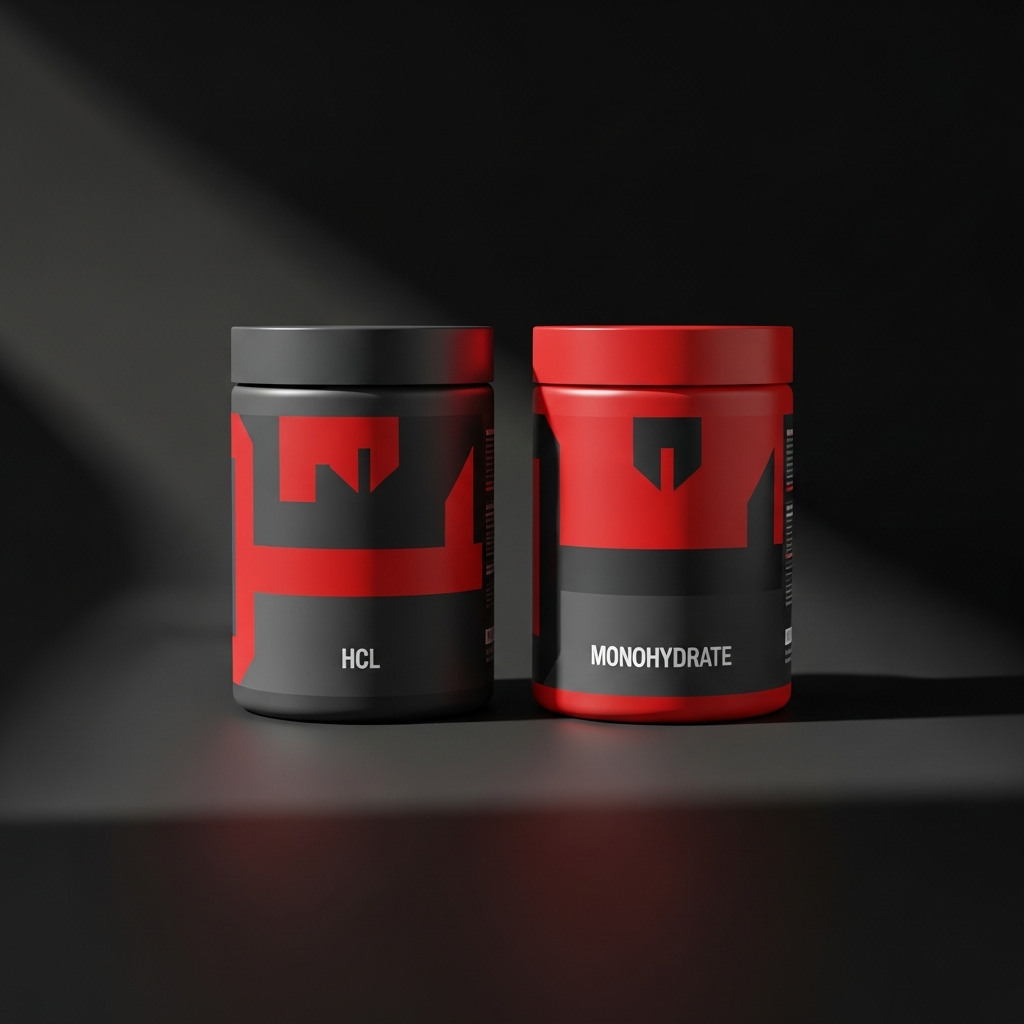
Creatine HCL vs Monohydrate: Which One Should You Actually Buy?
Creatine HCL is marketed as the upgraded version — smaller doses, better solubility, no bloating. But 'more soluble' doesn't automatically mean 'more effective,' and the price gap is significant. Here's the honest comparison, so you can decide without getting played by supplement marketing.
Key Takeaways
- Creatine monohydrate has by far the strongest evidence base — hundreds of studies over 30+ years consistently show it works.
- Creatine HCL is significantly more soluble in water, which means it dissolves better and may cause less stomach discomfort for people sensitive to monohydrate.
- No large, well-controlled head-to-head trial has proven HCL produces greater muscle creatine accumulation or better performance outcomes than monohydrate.
- HCL costs 2–5x more per effective dose than monohydrate — a meaningful premium for a form without proven superiority.
- Monohydrate is the right default for most people; HCL is a reasonable alternative for those who experience gastrointestinal issues with monohydrate.
What HCL and monohydrate actually are
Both forms deliver the same active molecule: creatine. The difference is in what's attached to it.
Creatine monohydrate is creatine bonded to one water molecule. It's the form used in virtually all the foundational research — the studies showing increased strength, power output, lean mass, and exercise capacity. It's also the cheapest to manufacture and has been available for decades. A standard serving is 3–5 g.
Creatine hydrochloride (HCL) is creatine bonded to a hydrochloride group. This changes its chemistry: it's significantly more soluble in water — roughly 38 times more soluble than monohydrate by some manufacturer claims. Because of this, a smaller dose (often 1–2 g) is claimed to deliver equivalent creatine. It dissolves almost instantly in liquid with no gritty residue, and it generates less osmotic pull in the gut, which is the mechanism behind the 'less bloating' claim.
On paper, those are real chemical differences. The question is whether they translate into meaningfully better outcomes in actual humans.
The evidence gap: where monohydrate wins by default
Creatine monohydrate's evidence base is one of the most robust in all of sports nutrition. More than 500 peer-reviewed studies. Consistent findings across populations — trained and untrained, young and older, male and female. The ISSN calls it the most effective ergogenic nutritional supplement currently available for improving high-intensity exercise capacity and lean body mass.
Creatine HCL's evidence base is thin by comparison. There are in-vitro studies showing superior solubility. There are a small number of company-funded trials showing it increases muscle creatine. What's missing is a large, independent, head-to-head trial showing that HCL actually accumulates muscle creatine better or produces better performance outcomes than monohydrate at equivalent doses.
A 2022 review in Nutrients examined the comparative evidence for alternative creatine forms (including HCL, ethyl ester, buffered, and others) and concluded that none had sufficient evidence to be considered superior to creatine monohydrate. That's not a death sentence for HCL — it's a statement about the state of the evidence.
Solubility, bloating, and who HCL actually helps
The most legitimate advantage of HCL is digestive tolerance. A small but real subset of people experience gastrointestinal discomfort with creatine monohydrate — bloating, cramping, or loose stools, usually more common during a loading phase when taking 20 g/day in large doses.
The mechanism: monohydrate is osmotically active in the gut at higher doses, drawing in water and potentially causing GI distress. HCL, being more soluble, is absorbed more rapidly from the small intestine with less residual in the gut. For people in the sensitive minority, this is a real benefit.
That said, most people taking monohydrate at the maintenance dose (3–5 g/day) never experience any GI issues at all. The bloating concern is most associated with large loading doses, which you can avoid entirely by using a gradual loading approach or skipping loading altogether and going straight to 5 g/day maintenance.
In other words: HCL solves a problem that most monohydrate users don't have.
The cost comparison: what you actually pay per dose
This is where the HCL premium becomes hard to justify for most buyers. Compare on a cost-per-effective-dose basis, not sticker price:
| Form | Typical Canadian cost per 5 g creatine | Typical serving size |
|---|---|---|
| Creatine monohydrate (bulk, 1 kg) | $0.15–$0.30 | 5 g |
| Creatine monohydrate (branded, 500 g) | $0.25–$0.45 | 5 g |
| Creatine HCL (branded, 90 servings) | $0.75–$1.50 | 1.5–2 g (claimed equiv.) |
HCL products typically claim that 1.5–2 g is equivalent to 5 g of monohydrate due to better bioavailability. Even granting that claim (and it hasn't been proven head-to-head), you're paying 2–5x more per dose. Over a year of daily use, that's a significant difference — often $80-150 more.
For a supplement that is already cheap at baseline, that premium requires strong evidence of superiority to justify. The evidence currently doesn't support that level of premium for the average user.
Who should choose which form
Choose creatine monohydrate if:
- You want the most evidence-backed form available
- Budget matters — and it does, even at these price points, over a year
- You have no history of GI sensitivity to supplements
- You want Creapure or another certified-purity badge (monohydrate options are far more numerous)
Consider creatine HCL if:
- You've genuinely tried monohydrate and experienced consistent GI discomfort, even at maintenance doses
- You mix creatine into drinks where solubility and taste matter to you
- You're willing to pay the premium for convenience
One approach worth trying before switching to HCL: if monohydrate causes stomach issues, try taking it with food instead of on an empty stomach, reduce to a 3 g dose, skip the loading phase, and use micronized monohydrate (finer particles, dissolves better). Many people resolve their GI concerns without changing form at all.
HCL vs Monohydrate at a glance
- 500+ Peer-reviewed studies on creatine monohydrate's efficacy and safety
- 2–5x Higher typical cost per effective dose of HCL vs monohydrate in Canada
- 38x Greater water solubility of HCL over monohydrate — real chemistry, unproven performance advantage
Frequently Asked Questions
Is creatine HCL better than monohydrate?
Not proven. Creatine HCL is more soluble and may be easier on the stomach, but no large independent trial has shown it produces greater muscle creatine accumulation or better performance outcomes than monohydrate. Monohydrate remains the evidence-backed default.
Why is creatine HCL so much more expensive?
HCL is a patented, newer form that costs more to manufacture and is marketed as an upgraded alternative. The price premium reflects novelty and marketing positioning, not proven superiority in head-to-head outcome studies.
Does creatine HCL cause less bloating?
For people who experience GI discomfort with monohydrate, HCL is often better tolerated due to its higher solubility and faster gut absorption. However, most people taking monohydrate at maintenance doses (3–5 g/day) never experience bloating at all.
Can I switch from monohydrate to HCL?
Yes, without any special transition protocol. If you're fully saturated on monohydrate, switching to HCL at its recommended dose continues maintaining that saturation. There's no washout period needed.
How much creatine HCL equals 5 g of monohydrate?
Manufacturers typically claim 1.5–2 g of HCL is equivalent to 5 g of monohydrate due to better bioavailability. This claim has not been confirmed by independent head-to-head muscle biopsy studies, so treat it as a manufacturer claim, not an established equivalency.
Sources & Further Reading
- Lanhers C et al. (2017) — Creatine supplementation and lower limb strength performance: a systematic review and meta-analyses. Sports Med.
- Jäger R et al. (2011) — Analysis of the efficacy, safety, and regulatory status of novel forms of creatine. Amino Acids.
- Kreider RB et al. (2017) — ISSN position stand: safety and efficacy of creatine supplementation. J Int Soc Sports Nutr.
- Twycross-Lewis R et al. (2016) — The effects of creatine supplementation on thermoregulation and physical (cognitive) performance: a review and future prospects. Amino Acids.