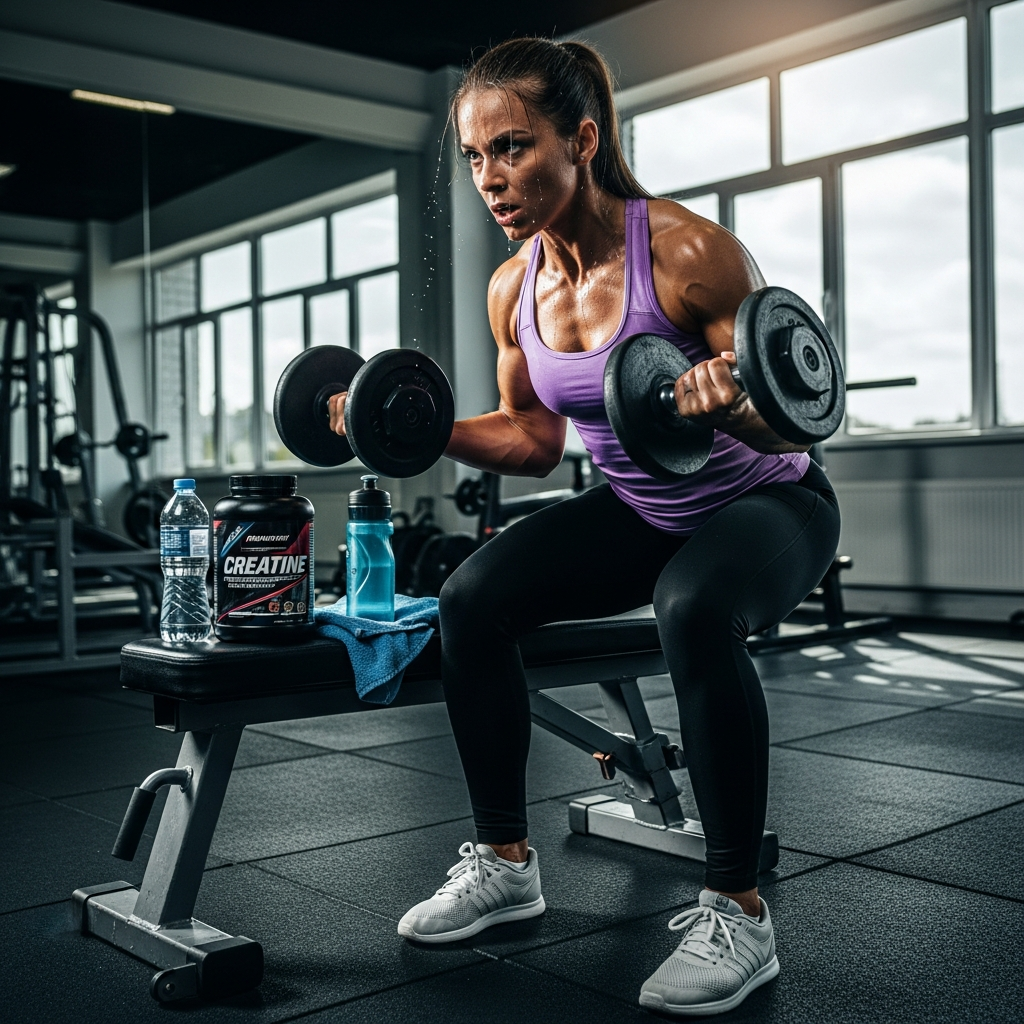
Creatine for Women: Benefits, Dosing, and What the Research Actually Shows
The idea that creatine is a 'men's supplement' is one of the biggest myths in sports nutrition. Women benefit from creatine too — and in some areas, including brain health and bone density, the evidence is particularly strong. Here is everything women need to know.
Key Takeaways
- Women benefit from creatine supplementation just as meaningfully as men — across strength, lean mass, recovery, brain health, and bone density.
- Women naturally have lower muscle creatine stores than men, which means supplementation produces a proportionally larger increase in phosphocreatine availability.
- Creatine does not cause masculinization — it has no effect on testosterone or androgenic hormones in women.
- The 2023 Stanford RCT found creatine augmentation significantly reduced depression symptoms in women faster than antidepressants alone.
- Post-menopausal women show particularly strong benefits for bone mineral density and lean mass preservation.
- 3–5g of creatine monohydrate per day is the evidence-backed dose for women — the same as for men.
Does Creatine Actually Work for Women?
Yes — clearly and consistently. The research on creatine in women spans over two decades and multiple outcomes: muscle strength, lean body mass, recovery, bone health, and cognitive function. The International Society of Sports Nutrition's position stand on creatine explicitly states that creatine supplementation is effective across both sexes.
The persistent myth that creatine is a men's supplement stems from early research that primarily used male subjects — a common bias in sports science that has since been corrected. When researchers began studying women specifically, the results were clear: women respond to creatine supplementation and see meaningful improvements in performance, body composition, and health markers.
One key physiological reason women may benefit especially: women naturally have lower resting muscle creatine stores than men. This means supplementation produces a proportionally larger relative increase in phosphocreatine availability — giving women's muscles more new fuel per gram of creatine consumed.
Strength, Power, and Athletic Performance
The most well-studied benefit of creatine in women is strength and power output. A systematic review of creatine supplementation in females found significant improvements in muscular strength, power, and lean mass across resistance-trained women. Key findings:
- Upper and lower body strength: Multiple randomized trials show women supplementing with creatine gain significantly more strength during resistance training programs compared to placebo groups — typically 10–15% greater strength gains over an 8–12 week program.
- Sprint and high-intensity performance: Women in team sports and track disciplines see improvements in repeated sprint ability and peak power output — the same phosphocreatine-dependent mechanism that benefits male athletes.
- Lean mass: Creatine consistently increases lean body mass in women, primarily through enhanced training quality and reduced muscle protein breakdown — not through fluid retention alone.
For sport-specific benefits, see our article on creatine for athletes.
Bone Health: An Underrated Benefit for Women
One of the most important and least discussed benefits of creatine for women is bone health. This is particularly relevant for post-menopausal women, who face accelerated bone density loss due to declining estrogen.
Creatine supports bone health through two mechanisms: it enhances the quality of resistance training (loading bones more effectively), and it may directly influence bone metabolism by supporting the energy needs of osteoblasts (bone-building cells). A 2015 randomized controlled trial in post-menopausal women found that creatine supplementation combined with resistance training produced significantly greater improvements in bone mineral density at the femoral neck compared to resistance training plus placebo.
For women approaching menopause or in the post-menopausal years, the combination of creatine supplementation and resistance training is one of the most evidence-backed interventions for maintaining bone density and reducing fracture risk.
Will Creatine Affect Hormones or Cause Masculinization?
No. This is a persistent concern and it is not supported by evidence.
Creatine does not increase testosterone. It does not increase DHT (dihydrotestosterone) in women. It does not cause androgenic effects. Creatine is not a hormone, a hormone precursor, or a steroid. It is a naturally occurring nitrogen-containing compound that your body already makes from the amino acids arginine, glycine, and methionine.
One older study found elevated DHT in male rugby players during loading — but this finding has not been replicated, was specific to males, and the methodology has been questioned. There is no evidence this applies to women.
What creatine does do in women: increase muscle creatine phosphate stores, improve energy availability for high-intensity efforts, and support lean mass development through better training. None of these effects are masculinizing — they simply make the muscles you already have work better.
Will it make you 'bulky'? No. Muscle growth in women is tightly governed by lower testosterone levels. Creatine supports the quality of training; it does not override your hormonal environment. The women who use creatine and look 'bulky' look that way because of their training program, diet, and genetics — not because of creatine.
Mental Health, Cognition, and Depression
The cognitive and mental health evidence for creatine is particularly relevant for women. A 2023 Stanford-led randomized controlled trial found that women with major depressive disorder who received creatine augmentation alongside their SSRI antidepressant showed significantly greater reductions in depression scores — and responded faster — than women on SSRI alone.
Women experience higher rates of depression than men. The brain energy hypothesis — that reduced phosphocreatine availability in the prefrontal cortex contributes to depressive symptoms — may partly explain this disparity, and may explain why creatine augmentation shows particular promise in women.
Beyond clinical depression, creatine has demonstrated improvements in working memory, processing speed, and cognitive resilience under mental fatigue in several controlled trials. For women managing demanding cognitive workloads alongside physical training, creatine's dual physical and cognitive benefits make it especially valuable. Read more in our detailed article on creatine for mental clarity and mood.
How Women Should Take Creatine
The dosing protocol for women is the same as the general recommendation — and simpler than most people expect:
- Daily dose: 3–5g. Smaller women (under 55kg) can start at 3g; larger or more athletic women can go to 5g. There is no strong evidence that women need a different dose from men at equivalent bodyweights.
- Loading phase: optional. Loading (20g/day split into 4 doses for 5–7 days) saturates stores faster but is not required. A consistent 3–5g/day achieves full saturation within 3–4 weeks.
- Timing: flexible. Research shows creatine works regardless of when you take it, as long as you take it daily. Post-workout timing with a protein-carbohydrate meal has a slight edge in some studies — but consistency matters more than exact timing.
- Form: creatine monohydrate. Standard or micronized monohydrate is the gold standard — used in all the research cited here. No other form has proven superior in women specifically.
- During menstrual cycle: no adjustment needed. There is no evidence that cycle phase affects creatine absorption or efficacy. Take it consistently throughout the month.
Use our Creatine Dose Calculator for a personalized dose recommendation. For product picks, see our Best Creatine for Women guide.
Creatine for Women: Key Numbers
- 12,100 Canadians search 'creatine for women' every month — it is one of the most common supplement questions
- Lower Women's baseline muscle creatine stores vs men — meaning supplementation produces a proportionally bigger boost
- 2023 Stanford RCT showing creatine reduced depression faster than SSRI alone in women
- 3–5g Daily creatine monohydrate — the evidence-backed dose for women
Frequently Asked Questions
Should women take creatine?
Yes — the evidence clearly supports creatine supplementation for women. Benefits include improved strength and power, better lean mass during resistance training, faster recovery, potential bone density support (especially post-menopause), and emerging evidence for improved mood and cognitive function. The concerns — masculinization, hormone disruption, weight gain — are not supported by research.
Does creatine affect women's hormones?
No. Creatine does not increase testosterone, DHT, or any androgenic hormone in women. It is not a steroid or hormone precursor. Its mechanism is purely energetic — it increases phosphocreatine in muscle and brain cells to support ATP regeneration. Hormonal profiles in women are unaffected by standard creatine supplementation.
Will creatine make women look bulky?
No. Creatine does not override your hormonal environment or training program. Women's testosterone levels are roughly 10-15x lower than men's, which is the primary limiter of muscle mass accumulation. Creatine improves training quality and supports lean mass development — it does not cause the kind of muscle growth that requires years of heavy training and a very specific hormonal profile.
How much creatine should a woman take per day?
3–5g of creatine monohydrate per day. Smaller women (under 55kg) can start at 3g; heavier or more athletic women can go up to 5g. A loading phase (20g/day for 5–7 days) is optional — it saturates stores faster but is not necessary for results. Use our Creatine Dose Calculator for a personalized recommendation.
Is creatine safe for women?
Yes. Creatine monohydrate is one of the most thoroughly studied supplements in nutrition science. No serious adverse effects have been documented at standard doses (3–5g/day) in healthy women. The main side effects reported are minor GI discomfort (usually from taking it on an empty stomach) and initial water retention of 0.5–1.5kg as muscles hydrate.
What is the best creatine for women?
Creatine monohydrate — standard or micronized — is the best form for women based on the research. Micronized dissolves more easily and may reduce GI sensitivity. Look for Creapure-certified or NSF-certified products for guaranteed purity. See our Best Creatine for Women guide for top-rated options available in Canada.