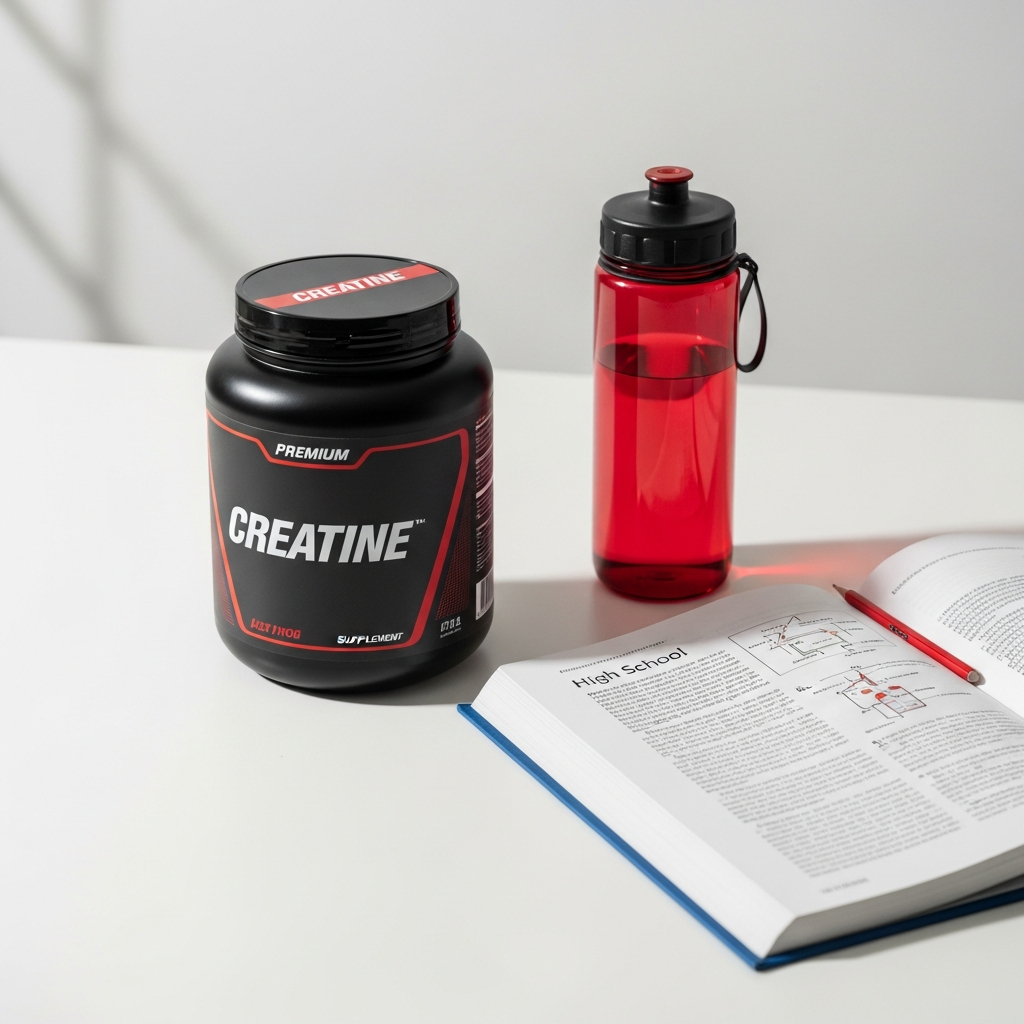
Creatine for Teens: Is It Safe, and When Is It Appropriate?
Parents Google this question constantly, and young athletes ask their coaches. The honest answer sits somewhere between 'absolutely fine, they're just humans' and 'wait until they're done developing' — and where exactly depends on age, goals, and context. Here's what the evidence and Canadian guidelines actually say.
Key Takeaways
- No major sports medicine body currently recommends creatine supplementation for athletes under 18 as a routine practice, primarily due to a lack of long-term paediatric safety data.
- Short-term studies in adolescents have not found harm, and creatine occurs naturally in food — but 'probably safe' is not the same as 'well-studied in this population'.
- The priority for teenage athletes is diet, sleep, and training quality — supplements deliver marginal gains on top of those fundamentals, and most teens haven't maxed out the basics.
- Older teens (16+) who already train seriously, eat well, and understand supplementation exist in a different risk category than a 13-year-old who wants to bulk up fast.
- If a teen is considering creatine, the conversation should involve a sports dietitian or doctor, not just a YouTube recommendation.
What Canadian and international guidelines actually say
No major sports medicine or paediatric body — not Health Canada, not the American Academy of Pediatrics, not the Canadian Paediatric Society, not the ISSN — gives a blanket green light to creatine supplementation for athletes under 18. The ISSN's position statement, the most comprehensive in the field, notes that creatine is not recommended for use by those under 18 unless the supplement is being used under the supervision of a qualified professional and the potential benefits outweigh the risks.
That's a carefully worded statement, not an outright ban. The concern isn't an established harm — it's the absence of enough long-term paediatric data to make a population-level 'safe' recommendation. Adults have decades of study behind them. Teenagers don't.
Health Canada classifies creatine as a natural health product. Products sold in Canada must carry an NPN and comply with recommended dosages, but there is no age restriction written into law. The guidance from sports medicine professionals is precautionary, not regulatory.
What the research on adolescents actually shows
A handful of studies have looked directly at creatine in teenage athletes. A 2001 study by Almada and colleagues found that creatine supplementation in adolescent baseball players was associated with improved performance without adverse effects. Other small trials in teenage swimmers and football players have found similar short-term safety profiles — no kidney problems, no concerning hormonal changes, no liver markers out of range.
The catch: these are short-term studies (weeks to months) with small samples. Creatine is generally safe in these trials, but 'no harm detected in an 8-week study of 20 teenagers' is not the same as 'safe for a 14-year-old to take indefinitely.' The long-term paediatric data simply hasn't been collected, which is the honest scientific gap behind the cautious guidelines.
Creatine also occurs naturally in food — red meat and seafood contain it. A teenager eating a carnivore-friendly diet is already getting 1–2 g of dietary creatine daily. Supplementation adds a larger dose on top of that, but it's not introducing a foreign compound.
Why context matters more than age alone
A 17-year-old competitive powerlifter who trains six days a week, eats well, sleeps eight hours, and wants to optimize performance exists in a very different context from a 13-year-old who saw a TikTok about getting bigger for the school team.
The concerns around teenage creatine use are highest when:
- The teen is still in early puberty and their hormonal and musculoskeletal development is rapid and potentially sensitive to interference (even if creatine doesn't interfere directly, this is the cautious window)
- The motivation is body image or shortcutting effort rather than genuine athletic performance
- Basic nutrition, sleep, and training are not already in place — supplementing on top of a poor diet and inconsistent training is optimizing the wrong things
- No professional guidance is involved
The concerns are lower — though the guideline gap still exists — when the athlete is older (16–17), already training seriously, has their diet dialled in, and is using creatine with awareness and professional input.
The case for fundamentals first
Even setting aside the safety debate, there's a strong argument that most teenage athletes don't need creatine yet — not because it's dangerous, but because they haven't maxed out the things that matter more.
The performance ceiling on nutrition, sleep, consistent training, and skill development in a teenage athlete is enormous. A 16-year-old who starts sleeping 8.5 hours instead of 6.5, adds 200 quality calories per day, and improves their training consistency will see far larger gains than any supplement can provide. Creatine is most valuable as a marginal optimizer on top of solid fundamentals — and for most teens, those fundamentals aren't solid yet.
This isn't a reason to dismiss creatine. It's a reason to prioritize correctly. The recommendation from sports dietitians working with young athletes consistently sounds like: 'Get the food, sleep, and training right first. Come back to supplements when those are sorted.'
Practical guidance for parents and young athletes
If a teenager — or their parent — is seriously considering creatine, here's a sensible framework:
- Talk to a registered dietitian or sports medicine doctor first. Not a supplement store employee, not a YouTube channel. A professional who can assess the individual's diet, training, and development stage.
- Focus on dietary creatine sources first. Regular consumption of lean red meat, chicken, and fish already raises muscle creatine stores meaningfully compared to a fully plant-based diet. This isn't a supplement at all.
- If supplementing, use creatine monohydrate at standard doses. The 3–5 g/day maintenance dose is what the research uses. There's no reason to exceed it, and elaborate 'teen formulas' from supplement companies don't offer anything over plain monohydrate.
- Avoid proprietary blends and stimulant-stacked products marketed to teens. Many pre-workouts contain caffeine, stimulants, and compounds with even less paediatric safety data than creatine alone.
- This is not an area where 'everyone's doing it' is reassuring. Popularity doesn't establish safety. The honest position is: probably safe in the short term for older teens, not enough long-term data to make a confident population recommendation.
Creatine for teens: the key facts
- No ban No legal age restriction on creatine in Canada — guidance is precautionary, not regulatory
- 16+ Age range where serious teenage athletes most commonly appear in research contexts
- 1–2 g Daily dietary creatine a teen gets from eating lean red meat and seafood regularly
Frequently Asked Questions
Is creatine safe for teenagers?
Short-term studies in adolescents have not found harm, but no major sports medicine body recommends creatine for under-18s as routine practice due to a lack of long-term paediatric safety data. The honest answer is 'probably safe in the short term, especially for older teens' — not 'proven safe for long-term adolescent use'.
What age can you start taking creatine?
There is no legal minimum age in Canada. Professional guidelines suggest caution under 18 due to the absence of long-term paediatric studies. Most sports dietitians working with young athletes recommend waiting until 18 or focusing on dietary sources first.
Is creatine banned in youth sports?
No. Creatine is not on the WADA prohibited list and is not banned in any major youth sports organization. It is a legal, widely available supplement. The discussion is about whether it is appropriate, not whether it is permitted.
What should a teenage athlete focus on instead of supplements?
Sleep (8–9 hours), adequate calorie and protein intake, consistent training, and skill development. These factors have far larger effects on athletic performance than any supplement for a teenage athlete who hasn't optimized them first.
Can a 16-year-old take creatine?
Many 16-17 year old athletes do use creatine, and short-term research in this age group has not shown harm. The recommendation from sports medicine professionals is that it should be done with professional guidance and only after nutrition and training fundamentals are in place.
Sources & Further Reading
- Kreider RB et al. (2017) — ISSN position stand: safety and efficacy of creatine supplementation. J Int Soc Sports Nutr.
- American Academy of Pediatrics (2005) — Use of performance-enhancing substances. Pediatrics.
- Metzl JD et al. (2001) — Creatine use among young athletes. Pediatrics.
- Canadian Paediatric Society — Adolescents and performance-enhancing substances. Paediatr Child Health.
- Buford TW et al. (2007) — ISSN position stand: creatine supplementation and exercise. J Int Soc Sports Nutr.