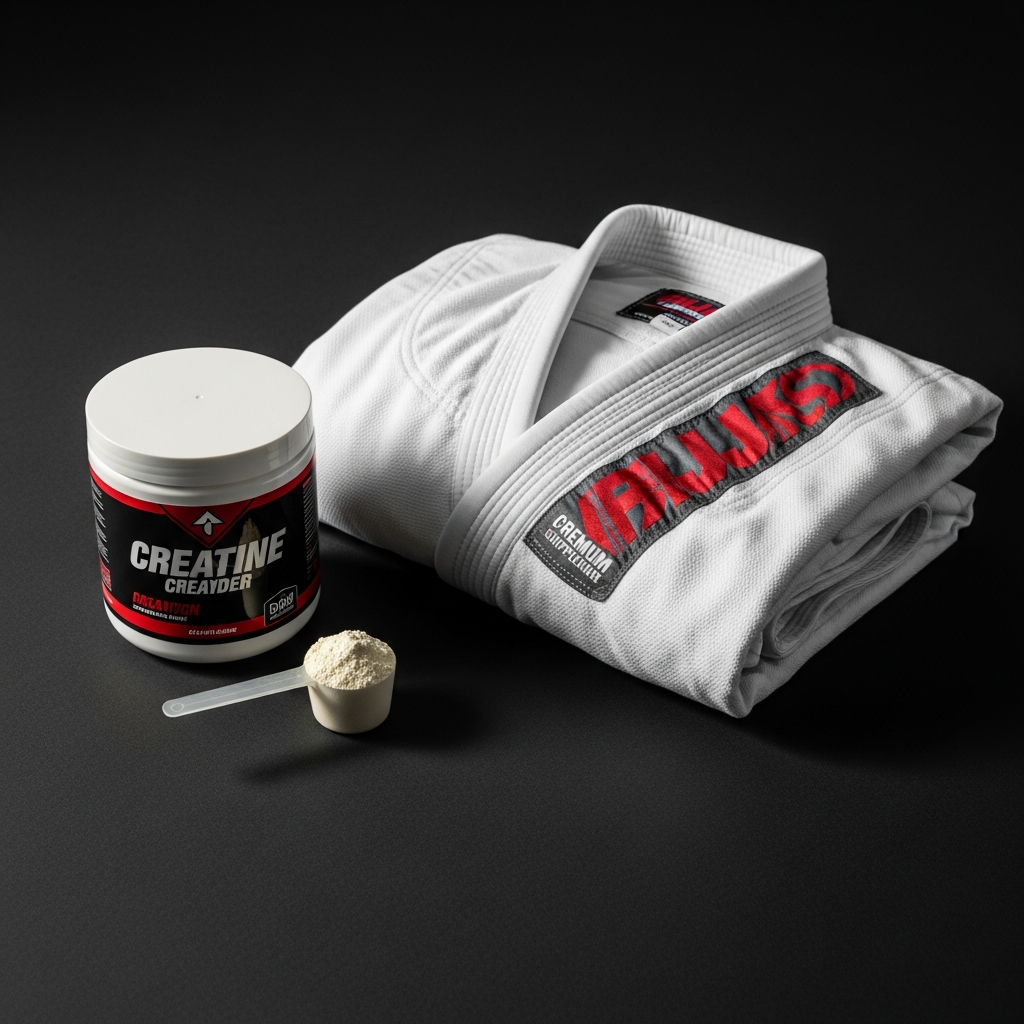
Creatine for Jiu Jitsu: Does It Actually Help on the Mat?
Jiu jitsu is not a sport you typically associate with supplement stacks — but creatine's benefits map well onto what BJJ actually demands. Here's how the research applies to the mat, from scrambles and grip fatigue to drilling endurance and weight-cut recovery.
Key Takeaways
- BJJ repeatedly taxes the phosphocreatine system — the same energy pathway creatine directly supports — during explosive takedowns, guard passes, and submission attempts.
- Research on wrestling, judo, and grappling sports shows creatine improves repeated sprint and power output, which translates directly to competitive rolling.
- Creatine will not make you stronger in technique, but it can increase the number of hard rounds you can go before your power and pace decline.
- The 1–2 kg of water weight creatine adds is intramuscular, not fat — but is worth planning for if you compete with a weigh-in.
- Recovery between training sessions is where many BJJ practitioners notice the clearest benefit: less soreness, more capacity to train the next day.
What energy systems does jiu jitsu actually use?
Understanding why creatine is relevant to BJJ starts with understanding what powers the sport. Jiu jitsu is a mixed-energy-system sport. A five-minute round involves periods of low-intensity positional work interspersed with explosive bursts — a double-leg attempt, a hip escape, a submission finish, a defensive scramble. Those explosive moments are short (2–8 seconds), maximal, and decisive.
Short explosive efforts are powered by the phosphocreatine (PCr) system — the fastest energy pathway in the body, and exactly the one creatine supplementation directly supports. When you fire off an explosive movement, your muscles burn ATP almost instantly and then regenerate it from stored PCr. The more PCr you have available, the more power you can produce, and the faster you recover between bursts.
The aerobic system handles the in-between: positioning, maintaining posture, controlling breathing. Creatine doesn't primarily help here. But the moments that end rounds — the ones that win or lose positions — are fuelled by PCr. That's where the supplement becomes relevant.
What does the research on grappling sports show?
There is no large creatine trial specifically in BJJ practitioners. But there is a meaningful body of research on grappling sports — wrestling, judo, and sambo — whose physical demands closely mirror BJJ in terms of intermittent maximal effort, grip strength, and body contact.
Key findings from this body of work:
- A 2009 study by Vargas-Molina and colleagues found that creatine supplementation significantly improved repeated sprint performance and reduced fatigue in wrestlers across multiple bouts — exactly the repeated-round scenario of a BJJ training session or tournament.
- Research on judo athletes (Sterkowicz et al., 1999) found that creatine improved performance on the Special Judo Fitness Test, which involves repeated explosive throws — an analogue for explosive scrambles in BJJ.
- Multiple meta-analyses on high-intensity intermittent exercise — the category BJJ falls into — confirm that creatine improves mean power output and reduces performance decline across repeated bouts.
The translation isn't perfect (grappling ≠ BJJ), but the physiological similarity is strong enough that the evidence is directly applicable to what happens in a BJJ class or competition.
Grip strength, drilling endurance, and mat time
Two aspects of jiu jitsu where creatine's benefits are often first noticed:
Grip strength and endurance. Grip is a limiting factor in grappling. Your fingers and forearms fatigue before your legs or lungs in many situations — especially during gi training. Forearm muscles rely heavily on the PCr system for repeated forceful contractions. Studies have shown creatine supplementation improves grip strength and resistance to grip fatigue under repeated testing protocols. This directly applies to collar grips, sleeve control, and submission finishes.
Drilling volume. Most of a BJJ practitioner's mat time is drilling, not live rolling. The ability to drill a technique cleanly for 50 repetitions rather than 30 before technique breaks down is a function of muscular endurance in the context of repeated short-burst efforts — again, the PCr system. More creatine means more reps before form deteriorates, which means more quality repetitions per session over a training career.
Neither of these is dramatic on a day-to-day basis. The cumulative effect over months of training is where the compounding matters.
What about the weight gain? Does it matter for competition?
Creatine typically adds 1–2 kg in the first week through intramuscular water retention. For BJJ competitors who train close to a weight class limit, this is worth thinking about.
A few things to clarify:
- The weight is intramuscular fluid — water stored inside muscle cells alongside creatine. It is not fat, and it is not subcutaneous water (the kind you can cut with a sauna). It does not come off with a sweat suit.
- If you compete and cut weight, starting creatine close to a competition cycle will push your walk-around weight up by 1–2 kg, making the cut harder.
- If you are comfortable at your weight class with room to spare, this is a non-issue. Most recreational practitioners and open-weight competitors never need to think about it.
- The common strategy for competitive grapplers: stop creatine 4–6 weeks before a weigh-in (not because stopping is beneficial, but because muscle creatine stores decline over that timeframe and the associated water weight gradually leaves with it), then resume supplementation after competing.
None of this changes the fundamental calculus: the performance benefit is real, and the water weight is manageable with planning.
Recovery: the benefit most BJJ practitioners notice first
For recreational and competitive BJJ practitioners training 3–5 times per week, recovery capacity often limits training volume more than anything else. You can't improve on Monday if you're still wrecked from Saturday.
Creatine supports recovery through two mechanisms:
- Reduced muscle damage markers. Several studies show creatine supplementation is associated with lower creatine kinase (CK) levels after eccentric exercise, suggesting attenuated muscle cell damage. Less damage means faster recovery.
- Glycogen resynthesis. Creatine has been shown to speed up glycogen re-loading when taken with carbohydrates post-training. Faster glycogen replenishment means you start the next session with full energy stores rather than depleted ones.
Many BJJ practitioners who add creatine report that they notice less soreness and more willingness to train the next day before they notice any strength change. This is consistent with the recovery mechanism: the performance gains take weeks to accumulate, but the reduced post-training soreness is more immediate.
How to actually use creatine for BJJ
The protocol for BJJ is the same as for any athlete — creatine doesn't need to be customized by sport:
- Form: Creatine monohydrate. There's no evidence any other form outperforms it for grappling-specific outcomes, and monohydrate is far cheaper per dose.
- Dose: 3–5 g per day. No need to exceed this; higher doses don't produce more benefit after saturation.
- Loading: Optional. Loading (20 g/day for 5–7 days) reaches full saturation in a week. Going straight to 5 g/day reaches the same saturation in 3–4 weeks. Load if you want faster results; skip it if you want simplicity.
- Timing: Close to training — either before or after — is slightly better than random timing, but consistency matters far more. Take it every day, including rest days.
- Competition planning: If you compete at a specific weight class, begin tapering creatine 4–6 weeks before your event. Resume immediately after.
The bigger picture: creatine is a marginal optimizer, not a game-changer. No supplement improves positional awareness, timing, or technique. A blue belt who trains five days a week will beat a white belt on creatine every time. But at equivalent skill levels and training volume, creatine gives you a bit more power for longer — and in a sport decided by small advantages, that adds up.
Creatine for BJJ at a glance
- PCr system Primary energy pathway for explosive scrambles, takedowns, and submission attempts in BJJ
- 1–2 kg Typical initial weight gain from intramuscular water retention — plan for weigh-ins
- 3–5 g/day Maintenance dose — same protocol as any athlete, no BJJ-specific adjustment needed
Frequently Asked Questions
Does creatine help with Brazilian jiu jitsu?
Yes, in ways that are specific to what BJJ demands. Explosive scrambles, takedown attempts, and submission finishes rely heavily on the phosphocreatine energy system, which creatine directly supports. Research on wrestlers and judoka — sports with similar physical demands — consistently shows improved repeated explosive performance with creatine.
Will creatine make me stronger in jiu jitsu?
Creatine supports explosive power output and recovery — it does not improve technique, timing, or positional awareness. It helps you maintain higher power output across more rounds and recover faster between sessions. Skill development from mat time matters far more.
Should I worry about the weight gain from creatine in BJJ?
Only if you compete near a weight class limit. The 1–2 kg creatine adds is intramuscular water that does not come off with sweat cuts. Competitive grapplers typically taper creatine 4–6 weeks before a weigh-in and resume after competing.
Does creatine help grip strength for gi jiu jitsu?
Yes. Studies show creatine improves grip strength and resistance to grip fatigue under repeated testing protocols. Forearm muscles rely heavily on the phosphocreatine system for repeated forceful contractions — exactly what collar and sleeve gripping demands.
How long before I notice creatine working in BJJ training?
Most practitioners notice reduced soreness and improved recovery between sessions within 1–2 weeks. Improved power output and endurance across rounds typically becomes noticeable after 3–4 weeks of consistent supplementation at full muscle saturation.
Sources & Further Reading
- Sterkowicz S et al. (1999) — Effects of creatine monohydrate supplementation on the performance of the Special Judo Fitness Test. Int J Sports Med.
- Vargas-Molina S et al. (2020) — Effects of creatine supplementation on combat sport athletes: a systematic review. J Int Soc Sports Nutr.
- Rawson ES & Volek JS (2003) — Effects of creatine supplementation and resistance training on muscle strength and weightlifting performance. J Strength Cond Res.
- Kreider RB et al. (2017) — ISSN position stand: safety and efficacy of creatine supplementation. J Int Soc Sports Nutr.
- Greenhaff PL et al. (1993) — Effect of oral creatine supplementation on skeletal muscle phosphocreatine resynthesis. Am J Physiol.