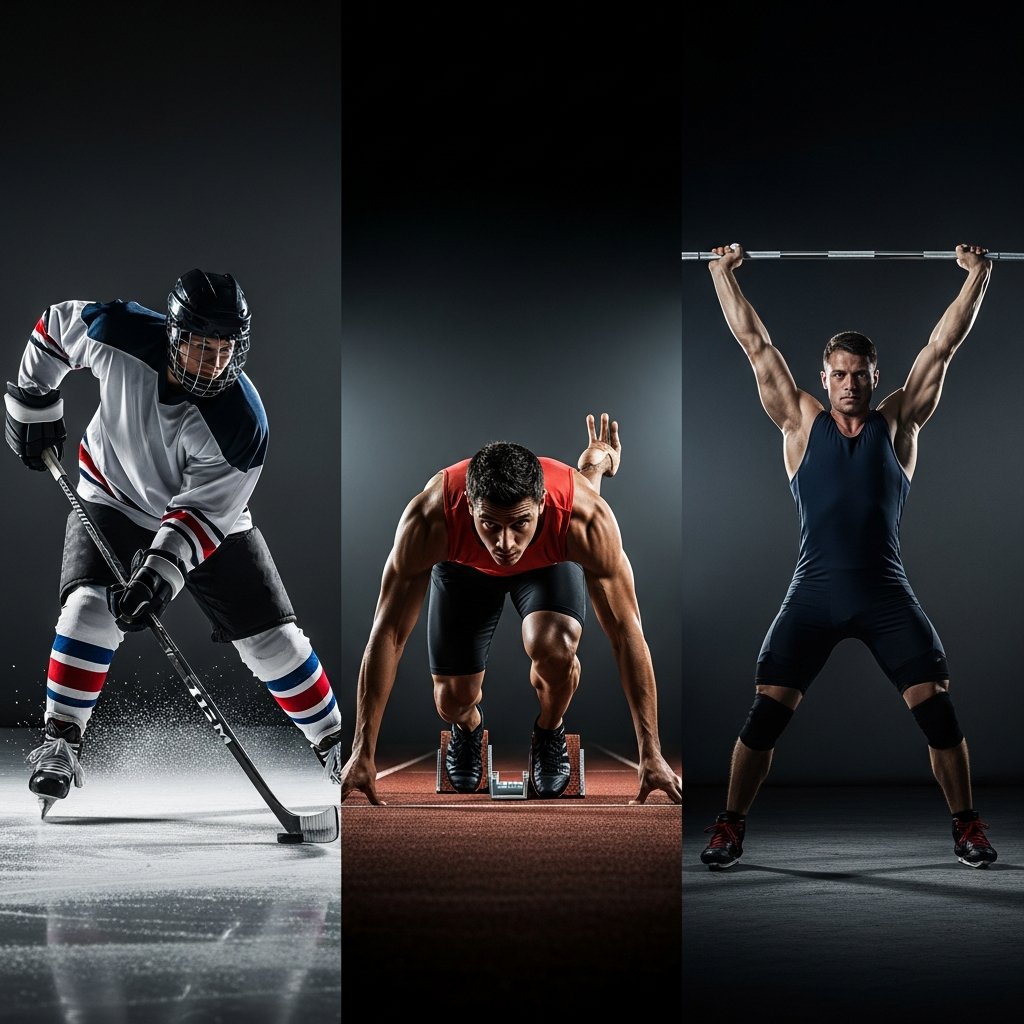
Creatine for Athletes: Sport-by-Sport Performance Advantages
Creatine is not just for bodybuilders. From sprinters to hockey players to swimmers, athletes across nearly every sport use it — and the evidence backs them up. Here is a sport-by-sport breakdown of the advantages.
Key Takeaways
- Creatine is the most evidence-backed performance supplement available to athletes — endorsed by the ISSN, IOC, and leading sports dietitians worldwide.
- It directly increases phosphocreatine stores, giving athletes more ATP for explosive, high-intensity efforts lasting under 30 seconds.
- Strength and power athletes (weightlifters, sprinters, football players) see the largest benefits — typically 5–15% improvements in peak power.
- Team sport athletes benefit through repeated sprint ability, reduced fatigue between bouts, and faster recovery between matches.
- Endurance athletes benefit less from acute performance but gain from faster recovery, reduced muscle damage, and better high-intensity interval capacity.
- 3–5g of creatine monohydrate per day is the evidence-backed dose for all athlete types — no loading phase required.
Why Creatine Is the Most Useful Supplement in Sport
Out of thousands of sports supplements on the market, creatine monohydrate stands alone in terms of research depth and consistent real-world results. The International Society of Sports Nutrition's position stand calls it the most effective ergogenic nutritional supplement currently available to athletes for increasing high-intensity exercise capacity and lean body mass.
The mechanism is straightforward: creatine saturates your muscles with phosphocreatine, the molecule your body uses to rapidly regenerate ATP — the universal energy currency for muscle contraction. During explosive efforts lasting 1–30 seconds (a sprint, a heavy lift, a change of direction), your ATP is depleted in seconds. More phosphocreatine means your muscles can regenerate ATP faster, letting you push harder and recover faster between efforts.
What makes creatine uniquely valuable across sports is that this regeneration system is used in virtually every athletic movement — not just in the gym. Whether you are a hockey player battling for a puck, a rugby flanker at the breakdown, or a 100m sprinter in the blocks, you are running on phosphocreatine.
Strength and Power Sports: The Biggest Gains
Athletes in strength and power disciplines see the most dramatic benefits from creatine supplementation. The evidence here is overwhelming:
- Weightlifting and powerlifting: Multiple meta-analyses confirm creatine increases 1-rep max strength by 5–10% and peak power output by 5–15%. A 2003 meta-analysis of 22 studies found creatine produced significantly greater gains in strength, sprint performance, and work output compared to placebo.
- Track and field (sprinting, throwing, jumping): Sprint performance over 6–30 seconds consistently improves with creatine loading. Shot putters, discus throwers, and hammer throwers — who rely on single explosive efforts — benefit from increased peak force production.
- Football and rugby: Body composition improvements (more lean mass, less fat mass), combined with strength and sprint gains, are particularly valuable for contact sport athletes who need to be both powerful and explosive.
- Gymnastics and CrossFit: High-skill, repeated high-intensity movements benefit from the faster ATP regeneration creatine provides — especially in competition formats with minimal rest between events.
Use the Creatine Dose Calculator to find your optimal daily dose based on your bodyweight.
Team Sports: Repeated Sprint Ability and Match Recovery
Team sport athletes — hockey, soccer, basketball, volleyball, lacrosse — perform hundreds of high-intensity sprints, cuts, and explosive actions during a game. Creatine's benefit here is not just one explosive effort; it is the ability to repeat those efforts with less fatigue accumulation.
Research on team sport athletes shows:
- Soccer: A 2012 study found creatine supplementation improved repeated sprint performance and reduced markers of muscle damage in soccer players during preseason.
- Hockey: A sport built on short explosive shifts (30–45 seconds), followed by bench recovery. Creatine's effect on phosphocreatine resynthesis directly supports the energy demands of a hockey shift — allowing players to come back on stronger in the third period.
- Basketball: Studies on basketball players show improved agility, vertical jump height, and sprint performance — all critical skills for on-court performance.
For team sport athletes in Canada, creatine monohydrate is widely used at the CFL, CHL, and university levels — and is entirely legal and uncontrolled by any sport governing body. (For more on legality, see our article Is Creatine a Banned Substance?)
Endurance Sports: A More Nuanced Picture
For endurance athletes — marathon runners, cyclists, triathletes — the performance picture is more nuanced. Creatine does not directly improve VO2 max or aerobic efficiency. However, it offers several indirect benefits that many endurance athletes undervalue:
- High-intensity interval training (HIIT): Most endurance athletes now include HIIT sessions to build speed and lactate threshold. Creatine improves performance during these high-intensity intervals, making training quality better.
- Reduced muscle damage and faster recovery: Long-distance efforts cause significant muscle micro-damage. Studies show creatine reduces markers of muscle damage (creatine kinase, lactate dehydrogenase) after prolonged exercise, potentially shortening recovery windows between sessions.
- Body composition: Creatine's effect on lean mass and reduced fat mass can improve power-to-weight ratio — valuable for cyclists and runners who benefit from being both strong and lean.
- Note on weight: Creatine causes 0.5–1.5kg of initial water retention as muscles increase their osmolarity. Some endurance athletes (especially elite marathon runners) avoid creatine to maintain minimum race weight. This is a legitimate individual decision.
Combat Sports: Strength, Power, and Recovery
Combat sport athletes — MMA, wrestling, judo, boxing — operate in a demanding environment: they must make weight, then perform explosive, strength-dependent efforts for multiple rounds. Creatine serves these athletes well, with a few considerations:
- Grappling sports (wrestling, judo, BJJ): Explosive takedowns, hold strength, and scramble capacity are all phosphocreatine-dependent. Research on wrestlers shows improved strength and reduced fatigue with creatine supplementation.
- Striking sports (boxing, kickboxing, MMA): Power output per strike and the ability to maintain punch/kick velocity in later rounds both improve with better ATP regeneration.
- Weight cutting caution: Combat athletes who water-cut to make weight should be aware that creatine increases water retention in muscles. This is not a medical risk, but it may make weight cuts harder. Most combat athletes cycle off creatine 1–2 weeks before a weigh-in and resume supplementation post-weigh-in.
For more on creatine safety and timing, see our guide on optimal creatine timing.
How Athletes Should Dose Creatine
The dosing protocol for athletes is the same as for general use — and simpler than most people expect:
- Daily maintenance dose: 3–5g per day. For larger athletes (over 100kg), 5g is appropriate. No loading phase is needed — it just saturates stores faster.
- Timing: Flexible. Post-workout creatine has a slight edge in some studies (co-ingested with protein and carbohydrate), but consistency matters more than exact timing. Take it when you will remember.
- In-season vs. off-season: Creatine works year-round. There is no benefit to cycling it. Many athletes who cycle off find their strength and recovery regress within 4–6 weeks as stores deplete.
- Form: Creatine monohydrate remains the gold standard — it is the form used in virtually all research, it is the cheapest, and it works. Micronized monohydrate mixes better. There is no proven benefit to HCL, buffered, or other forms over monohydrate.
See our Best Creatine in Canada rankings for top-rated products used by Canadian athletes, or browse by creatine monohydrate specifically.
Creatine and Athletic Performance: The Numbers
- 5–15% Increase in peak power output in strength athletes
- 500+ Human studies confirming creatine's ergogenic effects
- 3–5g Daily dose used across virtually all sport-specific research
- #1 Rated performance supplement by the ISSN for high-intensity exercise
Frequently Asked Questions
Which sport benefits most from creatine?
Strength and power sports (weightlifting, powerlifting, sprinting, football) see the largest performance gains — typically 5–15% in peak power. Team sport athletes (hockey, soccer, basketball) also see significant benefits in repeated sprint ability and match recovery. Endurance athletes see more modest but still meaningful benefits through better interval training quality and faster recovery.
Is creatine safe for competitive athletes?
Yes. Creatine is not banned by WADA, the IOC, the NCAA, or any major sport governing body. It is one of the most thoroughly studied supplements in sports medicine, with no documented cases of serious adverse effects at standard doses (3–5g/day) in healthy athletes.
Should athletes do a creatine loading phase?
Loading (20g/day for 5–7 days) saturates stores faster — useful before a competition block. Maintenance dosing (3–5g/day) achieves the same saturation in 3–4 weeks. If you have time, skip the loading phase; if you want rapid saturation before a season starts, loading is a valid option.
Does creatine help with sports endurance?
Not directly — creatine does not improve VO2 max or aerobic energy systems. However, it improves high-intensity interval training quality, reduces post-exercise muscle damage markers, and can improve power-to-weight ratio. Endurance athletes benefit most when they include regular high-intensity training sessions.
Can female athletes take creatine?
Absolutely. Research consistently shows female athletes benefit from creatine supplementation — though average gains are slightly smaller than in males due to differences in baseline muscle creatine saturation. Female athletes typically start closer to saturation, meaning the ceiling for improvement is somewhat lower, but real performance benefits still occur.
Should combat sport athletes avoid creatine before weigh-ins?
Many do, as a precaution. Creatine causes 0.5–1.5kg of water retention in muscle tissue. For athletes doing precise weight cuts, stopping creatine 1–2 weeks before weigh-in reduces this extra water weight. Resuming immediately after weigh-in is safe and common practice.