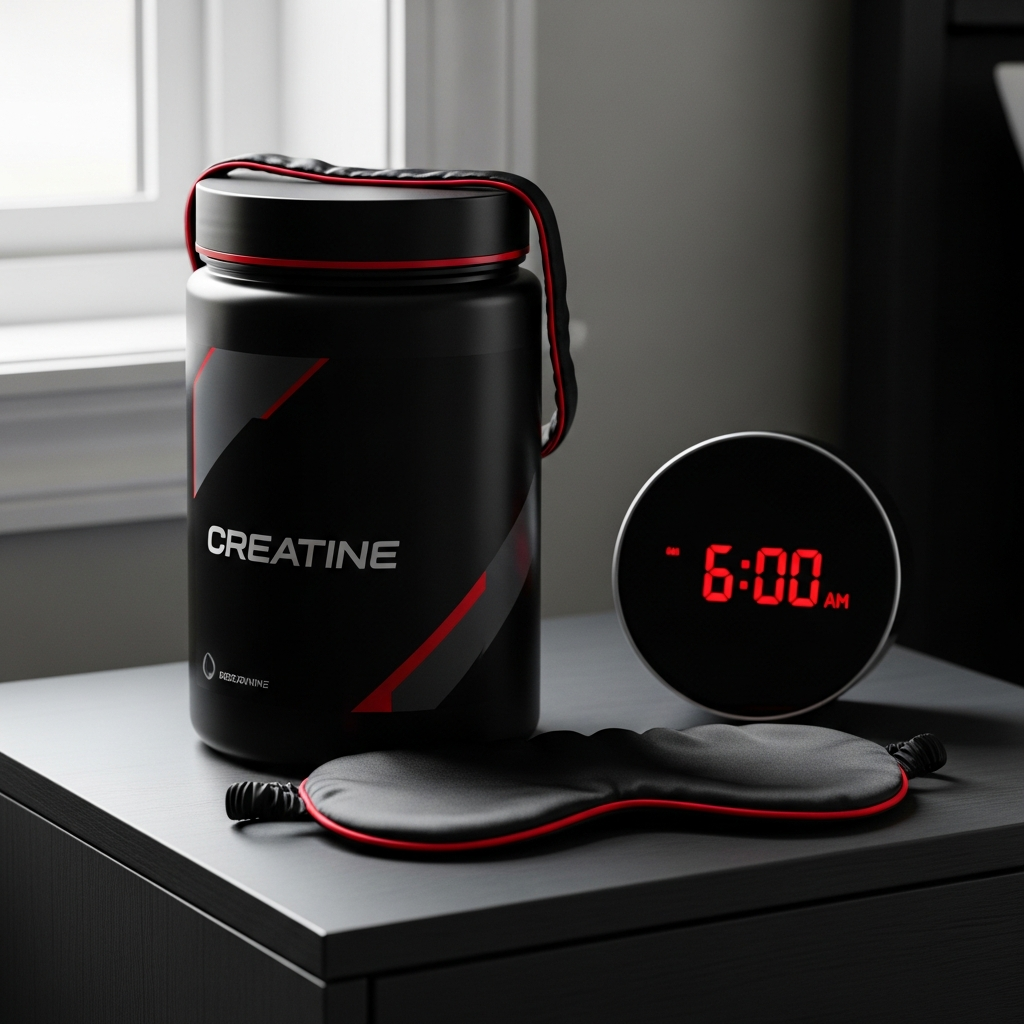
Creatine and Sleep: Does It Affect Your Rest?
Some people notice they sleep differently after starting creatine. Researchers have actually studied this — and the findings are more interesting than 'it does nothing.' Here's what creatine does and doesn't do to your sleep, including the emerging research on sleep deprivation and cognitive recovery.
Key Takeaways
- Standard creatine supplementation does not contain stimulants and does not typically disrupt sleep in people with normal sleep patterns.
- Several studies suggest creatine may partially offset the cognitive performance decline caused by sleep deprivation — particularly on tasks requiring short-burst mental effort.
- Creatine supports brain energy metabolism (PCr/ATP system), which may explain why sleep-deprived subjects who are supplemented maintain better performance than unsupplemented controls.
- There is no strong evidence that the timing of creatine (morning vs evening) meaningfully affects sleep quality.
- If you notice sleep changes after starting creatine, the most likely culprits are the stacked pre-workout formula — not the creatine itself — or an adjustment period as body water shifts.
Does creatine disrupt sleep?
Creatine monohydrate is not a stimulant. It contains no caffeine, no beta-alanine tingle, no adrenergic compounds. Taken alone, there is no pharmacological mechanism by which creatine should disrupt sleep initiation or sleep architecture.
This is supported by the research record: studies tracking sleep quality in creatine-supplemented participants do not report increased insomnia, reduced sleep duration, or worse sleep quality compared to placebo groups.
Where confusion often arises: most gym-going creatine users take it as part of a pre-workout stack, and pre-workout formulas frequently contain 150–300 mg of caffeine plus other stimulants. If someone starts a new supplement regimen that includes creatine-plus-pre-workout and notices disrupted sleep, the caffeine is almost certainly the cause — not the creatine.
The practical check: if you're taking creatine as a standalone supplement at any time of day and experiencing sleep changes, other variables are more likely explanations — changes in training intensity (which affect deep sleep architecture), dietary changes, or the adjustment period in the first week when intramuscular water retention increases slightly.
The more interesting finding: creatine and sleep deprivation
Here's where the research gets genuinely interesting. Several studies have looked at whether creatine supplementation can buffer the cognitive and performance decline caused by not getting enough sleep — and found that it can, to a meaningful degree.
A widely-cited 2006 study by McMorris and colleagues had subjects take creatine (20 g/day for 7 days) then undergo 24 hours of sleep deprivation. Compared to placebo, the creatine group showed significantly better performance on tests of mood, reaction time, and cognitive tasks requiring quick decisions. A 2011 follow-up by the same group replicated the finding with a longer sleep deprivation period.
The proposed mechanism: the brain uses phosphocreatine (PCr) to regenerate ATP rapidly for short-burst mental tasks — the same energy system creatine supports in muscle during high-intensity exercise. Sleep deprivation is thought to deplete cerebral PCr stores. Supplemental creatine, by elevating brain creatine levels, may sustain PCr availability longer under this stress, maintaining cognitive output when an unsupplemented brain would flag.
This is active research — the sample sizes are small, the protocols are extreme (24-hour sleep deprivation is not most people's experience), and brain creatine uptake from oral supplementation is modest compared to muscle uptake. But it suggests that creatine's effects extend meaningfully into neurology, not just muscle physiology.
Should you avoid creatine at night?
There is no strong clinical evidence that taking creatine in the evening or before bed negatively impacts sleep quality in people without sleep disorders. Unlike caffeine (where the timing is everything), creatine is not clearing from your system over hours — it's slowly accumulating in tissues over days and weeks.
That said, there's a practical argument for morning dosing that has nothing to do with sleep disruption: consistency. Morning routines (coffee, breakfast) are more predictable than evening ones, which makes daily adherence easier. Our guide on never missing your creatine covers habit anchoring in detail.
If you're concerned about evening dosing affecting sleep, morning is a fine default — not because evening creatine is sleep-disrupting, but because morning dosing removes any uncertainty and tends to be more consistent. The research on timing gives no strong vote either way for sleep impact.
The bigger picture: sleep is more important than creatine
Creatine may partially blunt the cognitive effects of sleep deprivation, but it does not and cannot replace the restorative functions of sleep itself. Muscle protein synthesis, hormonal release (growth hormone, testosterone), immune function, and memory consolidation all depend on quality sleep in ways that no supplement compensates for fully.
If you're chronically undersleeping and hoping creatine will carry your training progress, it won't — the ceiling on what creatine can do against a background of poor sleep is low. The Barnes et al. study on alcohol and training applies a similar principle: alcohol (like severe sleep deprivation) suppresses MPS by mechanisms that creatine doesn't address.
The correct model is: creatine supports the energy systems your muscles and brain use; sleep rebuilds those systems. Both matter, and sleep comes first in the hierarchy.
Creatine and sleep: key facts
- 0 Stimulant compounds in creatine monohydrate — it does not disrupt sleep pharmacologically
- 24 hrs Sleep deprivation context in which creatine showed cognitive protection in McMorris et al.
- Brain PCr The energy substrate creatine may preserve under sleep deprivation, explaining the cognitive effect
Frequently Asked Questions
Does creatine affect sleep quality?
Creatine monohydrate is not a stimulant and has no pharmacological mechanism that should disrupt sleep. Studies supplementing creatine do not report worse sleep quality compared to placebo. If you notice sleep changes after starting creatine, check whether you're taking it alongside a stimulant-containing pre-workout.
Can creatine help with sleep deprivation?
Emerging research suggests creatine may partially offset the cognitive performance decline caused by sleep deprivation — particularly on tasks requiring quick decisions and short-burst mental effort. The proposed mechanism is that creatine sustains brain phosphocreatine availability when sleep-deprivation would otherwise deplete it.
Should I take creatine in the morning or at night?
There is no evidence that evening creatine disrupts sleep. Morning dosing is a practical default for most people because it's more consistent — it anchors to a reliable daily habit. On rest days especially, time of day has essentially no effect on outcomes.
Why do I feel different when I sleep after starting creatine?
A common experience in the first week of creatine supplementation is increased intramuscular water retention, which can cause a mild sense of fullness or heaviness. This is not a sleep disturbance — it's a physical adaptation. Most people notice nothing after the first 1–2 weeks.
Can creatine replace sleep?
No. Creatine may blunt some cognitive effects of sleep deprivation, but it does not replace the restorative functions of sleep — muscle repair, hormonal release, immune function, and memory consolidation all depend on quality sleep in ways no supplement can replicate.
Sources & Further Reading
- McMorris T et al. (2006) — Effect of creatine supplementation and sleep deprivation, with mild exercise, on cognitive and psychomotor performance, mood state, and plasma concentrations of catecholamines and cortisol. Psychopharmacology.
- McMorris T et al. (2011) — Creatine supplementation and cognitive performance in elderly individuals. Aging Neuropsychol Cogn.
- Dolan E et al. (2019) — A systematic risk assessment and meta-analysis on the use of oral creatine supplementation. PLOS ONE.
- Rae C et al. (2003) — Oral creatine monohydrate supplementation improves brain performance: a double–blind, placebo-controlled, cross-over trial. Proc R Soc Lond B Biol Sci.