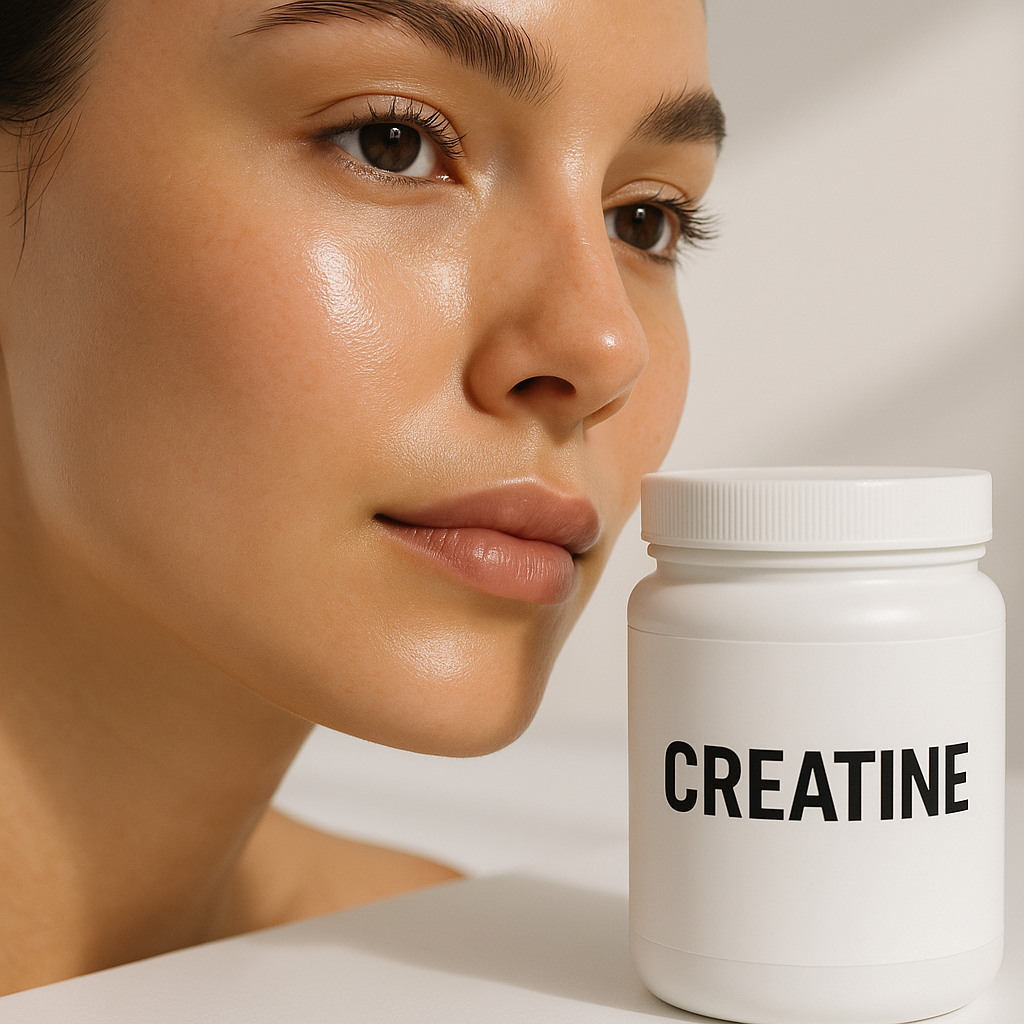
Creatine and Skin: Can It Actually Improve Your Complexion?
Creatine is best known for building muscle — but dermatologists have been quietly studying it for skin for over a decade. Here is what the science actually shows, and whether oral supplementation makes a difference to your complexion.
Key Takeaways
- Topical creatine has strong evidence for improving skin hydration, reducing fine lines, and stimulating collagen synthesis — this is the best-studied angle.
- Oral creatine may indirectly support skin through improved cellular energy metabolism, but direct skin evidence from oral supplementation is limited.
- The skin naturally stores creatine and phosphocreatine, which help fuel the rapid cell turnover required for healthy skin barrier function.
- A 2011 double-blind RCT found that topical creatine plus folic acid significantly reduced wrinkle depth and improved skin firmness in older men.
- Creatine is not a skincare treatment — but the basic science connecting cellular energy to skin health is real and growing.
How Your Skin Actually Uses Creatine
Before asking whether creatine is good for your skin, it helps to understand that your skin already uses creatine — actively and continuously.
The skin is one of the body's most metabolically demanding organs. The epidermis (the outer layer you can see) replaces itself completely every 2–4 weeks, which requires enormous amounts of cellular energy in the form of ATP. The dermis (the deeper layer that provides structure) is home to fibroblasts that continuously synthesize collagen, elastin, and hyaluronic acid — all of which require energy.
To support this energy demand, skin cells maintain their own stores of phosphocreatine — the rapidly mobilized energy reserve that creatine creates inside cells. Research has confirmed that creatine transporter proteins are expressed in human keratinocytes (the main skin cell type) and fibroblasts, meaning the skin is actively importing and using creatine from circulation.
As we age, skin creatine stores decline. A 2005 paper in the Journal of Investigative Dermatology found measurably lower creatine and phosphocreatine levels in aged skin compared to young skin, correlating with reduced ATP turnover and slower cell renewal — two of the hallmarks of visibly aged skin.
The Evidence for Topical Creatine (It Is Solid)
The most rigorous evidence for creatine and skin comes from topical application — creams and serums that apply creatine directly to the skin rather than relying on systemic uptake after oral supplementation.
A randomized, double-blind, placebo-controlled trial published in the British Journal of Dermatology in 2011 tested a creatine-plus-folic-acid cream on healthy male volunteers aged 35–65. After six weeks of daily application, the creatine group showed:
- Significantly reduced wrinkle depth (measured with optical profilometry)
- Improved skin firmness and elasticity (measured with a cutometer)
- Enhanced collagen synthesis in biopsied skin samples
The mechanism proposed: creatine replenishes the depleted phosphocreatine stores in aging fibroblasts, restoring their energy supply and allowing them to produce more collagen and maintain the extracellular matrix more effectively.
A separate in vitro study from Hannover Medical School found that creatine-treated fibroblasts showed increased proliferation, higher ATP levels, and greater resistance to oxidative stress compared to untreated controls. The researchers concluded that creatine acts as a cellular energy buffer that helps skin cells handle the oxidative stress associated with normal aging, UV exposure, and environmental pollutants.
Several major skincare brands — including Beiersdorf (Nivea) — have published internal research supporting topical creatine as an anti-aging active. This has led to a growing number of creatine-containing face creams in the European and North American markets.
What About Oral Supplementation?
The honest answer: the direct evidence for oral creatine improving skin is thin compared to the topical evidence. There is no large, well-controlled randomized trial showing that swallowing creatine monohydrate meaningfully changes your skin's appearance.
That said, there are reasons to think oral creatine could contribute to skin health indirectly:
- Systemic bioavailability: Oral creatine does reach the skin. The creatine transporter expressed in skin cells imports creatine from the bloodstream, and elevated plasma creatine from supplementation would theoretically increase substrate availability for skin cell metabolism. Whether this amount is meaningful compared to topical application — which delivers creatine directly — is unknown.
- Hydration effects: Oral creatine increases intracellular water retention in muscle tissue. Some researchers hypothesize that this osmotic effect may extend to skin cells, contributing to a plumper, more hydrated appearance. This has not been formally studied in skin.
- Collagen synthesis support: Creatine supplementation has been shown in several studies to increase whole-body protein synthesis when combined with resistance training. Since collagen is a protein, improved protein synthesis environment might support collagen turnover in skin — but this is speculative in the skin context.
The bottom line: if you are already supplementing creatine for performance, there is no reason to stop for skin reasons. But if your primary goal is skin improvement, the evidence strongly favors topical creatine in a dedicated skin product over oral supplementation.
Creatine, Hair, and Nails: A Brief Note
Hair and nails are dead keratin structures — they contain no living cells and cannot take up creatine from circulation. Creatine does not directly affect hair or nail growth in the way it affects living skin cells.
The widely circulated claim that creatine causes hair loss through DHT elevation comes from a single 2009 rugby player study that measured DHT levels but did not actually measure hair loss. Multiple subsequent studies have not replicated the DHT finding, and no clinical study has ever measured creatine-caused hair loss directly. The current consensus among sports scientists is that this claim is not supported by the available evidence.
For nails, the situation is similar — no evidence that creatine supplementation affects nail growth rate or strength.
What creatine may support is the health of the follicle (which is a living structure) and the matrix cells that produce nails — both of which are metabolically active and theoretically benefit from better cellular energy. But this is basic science reasoning, not clinical evidence.
What to Do With This Information
If you are looking for skin benefits from creatine, here is the practical hierarchy:
- Best option for skin specifically: A topical creatine product applied directly to the skin. Look for skincare products that list creatine (often as creatine or creatinol) in the active or key ingredients. Products combining creatine with antioxidants, peptides, or hyaluronic acid may offer additive benefits.
- Reasonable but indirect: Oral creatine supplementation, if you are already taking it for performance. The evidence for oral creatine improving skin appearance is not strong, but the basic cellular biology supports the idea that it helps — and there is no downside.
- Avoid overhyped claims: Any product claiming that oral creatine will dramatically reduce wrinkles or reverse aging is outrunning the science. The evidence for that level of skin benefit is topical, not oral.
Creatine remains one of the most studied and safest supplements available. The growing body of skin research is genuinely interesting — and it suggests the molecule does a lot more than help you lift heavier. But treat the skin science as emerging rather than settled, and calibrate your expectations accordingly.
Creatine and Skin: The Evidence at a Glance
- 2–4 weeks How often your epidermis completely replaces itself
- 2011 RCT British Journal of Dermatology trial showing topical creatine reduced wrinkle depth
- Fibroblasts The skin cells that make collagen — and actively import creatine
- Topical > Oral Topical creatine has stronger skin evidence than oral supplementation
- No DHT risk No clinical study has confirmed that creatine causes hair loss
Frequently Asked Questions
Does creatine help your skin?
Topical creatine has solid evidence for improving skin hydration, reducing fine lines, and stimulating collagen synthesis. Oral creatine may offer indirect benefits through improved cellular energy metabolism and systemic availability, but the direct skin evidence for oral supplementation is limited compared to topical application.
Does taking creatine make your skin look better?
There is no large clinical trial showing that oral creatine visibly improves skin appearance. The skin science mostly comes from topical creatine products applied directly to the face. That said, skin cells do use creatine from the bloodstream — the cellular biology supports a role in skin health, but the magnitude of the oral effect on appearance is unknown.
Does creatine cause acne or skin problems?
No. Creatine does not cause acne. Acne is driven by sebum overproduction, hormonal changes, and bacterial activity — none of which creatine directly influences. Some people notice mild skin changes when starting creatine (often from increased water retention), but clinical evidence for creatine causing skin problems is absent.
Is topical creatine in skincare products effective?
Yes — this is the most evidence-backed application. A 2011 double-blind RCT published in the British Journal of Dermatology found that a topical creatine-plus-folic-acid cream significantly reduced wrinkle depth and improved skin firmness in men aged 35–65 after six weeks of daily use.
Does creatine affect hair or nails?
Hair shafts and nails are dead keratin structures that cannot take up creatine. Creatine does not directly affect hair growth or nail strength. The claim that creatine causes hair loss via DHT comes from a single, small 2009 study that did not actually measure hair loss — subsequent studies have not replicated the finding.