Creatine and Gut Health: What to Do If It Upsets Your Stomach
Most stomach issues from creatine are not 'side effects' — they are dosing or timing problems with simple solutions. Here is a step-by-step approach to taking creatine comfortably, including what to do if standard monohydrate still bothers you.
Key Takeaways
- Stomach upset from creatine affects roughly 5–7% of users and is almost always caused by too large a single dose, poor mixing, or taking it on an empty stomach.
- The loading phase (20 g/day) is the most common cause of creatine stomach issues — splitting into 4–5 smaller doses throughout the day usually resolves it.
- Micronized creatine dissolves better than standard monohydrate and causes fewer GI issues in people who are sensitive to undissolved powder.
- Creatine HCL is sometimes marketed as easier on the stomach — the evidence for this claim is limited, and it is significantly more expensive.
- If stomach issues persist after adjusting dose and form, creatine monohydrate in capsule form is an option that many sensitive users tolerate well.
Why Creatine Sometimes Causes Stomach Issues
Creatine monohydrate is a naturally occurring compound, but it behaves as an osmotically active substance in the digestive tract — it draws water into the gastrointestinal lumen. In high enough concentrations, this osmotic pull can cause:
- Nausea or queasiness (the most common complaint)
- Loose stools or diarrhoea
- Stomach cramping or bloating
- General GI discomfort within 30–90 minutes of taking it
The key word is concentration. The same total daily dose spread across multiple smaller servings produces far less GI distress than a large single dose. A 5 g scoop taken with 300 ml of water behaves very differently in your gut than 10 g taken with the same amount of water.
Impurities in low-quality creatine products (poorly refined creatinines, residual solvents from synthesis) also cause GI irritation — another reason to choose products made with Creapure (the German pharmaceutical-grade creatine standard) or products that publish third-party testing results.
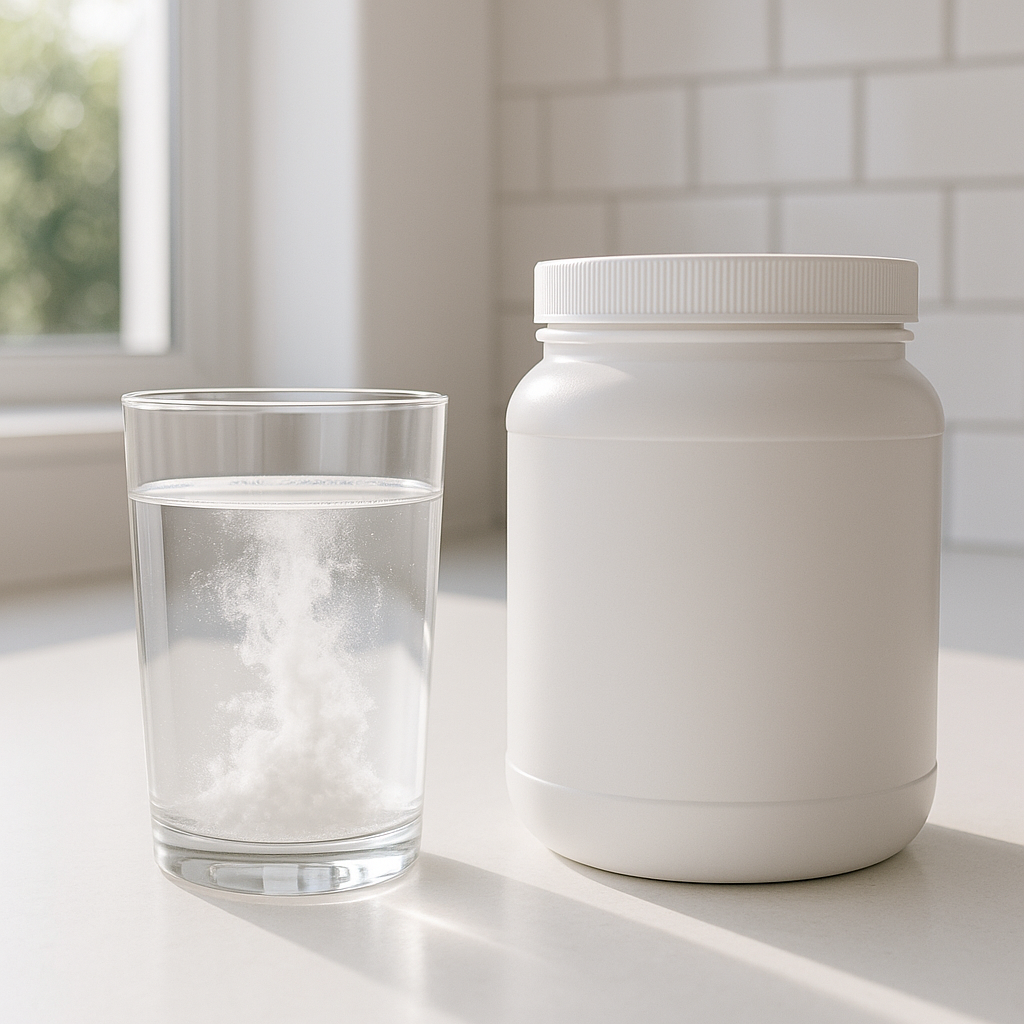
Undissolved creatine particles are another factor — some creatine monohydrate products, particularly coarser-ground versions, do not dissolve fully in cold water. The undissolved powder can irritate the stomach lining on its own.
The Most Common Culprit: Loading Phase Nausea
The loading phase — 20 g/day for 5–7 days — is where most creatine stomach complaints originate. Attempting to take all 20 g in one or two doses is a reliable way to feel terrible. The solution is straightforward: divide the daily loading dose into 4–5 doses of 4–5 g each, spread throughout the day.
For example:
- 5 g with breakfast
- 5 g mid-morning
- 5 g pre- or post-workout
- 5 g in the evening
Most people who could not tolerate the loading phase can do it comfortably with this approach. The absorption and muscle saturation rate is essentially the same — creatine absorption is not meaningfully affected by splitting doses.
If the loading phase still causes issues after splitting, simply skip it. The 3–5 g/day maintenance dose reaches muscle saturation in approximately 3–4 weeks — just slower than loading. The endpoint is the same, and the GI experience is dramatically more comfortable.
Standard vs. Micronized Creatine: Does It Matter for Stomach Tolerance?
Micronized creatine monohydrate is identical to standard creatine monohydrate in terms of the active molecule — it is simply ground to a much finer particle size. The practical differences:
- Dissolves faster and more completely in water, even cold water
- Reduced gritty texture in the glass — easier to drink
- Potentially fewer GI issues from undissolved particles, based on anecdotal reports and the logic of improved dissolution — though controlled head-to-head GI studies are limited
For the majority of users, the performance effect of micronized vs. standard monohydrate is identical. The choice between them is almost entirely about convenience and tolerance. If you find standard creatine causes stomach discomfort and you have not tried micronized, it is a reasonable switch to make before moving to more expensive alternatives.
Look for products labelled 'micronized' or 'ultra-fine' that list creatine monohydrate as the only active ingredient. Brands using Creapure (made in Germany by AlzChem) provide an additional quality assurance step regardless of particle size.
What About Creatine HCL for Stomach Sensitivity?
Creatine hydrochloride (HCL) is a form of creatine with a hydrochloride group attached, which makes it more water-soluble than creatine monohydrate. Manufacturers often market it as 'easier on the stomach' — and there is a theoretical basis for this: better solubility means less undissolved material in the GI tract.
The practical reality is more nuanced:
- The evidence comparing GI tolerability of HCL vs. monohydrate in clinical trials is very limited. Most claims are manufacturer-sponsored.
- Creatine HCL is typically dosed at 1–2 g/day (compared to 3–5 g for monohydrate), meaning you are taking much less total creatine per dose regardless of form — which alone would reduce GI load.
- When dosed equivalently (same total creatine content), the tolerability advantage of HCL over quality micronized monohydrate is not clearly established.
- Creatine HCL costs 3–5 times as much per gram of creatine as monohydrate.
If you have genuinely exhausted the options below (adjusted timing, micronized, capsule form) and still experience stomach issues, HCL is a reasonable experiment. But it should not be the first solution you reach for — it is expensive insurance against a problem that is almost always solvable with the adjustments above.
Step-by-Step: How to Fix Creatine Stomach Issues
Follow this sequence before concluding creatine does not work for your stomach:
- Step 1: Reduce your single dose. Never take more than 5 g in one sitting. If you are loading, split the 20 g into four 5 g doses spread through the day.
- Step 2: Take it with food. Taking creatine with a meal (especially one containing carbohydrates) significantly reduces the osmotic effect in your stomach. Avoid taking it on an empty stomach.
- Step 3: Use more water. Mix creatine in at least 200–300 ml of water per 5 g dose. Concentration is the driver of GI irritation — diluting it reduces the effect.
- Step 4: Switch to micronized. If a coarser product is causing issues, switch to a micronized or ultra-fine version. Better dissolution = less GI irritation from undissolved particles.
- Step 5: Try capsules. Creatine capsules bypass the dissolving problem entirely — the powder is inside a capsule that dissolves in your stomach at the rate the capsule shell controls. Many GI-sensitive users tolerate capsules when powder causes problems.
- Step 6: Choose a quality product. Low-quality creatine with impurities is a genuine cause of GI irritation. Switch to a product made with Creapure or one with third-party purity testing published on the label.
Working through these steps in order, the vast majority of people who experience creatine GI issues find a solution. True intolerance to creatine monohydrate in any form or dose is rare.
Creatine Stomach Issues: Troubleshooting
- 5–7% Users who experience GI discomfort from creatine
- Max 5 g Largest single dose to take at once
- With food Reduces osmotic stomach irritation significantly
- Micronized Better dissolving — fewer issues from undissolved particles
- Capsules Best option for users who react to powder form
Frequently Asked Questions
Why does creatine upset my stomach?
The most common causes are too large a single dose, taking it on an empty stomach, or impurities in a low-quality product. Creatine is osmotically active — it draws water into the gut — and high concentrations cause nausea, loose stools, or cramping. Reducing the dose per serving to 5 g or less and taking it with food resolves this in most people.
Does creatine cause long-term gut problems?
No. The GI effects of creatine are acute and dose-dependent — they occur in the hours after taking a dose that is too large or too concentrated. There is no evidence from 30 years of creatine research that creatine causes any lasting changes to gut flora, gut lining, or digestive function at standard doses.
Is creatine HCL easier on the stomach than monohydrate?
Possibly, but the evidence is limited. Creatine HCL is more water-soluble and may reduce undissolved particle irritation. However, the effective dose of HCL is much smaller than monohydrate, which alone reduces GI load. Before switching to the more expensive HCL form, try micronized monohydrate with food and adequate water — this resolves most GI issues.
Can I take creatine if I have IBS or a sensitive stomach?
Many people with IBS or sensitive stomachs do take creatine successfully by using small doses (3 g or less per serving) with food and plenty of water. Capsule form is often better tolerated than powder. Creatine has no documented negative effects on IBS specifically, but individual responses vary. Start with a small dose and increase gradually.
How long do creatine stomach issues last?
Acute GI discomfort from creatine typically passes within 1–3 hours of the dose causing the problem. It does not accumulate over time. If you are experiencing ongoing daily stomach issues, the likely cause is your dosing approach (too large, on empty stomach) rather than a true intolerance, and adjusting the approach should resolve it within a day or two.