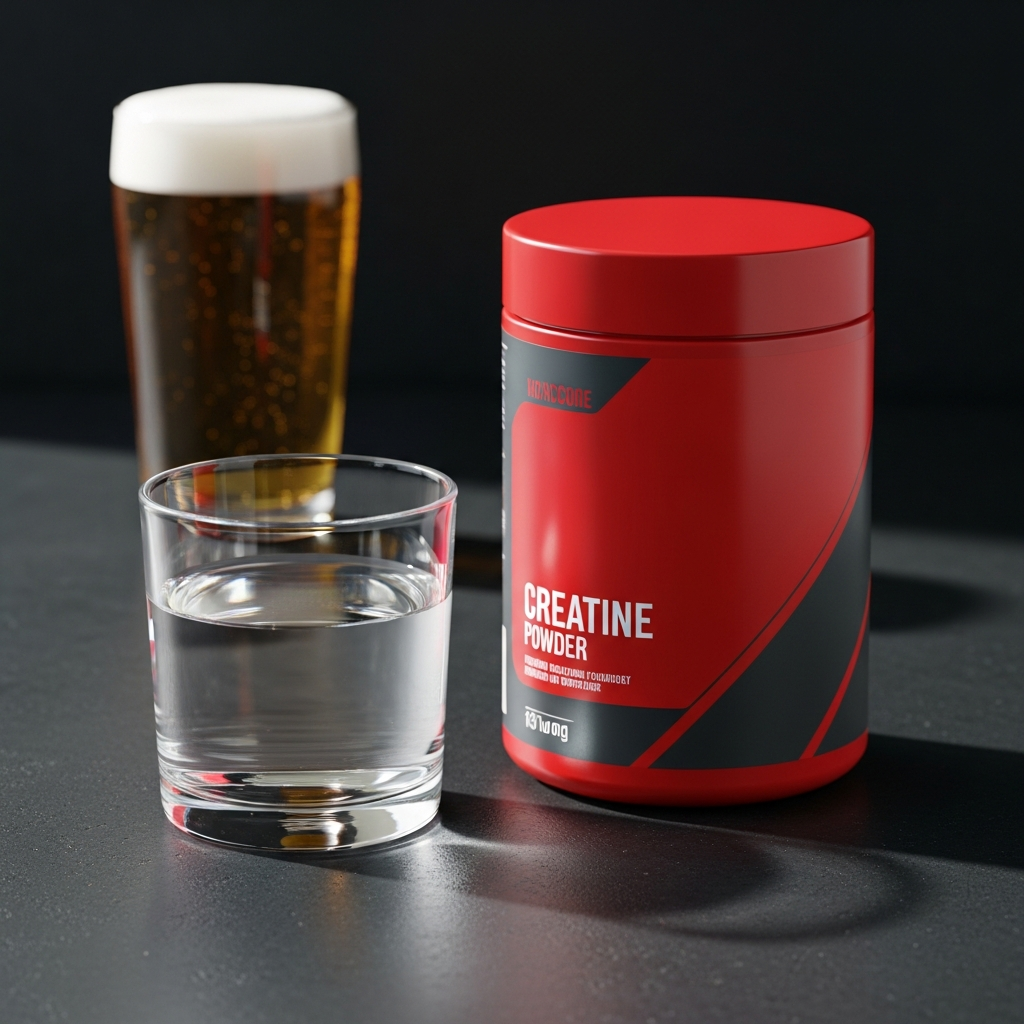
Creatine and Alcohol: What Actually Happens When You Mix Them?
There's a lot of noise online about creatine and alcohol — from 'one drink ruins your gains' to claims that the combo is dangerous for your kidneys. The actual research is more nuanced. Here's what happens when creatine and alcohol share space in your routine.
Key Takeaways
- A single moderate drinking session does not 'cancel out' creatine or flush it from your muscles — muscle creatine stores decline slowly over weeks, not hours.
- Heavy or chronic alcohol use does impair muscle protein synthesis and recovery, which blunts the gains creatine helps produce — the problem is the alcohol, not an interaction.
- There is no evidence that combining creatine with moderate alcohol use causes kidney damage in healthy people, despite widespread claims online.
- Both alcohol and creatine raise creatine kinase (CK) levels in blood tests; if you are tested after heavy drinking and training, elevated CK does not automatically signal kidney harm.
- Alcohol's main effect on creatine users is indirect: poor sleep, dehydration, and blunted recovery erode the training adaptations that creatine is meant to support.
Does alcohol cancel out creatine?
This is the most common question — and the short answer is no, a drinking session does not flush creatine from your muscles. Once creatine is stored intramuscularly, it is not rapidly excreted in response to alcohol. Muscle creatine concentrations decline slowly over weeks of non-supplementation, not over hours. The morning after a night out, your muscle creatine stores are essentially the same as they were before.
The myth likely comes from confusing two separate things: alcohol's well-documented negative effects on recovery and protein synthesis, and a direct chemical interaction between alcohol and creatine. The former is real. The latter isn't.
One Australian study (Barnes et al., 2010) did look at creatine plus alcohol after exercise-induced muscle damage. It found that recovery of muscle function was worse in the alcohol group, regardless of creatine supplementation — meaning alcohol blunted the recovery benefit creatine typically provides. That's meaningful, but the mechanism is alcohol suppressing muscle protein synthesis and disrupting sleep, not alcohol destroying stored creatine.
Is the creatine + alcohol combination hard on your kidneys?
The kidney concern is the most persistent myth in this space, and it's worth addressing directly. Creatine has been extensively studied for renal safety in healthy people — the consensus from multiple systematic reviews and the ISSN position stand is that standard doses (3–5 g/day) do not harm kidney function in people without pre-existing renal disease.
Alcohol, on the other hand, does have dose-dependent effects on kidney stress with chronic heavy use. The fear of combining the two seems to come from conflating these two separate sets of concerns.
One data point that causes confusion: both heavy resistance training and alcohol consumption can raise creatine kinase (CK) levels in blood tests. Creatine supplementation itself does not significantly elevate CK in resting conditions, but the combination of hard training, DOMS, and alcohol can produce a high CK reading that looks alarming if a clinician isn't aware of the context. This is a measurement artefact, not organ damage — but it's worth mentioning to your doctor if you have bloodwork done after a heavy training block and a social weekend.
The bottom line: for healthy adults with normal kidney function, there is no evidence that moderate alcohol use combined with creatine supplementation causes kidney harm.
The real risks: what alcohol actually does to your gains
The honest risk from combining alcohol with creatine isn't about chemistry — it's about recovery. Alcohol impairs the adaptations that creatine is meant to support:
- Muscle protein synthesis: Even moderate alcohol consumption (around 1–1.5 g/kg body weight, roughly 3–5 drinks for a 70 kg person) reduces post-exercise MPS by up to 24% in some studies. Creatine supports training performance; alcohol limits the downstream repair work.
- Sleep quality: Alcohol suppresses deep sleep and REM cycles. Most muscle repair and hormonal recovery happen overnight — disrupting this blunts the results of any training session, supplemented or not.
- Hydration: Alcohol is a diuretic. Creatine draws water into muscle cells. Drinking heavily the night before training can leave you genuinely underhydrated, which affects training performance and the fluid environment creatine relies on.
- Hormonal environment: Consistent heavy drinking suppresses testosterone and growth hormone — both relevant to the strength and hypertrophy goals most creatine users are pursuing.
One social drink after a well-recovered day? The evidence does not suggest this is meaningfully harmful to someone who trains consistently. But a regular pattern of heavy drinking while expecting creatine to compensate is optimistic at best.
Practical guidance: how to handle alcohol in your routine
Here's a sensible, evidence-based approach for creatine users who drink socially:
- Don't stop creatine on days you drink. There's no benefit to skipping your dose on social nights — and missing days gradually lowers your muscle saturation.
- Don't train hard the day after heavy drinking. The recovery impairment is real; you'll perform worse and benefit less from the session.
- Hydrate actively. Alternate water with alcoholic drinks and drink an extra glass or two before bed. This partially offsets the diuretic effect.
- Don't use creatine as a 'protection' against alcohol's effects. It isn't one. There are no credible studies showing creatine attenuates alcohol-induced muscle damage or recovery impairment.
Context matters too. Occasional moderate drinking has a vastly different evidence profile from chronic heavy use. The research suggesting meaningful harm to training adaptations generally involves doses well above social drinking levels. If you train seriously most of the week and have a couple of drinks on the weekend, the effect on your creatine-supported results is likely minimal.
Creatine + alcohol: what the evidence shows
- 0 Direct chemical interactions between creatine and alcohol documented in research
- Up to 24% Reduction in post-exercise muscle protein synthesis after moderate alcohol consumption — Barnes et al. and others
- Weeks Time scale for muscle creatine stores to decline — not hours after one drink
Frequently Asked Questions
Does alcohol flush creatine out of your muscles?
No. Muscle creatine stores decline slowly over weeks without supplementation — a single drinking session does not reduce them. The issue with alcohol is that it impairs recovery and muscle protein synthesis, not that it destroys stored creatine.
Is it dangerous to take creatine and drink alcohol?
There is no evidence that combining creatine with moderate alcohol use causes kidney damage or other harm in healthy adults. The concern is not chemical interaction — it's that heavy alcohol use blunts the training adaptations creatine is designed to support.
Should I skip creatine on days I drink?
No. Skipping doses gradually reduces muscle creatine saturation without any benefit. Take your normal dose regardless of whether you drink that day.
Can alcohol raise creatine kinase levels and look like kidney damage?
Heavy training and alcohol use can both independently raise CK levels in blood tests. A high CK reading after a hard training block and a social weekend is usually normal physiology, not organ damage — but mention it to your doctor if bloodwork is being interpreted without that context.
How much alcohol is too much if I'm taking creatine?
There's no creatine-specific threshold. The research on recovery impairment generally involves doses above typical social drinking (roughly 3-5 drinks for a 70 kg person). Occasional moderate drinking is unlikely to meaningfully affect results from a consistent training and supplementation routine.
Sources & Further Reading
- Barnes MJ et al. (2010) — Acute alcohol consumption aggravates the decline in muscle performance following strenuous eccentric exercise. J Sci Med Sport.
- Parr EB et al. (2014) — Alcohol ingestion impairs maximal post-exercise rates of myofibrillar protein synthesis following a single bout of concurrent training. PLOS ONE.
- Kreider RB et al. (2017) — ISSN position stand: safety and efficacy of creatine supplementation. J Int Soc Sports Nutr.
- Poulsen MB et al. (2014) — Creatine supplementation and kidney function. Amino Acids.