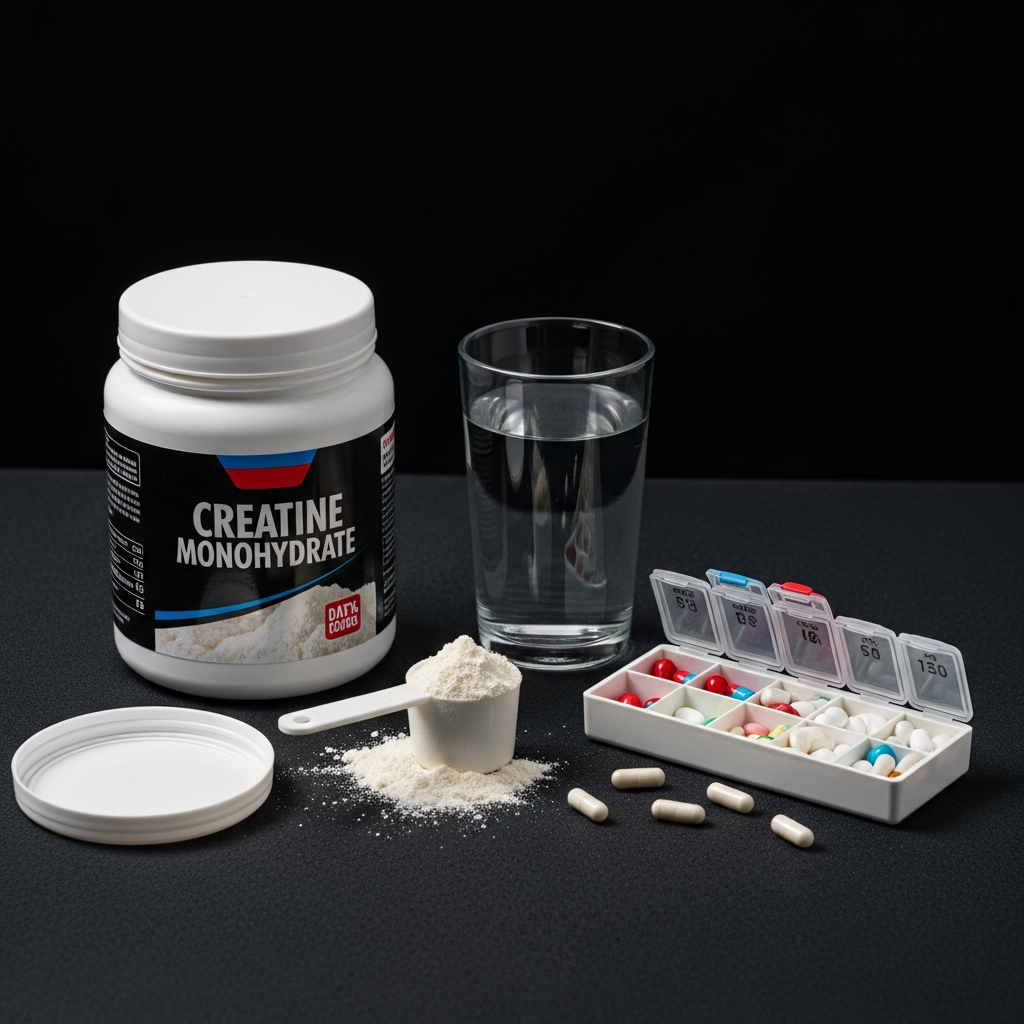
9 Common Creatine Mistakes That Quietly Waste Your Results
Creatine is the most researched sports supplement on the planet, yet most people leave results on the table with a handful of avoidable errors. Here are the nine mistakes we see most often — and exactly how to fix each one.
Key Takeaways
- Consistency beats timing: missing days is the single most common reason creatine underperforms.
- Most people under-dose. Roughly 3-5 g of creatine monohydrate every day is the evidence-based maintenance target.
- You do not need to cycle creatine, and you do not need expensive 'advanced' forms to see results.
- Judge progress over 4-8 weeks, not days — creatine saturates gradually.
- Pair creatine with actual training and adequate protein; it amplifies work, it does not replace it.
Mistake 1: Treating creatine like a pre-workout you only take on gym days
Creatine works by saturating your muscles' phosphocreatine stores. That saturation is built and maintained by daily intake — not by a big dose right before you train. Taking it only on workout days means your stores slowly drain on rest days and never reach a stable peak.
The fix is simple: take your dose every single day, training or not. Anchor it to an existing habit — your morning coffee, breakfast, or the same shake you already drink — so you never have to remember it.
Mistake 2: Under-dosing (a pinch is not a serving)
A surprising number of people scoop far less than a full serving, often because they're worried about side effects or trying to stretch a tub. The research is clear on what a maintenance dose looks like:
| Phase | Typical daily dose | Notes |
|---|---|---|
| Maintenance (recommended for most) | 3-5 g/day | Reaches full saturation in ~3-4 weeks |
| Optional loading | ~20 g/day (split into 4 doses) for 5-7 days | Saturates faster; can cause bloating in some |
| Larger athletes | Up to ~0.1 g per kg bodyweight | Bigger muscle mass holds more creatine |
If you weigh 90 kg and take 2 g a day, you are effectively micro-dosing. Aim for a level teaspoon (about 5 g) of monohydrate and stay consistent.
Mistake 3: Expecting results in a few days
Creatine is not a stimulant. You will not feel a buzz, and the strength and volume gains build as your muscles saturate over weeks. People who quit at day 5 because 'nothing happened' quit right before the payoff.
Give it a fair trial: judge your progress at the 4-8 week mark using objective markers — reps at a given weight, total training volume, and how recovered you feel between sessions.
Mistake 4: Paying more for 'advanced' forms you don't need
Marketing loves novelty: HCL, ethyl ester, buffered, liquid, nitrate. But creatine monohydrate remains the most studied, most effective, and cheapest form by a wide margin. The exotic forms are not proven to outperform it, and you usually pay a premium for the privilege.
| Form | Evidence base | Verdict |
|---|---|---|
| Monohydrate | Hundreds of studies | The gold standard |
| Micronized monohydrate | Same as monohydrate, finer grind | Great if you dislike grit |
| HCL / buffered / ester | Limited, no clear advantage | Usually not worth the markup |
Unless you have a specific reason (for example, you genuinely find monohydrate hard to mix), plain or micronized monohydrate is the smart default.
Mistake 5: Cycling on and off for no reason
There is no evidence that your body 'gets used to' creatine or that you need to cycle off to stay responsive. Cycling just lets your muscle stores drain, so you spend part of every cycle re-saturating instead of benefiting. Take it continuously.
Mistake 6: Ignoring hydration (and blaming creatine for cramps)
Creatine draws a small amount of water into your muscle cells — that's part of how it works. It does not dehydrate you, and modern research does not support the old myth that it causes cramps. But because you're training and holding a bit more intramuscular water, sensible hydration matters. Drink to thirst across the day; there's no need to force litres of extra water per gram.
Mistake 7: Obsessing over timing instead of consistency
Before vs after workout, morning vs night — the timing debate gets far more attention than it deserves. The total daily dose and long-term consistency drive results. Pick whatever time you'll actually stick to. If you want a marginal edge, taking it around your workout alongside some carbs or protein is a reasonable default, but do not let 'perfect timing' become a reason to skip a dose.
Mistake 8: Buying on price alone and skipping third-party testing
The flip side of not overpaying for exotic forms is not buying the cheapest mystery powder either. Look for a product that is clearly labelled as creatine monohydrate (ideally with a purity marker like Creapure) and, where possible, is third-party tested (NSF Certified for Sport, Informed Sport). That combination gets you proven efficacy and verified purity without the gimmick tax.
Mistake 9: Expecting creatine to work without the work
Creatine amplifies the training you do — it helps you squeeze out extra reps and recover between hard efforts, which compounds into more muscle and strength over time. On its own, with no progressive training and inadequate protein, it can't build muscle for you. Treat it as a multiplier on a solid routine, not a substitute for one.
Creatine done right, by the numbers
- 3-5 g Daily maintenance dose — Every day, training or not
- 4-8 wk Fair trial window — Judge results here, not day 5
- No Need to cycle off — Take it continuously
- #1 Monohydrate's rank — Most studied, best value
Frequently Asked Questions
What is the single biggest creatine mistake?
Inconsistency. Because creatine works by saturating your muscles over time, skipping days lets your stores drain and prevents you from ever reaching a stable, effective level. Taking a smaller dose every single day beats a large dose only on gym days.
Do I need to load creatine?
No, loading is optional. Loading (about 20 g/day for 5-7 days) simply saturates your muscles faster. Taking 3-5 g per day reaches the same saturation in roughly 3-4 weeks without the bloating some people get from loading.
Is it a mistake to take creatine on rest days?
The opposite — skipping rest days is the mistake. Daily intake maintains muscle saturation, so you should take your normal dose on rest days too.
Will creatine make me hold water or look bloated?
Creatine draws a small amount of water into your muscle cells, which can slightly increase scale weight early on. This is intramuscular, not the puffy subcutaneous bloat people fear, and it typically levels off. It is not a reason to under-dose.
Is an expensive form of creatine worth it?
For almost everyone, no. Creatine monohydrate (plain or micronized) is the most researched and effective form and costs the least. 'Advanced' forms like HCL or ethyl ester have not been shown to outperform it.
How long before I should expect to see results?
Give it 4-8 weeks of consistent daily use alongside training. Creatine is not a stimulant, so the benefits show up as gradually improved strength, training volume, and recovery rather than an immediate feeling.
Does creatine cause cramps or dehydration?
Current research does not support this old myth. Creatine does not dehydrate you. Just hydrate sensibly to thirst as you would with any training program.
Can creatine build muscle if I don't train?
No. Creatine amplifies the results of training and adequate protein intake; it cannot build muscle on its own without the training stimulus.